
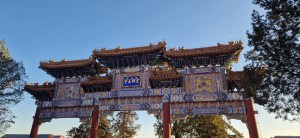
 China had emperors (帝) for about 4,000 years. The character 帝 can mean “emperor” and “god”, as the emperors were considered gods on Earth. The character represents an altar, where sacrifices could be made by the emperor as a gift to Heaven. Emperors were represented by the colour yellow (黄), therefore, the buildings directly related to the emperor as, of course, his vests and objects were all yellow. Actually, the character representing the colour yellow was inspired by the emperor’s looks.
Colour coding has a huge weight in Chinese culture. For example, the colour red (红) is the most auspicious colour and it is used for wedding dresses for good luck, while white (白) is definitely not used in weddings as it is a funeral colour, thus, connected to death. Each one of the five elements has its own colour, which is also linked to a cardinal direction and to an area of life. For example, red is linked to Fire (火), South (南) and to fame and reputation while green (绿) is linked to Wood (木), East (东) and to family. Chinese people not only organize their home according to these principles, but also organize their whole life.
Dynasties are all about family. The character 家 can mean “family” and “home” and represents a pig under a roof. In the old days, people would live together with the animals they were raising to eat. When together with other characters, 家 can change slightly its meaning. For example, if we put it together with “person” (人), 家人 means “family member”, and if we put it together with “whole” (全), 全家 means the “whole family”.
Royal families shaped the country, by adding (or losing) terrain, and by developing the cultural scene as well as the education system. They also regarded the country as the centre of the world. That is why China is known as the “Middle Country”: 中国, where 中 is “middle” and 国 is “country”. Probably, in the old days, it was known as the “Middle Empire”: 中帝国, where 中 is “middle”, 帝 is emperor, and 国 is country (“the middle country of the emperor”).
宫 means palace, where the emperor lived with his wife, his children, his servants and his concubines. The character shows a kind of house, with blocks and a roof. If we add the character 女 (woman), we get “palace woman/lady/maid” (宫女). 女 is also present in concubine (妾, below) and wife (妻, below). The character 宫 helps to translate “White House”: 白宫, where 白 is “White” and 宫 serves as “House”. It is also used to tell “maze”: 迷宫, where 迷 is (among other meanings) “confusing”. So, in China, “maze” is a confusing palace.
This article is part of the BRINGING ACROSS series
“Translation” in different languages comes from or is based on the meaning of two similar Latin words which convey the idea of transferring something from A to B… “bringing across”. In this category, we aim to explore how to “bring across” meaning between languages.

 WORDS IN IDEAS