
 Russians conquered Siberia between 1580 and 1778. In the meantime, in 1762, Catherine the Great became empress of Russia. This means that, when Catherine took the throne, almost all (and later all) Siberia was part of the Russian Empire. Under her ruling, Siberia acquired its status of “prison” and “exile”, but it was also invaded by a “piano fever”.
Sophy Roberts is a British journalist specialized in travel writing. When she heard there was lost pianos worth looking for in Siberia, she thought this was the perfect excuse to finally get to know this part of the world. What started as a piano quest, ended as a collection of stories about Siberia and the importance of music (and pianos) in the region. In truth, since Catherine the Great, music and pianos are entangled with Russian history and culture and it is impossible to talk about one without talking about the other.
This non-fiction book is a journey through time from 1762 to present days. Throughout its narrative, stories of pure horror go hand in hand with sublime stories of human endeavour. Catherine the Great was a huge fan of European culture and, in a time when pianos were the latest music technology, she adopted them and was the driving force to spread them to the entire Empire, even to the most remote and (almost) inaccessible places. At the same time, she was complicit with the slavery of her people and the use of Siberia for getting rid of dissidents.
Time passed by and dissidents kept rebelling and kept being sent to Siberia. However, these dissidents were educated people, with a love for music and the pianos. Therefore, when they went to exile, they made a point to take the pianos with them and educate people there. Then, during the soviet period, the state funded music schools to make the piano available to (literally) everyone. The “piano fever” gave rise to a whole piano industry for constructing pianos, fine-tuning them, learning how to play them, and enjoying them in every possible way.
Finding these old pianos was a journey to the most remote and isolated locations. There were amazing discoveries, great disappointments and also the possibility to connect people that loved the same pianos. Hearing their stories, the stories of the people connected to them, or simply the historical context in which each piano “lived” (and sometimes “died”) was the foundation of this book. Sophy Roberts was joined at times by the photographer Michael Turek. They also have a website dedicated to this book, where you can see some photos and videos, and hear some music played on a piano.
This article is part of the THE INTREPID BOOK SOCIETY series
The Intrepid Book Society is a fictional book club, a space to discuss books selected according to keywords.

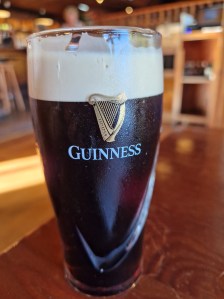 Nothing speaks Irish internationally more than Guinness beer. This is no coincidence. Arthur Guinness was a visionary and he wanted to brew such a beer that would be internationally recognized as an Irish product for many years to come. Hence, the choice of a harp as the symbol of the brewery. Yet, this is not just any harp, it is the “Brian Boru” harp, which you can see in the Long Room at the Trinity College Library in Dublin. It’s a medieval harp that stood the test of time and became the true symbol of Ireland. You can find it as the symbol of the Irish Government (adopted after the independence from England in 1922) and on Irish coins.
 WORDS IN IDEAS