After renewing its website, “Words in Ideas” is preparing its 3rd year of fresh new articles, starting in October. While you wait, you can read (or re-read) the best articles under the category “Foreign Lands”. These articles aim to compare languages and cultures.
During the first year, articles described some traditional food around the world. Here are the 5 best:
After renewing its website, “Words in Ideas” is preparing its 3rd year of fresh new articles, starting in October. While you wait, you can read (or re-read) the best articles under the category “Word Chronicles”. These articles aim to clarify words’ meaning.
During the first year, articles were focused on words’ origin and meaning. Here are the 5 best:
After renewing its website, “Words in Ideas” is preparing its 3rd year of fresh new articles, starting in October. While you wait, you can read (or re-read) the best articles under the category “The Intrepid Book Society”. This “Society” is a fictional book club, analysing a book per month according to a keyword or a key place.
During the first year, articles were written as reviews. Here are the 5 best:
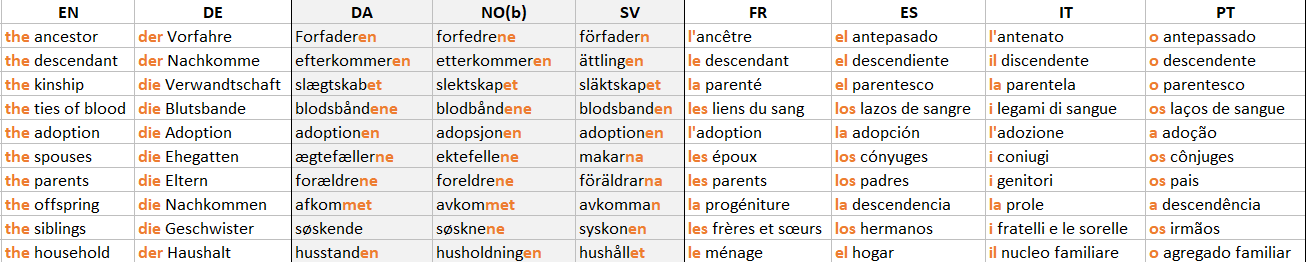
Family is a classic topic of every language learning syllabus. The members of “The Foreign Land’s Explorers” approached it the usual way initially, but they wanted to go further. So, they made a new table with terms related to family, but which were not learned in regular language classes. They built a table, knowing it was just a reference. Each word should not be taken as exact equivalents to the other languages. Once they had the table, they constructed the same sentences in every language, for example: “the spouses become parents and constitute a household with their offspring”.
[click to enlarge]
“Ah, ‘offspring’ in Italian is ‘prole’”, noted Leo. “Did you know that ‘proletariat’ comes from the Latin word ‘proletarius’, which means someone belonging to the lowest (and poorest) class that would only be considered as ‘citizen’ if they had children? I guess ‘children’ here would mean labour force or soldiers. Therefore, ‘prole’ in Italian comes directly from the Latin word meaning ‘children’”.
“Sometimes people don’t realize how much Latin language has influenced European languages, all of them”, said Elizbeth. “For example, ‘adoption’ is similar in these languages and comes from the Latin word ‘adopto’, which is the combination of ‘ad’ and ‘opto’. ‘Ad’ means ‘to’ and ‘opto’ means ‘choose’. So, basically ‘adoption’ is ‘to choose’”.
“I may be wrong, but it seems that word is the only word here in the table to come from Latin in what German, Danish, Norwegian, and Swedish are concerned”, noted Sophia. “Interesting that ‘offspring’ in Nordic languages is ‘of coming’. Well, in English it has a similar meaning: getting out of where they were made. Like the rivers that leave the place where they were ‘born’ and run until they reach the sea. They ‘come’ from somewhere.”
“Knowing where you come from has always been very important. Look at Royal families. Being part of a Royal family can determine if you will lead the country or not, whether you want it to or not”, said Elizabeth.
“Some Kings have renounced the post, so it’s not inevitable. But, yes, for them, it is something that is always there, since childhood. And they are also pressured to have a ‘prole’, a male heir to the throne and some ‘spare’ male children, just in case something happens to the oldest. It’s not exclusive for poor people, although it is different, of course”, added Michael.
“Poor people provide the labour force in sequence. Rich people build dynasties to rule the poor people. It is the system of castes. Once you are born in one, you have to play your role regardless of your wishes”, said Elizabeth.
“That is not entirely true nowadays”, said Sophia. “Royals can now marry commoners and commoners can aspire to climb the social ladder”.
“Dynasties still have weight in society. Being a son or a daughter of an important family is always a mark, even if that person follows a different path”, said Michael.
“Ok, remember I told you that we use more Latin-based words than we realize? Well, I checked the word ‘dynasty’ and it is actually a Greek word, although it was stolen by the Latin language’”, said Elizabeth.
“Let me see”, said Michael, looking at her computer and starting to read. “It says that a dynasty is ‘a succession of rulers of the same line of descent’ and it gives China as an example. Then, it says it can also be ‘a powerful group or family that maintains its position for a considerable time’. It meets what we were saying, I think”.
“Royal families are a reference. They are a symbol of continuity, tradition, and identity”, said Sophia. “That’s why they are so important for people. People see them as the leaders of the nation. It’s no coincidence that the countries’ history timeline is told through dynasties, especially in China. They say ‘this was done during this Dynasty’. For example, the Great Wall of China was constructed during the Ming Dynasty. You need to know when they ruled to know the respective period of time. In Europe, you talk about epochs, like Ancient Times, Medieval Times, Renaissance.”
“Well, in Europe, history is also made of dynasties, although they are named ‘Houses’, like in ‘The Game of Thrones’”, said Elizabeth and laughed. “For example, the House of Habsburg was one of the most influential families in European history. In the UK, the House of Tudor is one of the most famous Royal families due to King Henry VIII and his six wives. The current UK’s Royal family is the House of Windsor. And, of course, there were prominent families that didn’t belong to any Royal family, like the Medici, who ruled Florence for many years”, said Elizabeth.
“In the USA, they also categorize their history periods according to presidential administrations: the President Obama’s administration, the President Biden’s administration…”, noted Michael. “Actually, the story of the name ‘President’ is curious. When the USA became independent, they had to choose a name for their Head of the State. ‘King’ was suggested, but they didn’t want to give ideas of grandeur to a man who should be feeling humble. So, they decided to give him the name of ‘someone who chaired meetings’. They thought it was humble enough. Not any more”.
“Well, they also have dynasties of some sort there, like the Bushes and the Kennedys…”, said Leo. “Like the Medici, these families became powerful after they had become very rich.”
“In the end, money rules the world. And, sometimes, the families who have it”, concluded Jack.
** YOUR WORDS AND IDEAS **
By Isabella Muir | On 30 April 2025 at 12:08 Some very interesting insights into the meanings of ‘family’ – a term that has changed significantly over the centuries. Nuclear families (often blood relatives) contrasts with ‘blended’ families, where a wide range of relationships come together. It would be interesting to explore how ‘family’ contrasts with ‘community’ – both can be supportive networks, but both can be just the opposite!
By Words in Ideas | On 01 May 2025 at 21:19 That would be very interesting, yes. “Blended” families is a good term – maybe in future “blended” will replace “nuclear”?…
If someone asked someone else what family was, that person would probably answer: the father, the mother, and their children (adopted or not). Or two mothers and their children, or two fathers and their children. This is what is called the “nuclear family”. “Extensive family” would include aunts, uncles, cousins, godparents, grandparents, maybe even family friends. If that someone wanted to go even further, he or she could talk about the “distant family”, which are second cousins, third cousins, great uncles, great aunts, and the like. People that you probably never met in your life.
The historian James Casey wrote the book “The History of the Family”, published in 1989, advancing the studies of Friedrich Engels, whose book “The Origin of the Family, Private Property and the State” was published in 1884. These studies were developed from different perspectives: while James Casey aimed to write the history of what is considered “family”, Friedrich Engels aimed to explain how the State came to be, as a result of an evolution of the primitive blood-related organizations.
James Casey began his book by defining what “family” actually is. His conclusion was: there is no clear definition. Etymologically, “family” comes from the Latin word familia, that used to mean the assets of a household: the man, the woman (each one with their own role) and everyone else who lived in that house, including the slaves. It was more like an enterprise than a “nuclear family” as we understand it today. Yet, this was not the first kind of family that existed. Primitive peoples had complicated structures that included all blood-related members under the same tribe or clan, although it was possible to “adopt” some outsiders.
There are a few traits we still keep from those primitive times, like loyalty towards our blood relatives. Back then, being part of a tribe or a clan would imply the duty to avenge a member who was attacked or killed by a member of another tribe. This is still important in some “tribes”, especially families, but also groups of friends acting as alternative families. Bloodline would also determine each person’s place in society and it is still very influential today, especially in some cultures or in certain circles.
These primitive peoples were matriarchies, meaning that bloodlines were defined by mothers. However, children were raised by the community. According to Engels, this changed when men became the owners of the agricultural equipment, which they wished to pass on to their children (in other words, heritage). This became even more important as men acquired more property. So, men decided that bloodline would stop being defined by mothers and became defined by fathers. To ensure that children born to their wives were theirs, women became their property, together with houses, equipment, slaves, and servants. Hence, the familia.
Engels proved that society was structured by the way families would relate between themselves and would exercise power socially and politically. In the feudal regime, each family would belong to a caste (the main castes were nobility and commoners) and their hierarchy would depend on their possessions. The concept of family as we know today (the nuclear family) is a product of the changes that took place from the 17th century onwards (during the Industrial Revolution) with the decline of the feudal regime. The private sphere detached from the public sphere and children started to go to school in order to become professionals. From an early age, children would learn about individual responsibilities and would acquire the skills to compete with others for a job and a position in society. By losing their central role, “extensive families” lost their power to influence social and political matters. As the individual became the social unit, his “family” became smaller: only his wife and their children, living in a domestic home. However, some things did not change: men remained the heads of the household.
Under this new society structure, people could marry whoever they wanted and were not obliged to have their parents’ consent (due to heritage purposes). Love turned into the main reason for marriage and divorce started to rise. Individuals were liberated from the bonds and duties of belonging to blood-related communities, but they also lost their benefits. For example, raising children is now the sole responsibility of parents when it was a community task. Social life was more spontaneous because the houses were open to everyone and several nuclear families lived in each house. Today, individuals are more alone and with more responsibility on their shoulders.
Yet, the concept of family is changing again. Men are losing their permanent position as heads of the household. Domestic roles are shifting and both adults are taking on equally household chores and raising the children. As divorces increase, people create new nuclear families that cross over with the nuclear families previously created. Grandparents are living longer, but they keep their independent lives after retirement. On the other hand, professional careers are getting more demanding, the internet is leading to isolation, and people are feeling lost. How will families adapt to these new times?
“Hamnet” is the story of how the death of a child impacted a typical 16th century family living in England. The boy was living in Stratford-upon-Avon with his mother and his siblings. His father had moved to London to find better ways to provide for his family. The boy was called Hamnet, a variation of Hamlet, and his father was William Shakespeare. The boy’s death, and his father’s subsequent grief, gave rise to the renowned theatre play “Hamlet”.
“Maggie O’Farrell did extensive research to write this book”, said Ms Clara Smartest. “There are very few records about Shakespeare’s family and the death of his son, thus, she had to guess a lot. She deduced most of it from other information of the time. Although this is fiction, she wanted to be as accurate as possible.”
Most of the members of the Society had been completely unaware of Shakespeare’s personal and family life, let alone that he had a son who died aged 11.
“Sometimes people ask me what makes a masterpiece in literature”, said the Literature Professor Mr Matthew Barnepy. “Most of them think it is about the story. So, they go and write a very intriguing plot with a lot of action and many events happening in the background. Of course, the story is important, but it’s the way you tell the story that makes the difference. Maggie O’Farrell could have written the same story in a much simpler way, as a sequence of events, for example. Instead, she chose to take time to describe the details of everyday life as a way of casting a spell on us and making us captive to the narrative.”
“It must have been really hard to be away from his family, especially when a son dies. Life at that time was really hard”, said Ms Abigail Vooght. “I think the author wanted us to feel that. It was like we were part of the family, like we were there and it was happening to us as well.”
“It shows us the true meaning of ‘enjoying the little things’. The writer shows us how important they are, how much we should pay attention to them, for good and bad”, said Miss Amelia Matterfis. “We take a lot for granted. Like, we assume that children will grow up and prosper. Sometimes, they fall ill and die.”
“That is what happens in areas in conflict. People just don’t know if they will be alive the next day. In 16th century England, there was little hygiene and therefore many diseases. Death was just around the corner, but people would go on nevertheless. Nowadays, in the richest and most developed countries, people believe that medicine will cure everything. Sometimes we ask the impossible from doctors, who are just human beings, thus, not perfect”, said Ms Johanna Practicewell.
“Grief is grief regardless of the conditions or the time. Many deaths could have been avoided in the 16th century, it is true. However, children still die unexpectedly today and parents suffer the same. That’s what impressed me the most. Although she was describing a family from centuries ago, the same could be applied to a modern family”, said Miss Martha Lovefeelings.
“I think that the story is about love. Shakespeare married Agnes despite her being considered unconventional. She warned him many times until he was sure of what he was doing. Then, we can “see” the love between family members, including the father who is away for work”, said Mr Matthew Barnepy. “The focus is on Agnes, the mother, her relationship with her family, with society, and with her husband. How she coped with her loss, which was different from the way her husband coped. People react differently and sometimes that is not fully understood.”
“It’s interesting that no direct mention is made to Shakespeare. I believe the aim is to show that it’s just one family among many and the fact that it’s the family of the most famous playwright of all times makes no difference. They are just human beings, struggling to survive in an unforgivable world and trying to make the most of what they have. It could be our own family. It could happen to anyone”, said Mr Jeremy Toughready.
“Exactly, it makes us think how fragile life is and how fragile human relations are. It can all change in a moment. One minute the boy is alive and kicking and a few hours or a few days later he’s dead. Everyone is affected: the mother, the father, but also his sister, who was his partner of fun and accomplice of mischief”, said Miss Martha Lovefeelings.
After exchanging their first impressions, they discussed further some details of the story and how accurate they were to what is known. In the end, they concluded that it didn’t matter if the records showed a different perspective, for example about Shakespeare’s wife. Little was known anyway. Most of what was recorded were interpretations that could be wrong. Maggie O’Farrell had focused on facts.
“It is a great book, indeed”, said Mr John Booklish, ending the meeting. “Next month the book is ‘Three Daughters of Eve’, by Elif Shafak. Have a lovely week!”
** YOUR WORDS AND IDEAS **
By Isabella Muir | On 5 April 2025 at 15:11 Thank you for a wonderful review of what sounds like a wonderful book, which will now go to the top of my TBR book pile! Having read several of Maggie O’Farrell’s other books, I would agree that she is certainly an incredible author!
By Words in Ideas | On 5 April 2025 at 20:49 She is an amazing writer, indeed! I’m glad you liked the review and that it sparked your curiosity to read it. You won’t regret it!
As the book for this month was not translated to English, the members of The Intrepid Book Society had to help each other. Those who knew Spanish helped those who didn’t and many emails were exchanged between them. Sometimes, they would meet in person. This exercise helped bring them closer and to get to know each other better. It also made them realize how important it was to know foreign languages. There was so much in the world that was inaccessible for those who only knew one language! Indeed, by choosing which were the books “worthy” to be translated, publishers were deciding what their readers should read (or what would earn them more money…). Knowing other languages would broaden the perspectives about the world and the power of deciding what to read.
“Let me just say that it was delightful to see how much we helped each other to ‘decode’ this book. I heard that some of you decided to learn a new foreign language, which I personally think it’s great. Knowing a foreign language opens a door to a whole new world”, said Ms Clara Smartest.
She paused while the members would agree with her.
“This is a story about a family and about a TV show, although it is much more than that. Some of you may disagree with me, which is wonderful, but I think the ultimate goal is to make readers change their perspective of the world, to make them see beyond the surface”, she continued.
“Indeed”, Mr Matthew Barnepy agreed. “As a writer myself I greatly admire how the story was written, how we are led to a certain interpretation until, all of a sudden, we realize everything is different from what we thought previously. It’s brilliant.”
“Yes, I think it’s in the ending where good books reveal themselves and this book has a very good ending. Unexpected as well”, said Miss Amelia Matterfis.
They discussed the ending for a while. Usually, they would come up with different versions or they would disagree about what the writer had decided. Not this time. They all agreed that the ending chosen was the best fit for the story. If the ending was different, the story would be different and the point that the writer was making would be lost.
“I think the story also shows the misunderstandings between family members that can be perpetuated over time, turning them into apparently unsolvable problems. If people would talk to each other before things get to that point…”, said Miss Martha Lovefeelings, leaving the conclusion of the sentence in suspense.
“Sometimes it’s just not possible. For that to work, it would be important to know how to listen, something that can be very difficult due to the emotions associated with the matter in question”, said Ms Johanna Practicewell.
“True. I think that is shown in the book. Parents are not always aware of how their actions may affect their children. In this case, two children were affected in two distinct ways”, said Ms Abigail Vooght.
“The TV show was also very interesting to follow. We found out how much it is linked to the family story. Besides, it’s incredible how the public would have such strong reactions to all that was happening and never suspected the truth”, said Mr Jeremy Toughready.
“Precisely. It’s the capacity the group has to follow false beliefs, believing they are true. We see it every day these days”, Ms Johanna Practicewell. “Here, it was harmless, but this kind of blindness can be very dangerous.”
“Lying to the audience can be dangerous too”, replied Mr Jeremy Toughready. “Who knows how aggressive the crowd can become. Actually, there’s an example of something that happened in the show and the consequences that it had. Not so harmless, actually.”
“There was a good reason for that!”, protested Miss Martha Lovefeelings.
“The matter was solved in two ways: the public way and the private way. Not exactly the same…”, commented Mr Jeremy Toughready.
“We live in a society of lies and deception”, said Mr Matthew Barnepy. “I think that is what the book is showing us.”
“Is it possible to end the cheating? The double lives some people have?”, asked Miss Amelia Matterfis.
“That is the question, right? In the book, the deceit plays an important role. The goal would not be possible to be achieved if there was not a deceit”, concluded Mr Matthew Barnepy.
“I enjoyed following the brother and sister’s adventure. They were apart from each other for a long time, but the game they had to play together brought them closer together. It was nice”, said Miss Martha Lovefeelings.
“And their emotional evolution was also interesting. As they were finding out the truth, they changed their perspective, and what they believed was put into question”, added Miss Amelia Matterfis.
They discussed the details of the story and Ms Abigail Vooght made an interesting contribution as a parent and as a person who had to pretend all the time. Mr Mark Mindhearting talked about how the narrative was intertwined and how the writer weaved the events in a way that both the reader and the siblings would find the answers step by step.
“Well, having a reality show set on Mars is genius! I would definitely follow that show!”, said Miss Amelia Matterfis.
“It was a good catch, indeed. I think the whole story is very well structured and it keeps us guessing until the end. Full of twists along the way. It’s really good”, said Ms Clara Smartest.
“Well, that concludes today’s meeting”, said Mr John Booklish. “The book for next month is ‘The Anomaly’, by Hervé Le Tellier.”