

There is a huge avenue running from east to west (and vice-versa), whose midpoint is between Tiananmen Square and the Imperial City (which includes the Forbidden City). Besides these old iconic Chinese symbols, the avenue is full of modern buildings, the kind of buildings we are used to seeing in business districts in Western capitals. In reality, there are modern-Western-style buildings everywhere: airports, train stations, residential buildings, shopping centres. Wherever you look, it looks like you are in a Western city. Those who are expecting to see typical Chinese buildings, with the traditional roofs and characteristic doors, are going to be disappointed. Sure, there are palaces and temples from the old days, which are being preserved, especially for tourism purposes, but otherwise the city has been completely transformed.
The Imperial City, which includes the famous Forbidden City, was constructed at the beginning of the 15th century, together with the Tiananmen Square and the Temple of Heaven, a religious sacrificial place, exclusively for the emperor, located about six kilometres south. All these constructions were made to accommodate the emperor in the then new country’s capital. Until then, China’s capital had been Nanjing, further south. In Beijing, the emperor, his wife, his concubines and all his staff would live behind high walls. The Forbidden City was full of buildings with different purposes and where only authorised people could enter.
Similarly, Chinese families were living in courtyards, that is, the rooms were accessible from a central private courtyard. Just like in Forbidden City, each family house was organised according to the cardinal points. For instance, both the emperor and the head of the family would occupy the northern part of the palace/house. During the 20th century, after the end of the emperor’s era, these “courtyard” houses were demolished to give way to Western-like tall residential buildings. A few neighbourhoods are still standing or were reconstructed, but are exceptions.
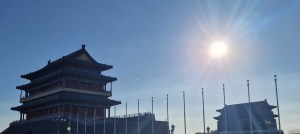 The history of China is full of this kind of destruction to construct better or different. The skyline of this city, as its name, has changed several times since it was founded. Back at the time of Marco Polo, this city was named Dadu and it was under the rule of the Mongol Empire. Its founder, Genghis Khan, was long gone and the empire was being managed by his descendants. Although the majority of the buildings from that time were destroyed, a few are still standing today, like the Bell and Drum Towers. These Towers are located near the Beijing Central Axis (Imperial City – Tiananmen Square – Temple of Heaven), whose urban planning was conceptualised in Marco Polo’s time.
Near Beijing, the Great Wall of China is a man-made wonder. It started as a small endeavour. Many, many centuries ago, warlords and rulers of the northern provinces felt the need to protect themselves from invaders coming further north, like the Mongolians. It did not work, as Mongolians invaded anyway. Truth to be told, at the time, the great wall did not exist, what existed was small walls built by each warlord or ruler. However, Chinese people do not forget and, once the Mongolians were expelled, they not only reinforced the different walls, but they connected them. Although the Great Wall is now continuous, there are sections constructed differently. Some are made of stone, others made of earth. Some are located in the desert, others follow steep mountains up and down.
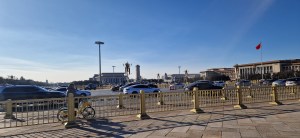 Beijing is not in danger of being invaded anymore. However, just in case, China has modernised its military forces and every now and then holds a grand military parade on the avenue between the former Imperial City and Tiananmen Square. The Chinese armed forces may still use Sun Tzu teachings, like the high level of discipline of its troops, but they also study the Western tactics and have developed Western equipment. Interestingly, in the last military parade, despite the fact that it had shown great military power, they also pledged for peace in the world.
Actually, the Chinese government believes, and it is working on it, that only peace can bring economic prosperity and economic prosperity is what makes the government pay for their military power as well as assure the improvement of the population’s living conditions. Since China has adopted Western trade models, the economic development has been astonishing. Scientific development has also been astonishing. However, unlike Western societies, scientific development aims to support economic development. The Chinese government invests in what will be more profitable and, when it does, the breakthroughs happen at breakneck speed. For example, the investment in green and sustainable technology is deeply changing the country in a very short period of time. Furthermore, technology is being adopted by the entire population: it is not possible anymore to pay in cash or debit/credit card, only through an app installed on the mobile phone (which means, everyone has at least one mobile phone). The only people paying in cash are tourists in designated tourist shops.
 Nevertheless, international economic development is dependent on international reputation and nothing shows how efficient and respecting other cultures a country is as organising big events like the Olympic Games. So, Beijing set itself to organise not one, but two Olympic Games: Summer Olympics in 2008 and Winter Olympics in 2022. They did not merely organise a flawless event, they planned jaw-dropping ceremonies and built iconic facilities. The Bird Nest (the National Stadium) and the Water Cube (the National Aquatics Centre) have become landmarks.
Has Beijing lost their cultural identity? Well, no. They are still following the same principles and Confucian teachings from thousands of years ago, but with new clothing.
Learn more:
- Article: “Story of cities #4: Beijing and the earliest planning document in history”, by Oliver Wainwright (The Guardian)
- Beijing and the Golden City of the Great Khan: Tracing Marco Polo’s Yuan Dynasty Dadu
- Video: “The Great Wall of China is NOT What You Think”
This article is part of the FOREIGN LANDS series
Foreign Lands aims to discuss the difference between languages and cultural backgrounds.

 Switzerland is all about the Alps, sanatoriums, chocolate, and cheese. In France, there is nothing else to do but to see the romantic Paris and eat haute cuisine. Italy was frozen in Roman times and only has pizza and pasta to taste. Portugal only has amazing beaches, good food, and friendly people. Nordic countries are cold in every way. And then there is Asia, which seems to be just one country full of Buddhist temples… and poverty. Africa is so poor, people still live in huts in the middle of the savannah, where there are lions, hyenas, hippos and giraffes. The Middle East is just desert. Latin America is Amazonia and the Caribbean is composed of exotic beaches.

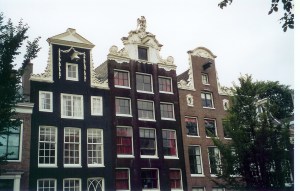
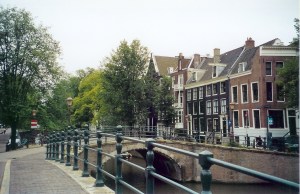 Amsterdam is known for its special cakes and colourful districts. Looking at its peaceful, village-like streets, it is easy to forget that this city was once a centre of world trade and an important place during the Second World War. The best approach to get to know Amsterdam is to keep all types of preconceptions out of one’s mind and pretend one has never heard anything about the city, which was what the members of The Foreign Land’s Explorers tried to do. It was an intense week, full of fun and cultural knowledge. They didn’t change the idea they had about the city, but they expanded it. Amsterdam proved to be much more than they thought it would be.
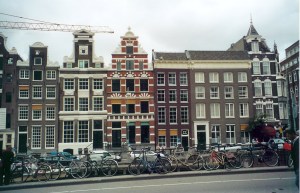 Bicycles were invented at the end of the 19th century and promptly were adopted by Amsterdam’s residents. As the city doesn’t have hills, it was easy to cycle there, first for fun and then for transportation. However, after the Second World War, cars started to invade the streets and soon the streets were full of noisy and killing machines. “Killing” because many people, mainly children, were being killed by cars. The residents organized themselves to end the situation and pressed the government to protect its people. It worked. A
  The
The 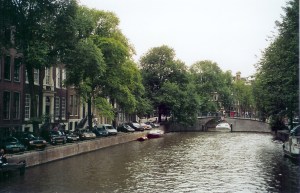 Nevertheless, that glorious century shaped the city and made it what it is today. A few centuries later, Amsterdam was finally thriving again when World War I broke out. Then, the Great Depression came, and, as this was not enough, World War II broke out. The Netherlands were invaded by the Nazi Germany and thousands of Jews were taken from the city. Probably many of them were descendants of those who had sought refuge during the 17th century’s persecutions. Anne Frank was among those who were taken to concentration camps and never returned.
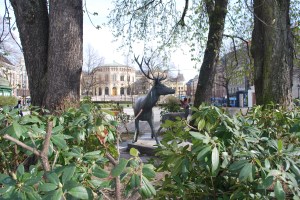 The capital of Norway is a pragmatic city, made for people to live there. Yet, it has a few surprises in store for less well-informed tourists. Looking like a simple village, Oslo is peaceful and quiet. Yet, it is also full of life and activities. It preserves its history, yet it is modernizing.
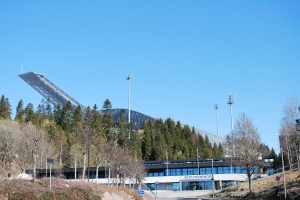 While Jo Nesbø’s characters usually drive their own cars to get there, the Society’s members had the chance to climb the mountain by metro, which runs along a narrow line very close to the edge of the steep slope. Although a bit scary for the fearful ones, the journey provides a spectacular view. The train carriages are prepared for the show as they are equipped with many windows. They are also prepared to accommodate the skis of those who go up the hill to practice alpine skiing, cross country, or ski jumping during winter. The Holmenkollen stop was constructed very close to the Holmenkollen National Ski Arena, where the Society’s members admired the huge Holmenkollbakken (the ski jumping hill of Holmenkollen). Being at the very top was vertiginous, especially because they knew that there was nothing but air underneath.
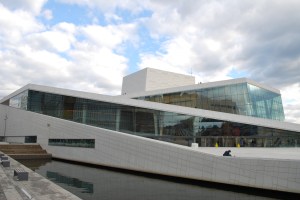 Back with their feet on the ground, the Society’s members made their return journey to Sentrum, the central area of Oslo, and got out at Jernbanetorget square. If they walked for about 20 minutes to the east, they would reach the district of Gamle Oslo (“Old Oslo”), where the Grønland Police Station is situated, the work place of Harry Hole. Instead, the Society’s members walked towards the waterfront, to Bjørvika. Here, they admired the Opera House, an iconic symbol of Oslo. Built by the water, it seems it is emerging from the fjord’s depths. Its roof extends to the ground, inviting visitors to climb to the top. Once there, the view is magnificent. On one side, the Society’s members could see the fjord in front and, on the left-hand side, the new Munch Museum and some new development buildings. On the other side, at the back, they could see the Barcode Project, which consisted of several tall and modern multipurpose buildings.
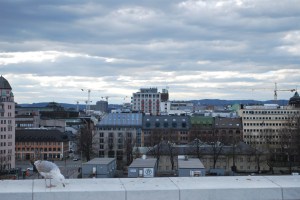 Everyone was happy to receive such great news. Not that they were not having fun, but that promised something special. Mr John Booklish remained mysterious and told them to follow him. They caught the tram to Aker Brygge, a modern area that mixed residence buildings for high-class people, marinas, shopping areas, and entertainment. There were many restaurants to choose from, but, before dinner, the Society’s members went to the Astrup Fearnley Museum of contemporary art, at the end of the street. It had an original design that perfectly blended into the environment.
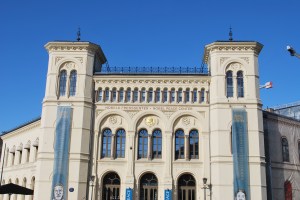 If someone was facing the fjord in front of the port, Aker Brygge would be on her/his right-hand side, the Akershus Fortress would be on her/his left-hand side, and Oslo City Hall would be on her/his back. It is in Oslo City Hall where it is announced the only Nobel Prize not awarded in Stockholm, Sweden: the Nobel Peace Prize. In front of Aker Brygge, in what was once a train station, the
 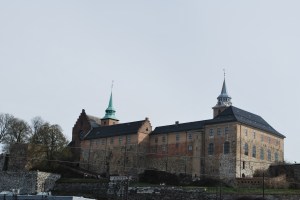 The Society’s members were talking about what they had learned at the Nobel Peace Center, about what peace meant in the world, and about how it related to the latest news while crossing the square in front of the port, passing the Fish Market and the City Hall, and heading to the Akershus Fortress. Once there, they were impressed by how well preserved it was. There were gardens everywhere around the buildings and a lovely park with a wonderful view to Oslo and the fjord.
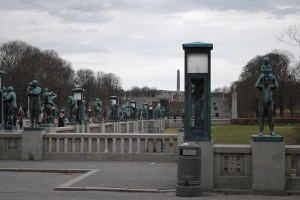 The Jo Nesbø’s character Harry Hole lives at a 15-minute walk north of Karl Johans gate. Karl Johans gate is the best-known street of Oslo and it is where the heart of the city beats. Located about 700 metres parallel to the port, it connects the Royal Palace and the National Parliament, and it’s full of shops, cafés and luxurious hotels, with a garden on the side. This is also where the National Theatre was built. All these landmarks were built in the 19th century. Built in the 18th century, the Frogner Manor, today the Oslo City Museum, gave its name to the entire district. Back in the day, the Manor included a garden that later became a park. Nowadays, this park is full of eccentric sculptures made by Gustav Vigeland, one of the greatest Norwegian artists. Vigeland was also the creator of the Nobel Peace Prize medal.
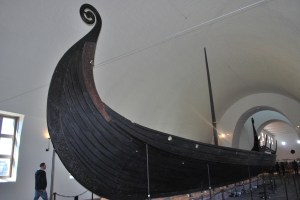 Like Berlin, Oslo also has a Museum Island. Except, in Oslo it is not an island, but a peninsula, and it is not exactly situated in the middle of the city centre, but not very far from the port. Besides, it is much bigger and you can hike, cycle, swim and do all kinds of outdoor activities there, including yoga. As for the museums, they are: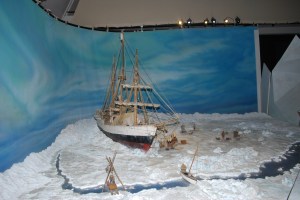
 In 1917, during the First World War, the writer Edith Wharton was invited to visit Morocco by the French Governor of the then French protectorate. She travelled around the country for a month, witnessing traditional events, admiring historical landmarks and meeting women who were part of the Vizier’s harem. Back home, she wrote a book, which was intended to be the first tour guide book of the country. It is a Westerner’s view of what was then considered the “Near East” (meaning North Africa). Edith Wharton fiercely and openly defended French governance and implicitly criticized some Arab practices. For example, she described the women of the Vizier’s harem as prisoners and unhappy and the ceremonies she witnessed were deemed primitive.
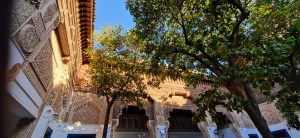 When in Marrakesh, Edith Wharton stayed at the
 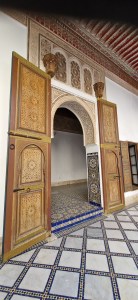 Ms Clara Smartest walked freely through the labyrinth of majestic rooms and courtyards. Although there was little furniture, Ms Clara Smartest could easily imagine how it was to live in such a place. For the Vizir, it was like living in the “One Thousand and One Nights” fairy tale. However, for the women who were part of the Vizier’s harem, and as Edith Wharton mentioned in her book, the Palace was a prison. A beautiful prison, with charming fountains, decorated with lovely tiles, and with interior courtyards and gardens, but a prison such the same. A world apart from the outside world.
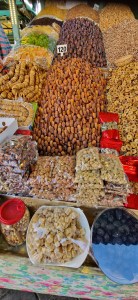 Outside, the city vibrated to the rhythm of its beating heart: the
 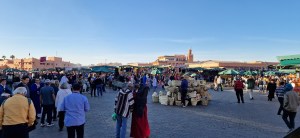 Ms Clara Smartest immersed herself in this improvised maze of street vendors and let her senses be overwhelmed. Later, she learned that this market has existed since the 11th century and remained pretty much the same. Travelling merchants from several regions of Africa, Europe, and the Middle East used to converge there to do business and exchange information, turning the square into a melting pot of different cultures. Due to these long-lasting traditions, Jemaa el-Fnaa became a
 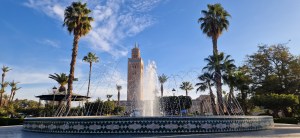 The square is located inside the Medina (the old Arabic town), a
 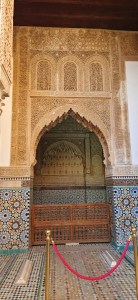 Edith Wharton had also visited the
 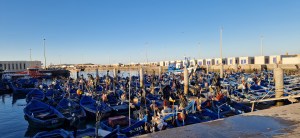 Travelling caravans, composed of camels loaded with goods to be sold or exchanged, have always been a typical image of the Desert. As Morocco is situated in a privileged geographical location, connecting North Africa and the Sahara Desert with the Atlantic Ocean and Gibraltar (the closest point between Europe and Africa), it is not surprising that European powers were eager to take hold of this land. The Roman Empire was the most successful, but then the Arabs invaded the region and kept Europeans out for centuries. Nevertheless, Europeans greatly influenced the Morocco Atlantic coast by building ports and doing business.
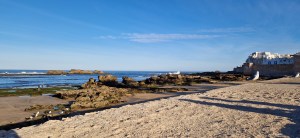 On reaching the coast, Ms Clara Smartest noticed how different the cities were compared with Marrakesh, located inland. While Marrakesh was connected to the desert and to oases, cities like
 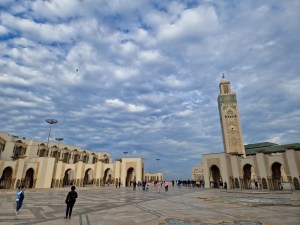 Casablanca was the most cosmopolitan city that Ms Clara Smartest visited in Morocco. The presence of international companies, especially American, was striking and contrasted with the old traditional buildings. Touristically, there was little to see there. The only exception was the
 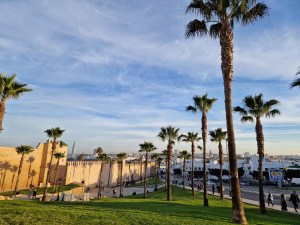 Ms Clara Smartest trip ended in Rabat, Morocco’s capital. At approximately 92 km north of Casablanca, the French governance made Rabat its administrative capital. The Governor underwent many constructions that transformed this imperial traditional city into a modern westernized capital, although Moroccan legacy was scrupulously respected. The result was an achievement worthy of inscribing Rabat as a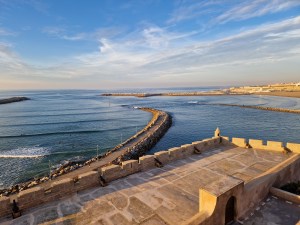
 Once there, she realized that the French influence was elusive, but the country turned out to be surprising, with a fascinating culture. The war with the USA was present, yet gone. It was like it was something that had happened and which had shaped the country, but, although the people were still overcoming it, it was a closed matter. Interestingly enough, Elizabeth didn’t see any burgers or pizzas franchises. The Western influence was like the Chinese influence: had been assimilated and transformed into something typically Vietnamese.
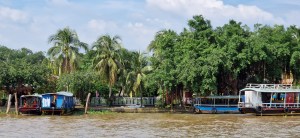 Watching the jungle passing by inside the boat, Elizabeth was imagining what it would be like for American troops to patrol the Mekong River during the Vietnam war. She had watched enough films and TV series to know how scared the Americans were of Viet Congs, the name given to the Vietnamese Communists’ guerrilla force. After visiting the Cu Chi tunnels, she understood why.
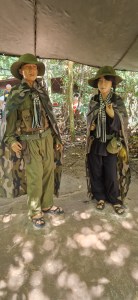 As the border between North Vietnam and South Vietnam was closed, Ho Chi Minh devised a
 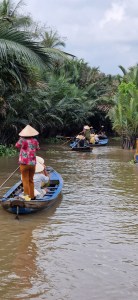 What was then a living hell, it was now a beautiful and peaceful site. Boats were running up and down the river, taking tourists to the islands along the Mekong River where they could go on a peaceful rowing boat trip, stroll through the jungle, watch how chocolate and coconut sweets were made, buy crocodile bags and liquor with snakes inside. Elizabeth noted how Vietnamese were friendly, but were not fooled. Their relaxed posture showed that Vietnam was their land and if foreigners would try to take their land away from them those foreigners would meet hell until they go back the way they came.
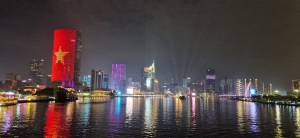 During the 1050 years of Chinese rule, the feeling of independence grew stronger and stronger despite the efforts of China to turn the Viets of the South into submissive Chinese. It took a lot of time, but the Viets finally expelled the intruders. Except for a short period of 10 years in the 15th century, the Nam Viet maintained its independence (in the midst of many internal wars), changed the name to Đại Việt [the big Viet] and then to Việt Nam, and expanded its territory to the South. The French invaded in the second half of the 19th century and were expelled in 1954. By then, the feeling of independence was already embedded in Vietnamese identity. Therefore, when the time came to fight the mighty force of the USA, the population united against it: while some took up arms, others would provide them with supplies. For example, women would work during the day, and then, in the dead of the night and dressed in black, they would take food and messages to the warriors. The entire population were engaged in the war on the same side, except for those collaborating with the Americans (who left the country along with the Americans and are now living in California).
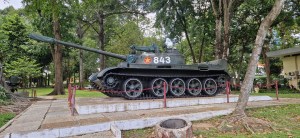 The peace and the unification of the country began when the tanks from the North entered Saigon and arrived at the Presidential Palace, the seat of the Southern Government, on 30 April 1975. This Palace is now a museum and the historical tanks are still there as a reminder.
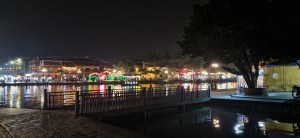 The Portuguese landed in Vietnam in 1516, being the first Westerns to get there. By 1535, they were allowed to build a port, which contributed to turning Faifo (now Hoi An) into an important trading centre. The buildings existing today were built between the 15th and the 19th centuries and reflect the influence of different cultures. There are some westernized houses, but the majority have clearly a Chinese or a Japanese design. In fact, back in the day, there was a great Japanese community of merchants living there. They left the iconic Japanese bridge, which is now the symbol of Hoi An.
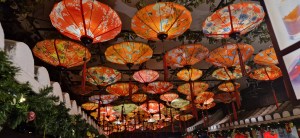 Nowadays, Hoi An Ancient Town is a
 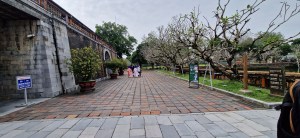 The 19th century was a time of change in the country. The port of Hoi An started to decline as the port of Da Nang, about 50 kilometres north, started to rise and slowly replaced it as the new trading centre. Today, many foreign companies are establishing there, which, combined with luxury beach resorts that take advantage of the coast, has led to a great development of the city. Back in 1802, a new dynasty began in Vietnam and the new Emperor changed the country’s capital to Hue, about 100 kilometres north of Da Nang. Greatly influenced by Chinese culture, he decided to build a new Imperial Palace there inspired by the Forbidden City in Beijing. It was the Emperor’s residence until 1945. It was partly destroyed during the Second Indochina War by American bombs (or democratic flowers, as they are called in Vietnam). Now, it is a
 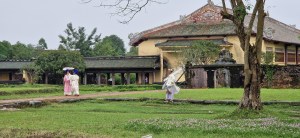 Even under construction, the
 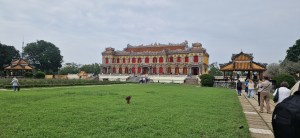 The Palaces followed one after the other, each one with its own specific function. There were secondary buildings on both sides where Elizabeth saw photos hanging on the walls showing ceremonies that took place during the 140 years that the Imperial City was in operation. Halfway through, empty spaces reminded tourists of the war that destroyed the missing Palaces. The first and the last Palaces were already reconstructed and they were both magnificent. However, Elizabeth noticed how different the last one, which served as the emperor’s residence, was. It had clearly a Western influence.
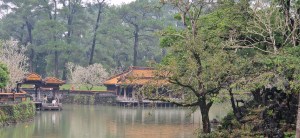 Several Emperors ruled in the Imperial Citadel of Hue and they all had to deal with the French. The political line of this dynasty was to ignore the French (and all other Western powers), isolating the country and banning international trade. From the Emperors of this dynasty, Tuc Duc was the most disliked. For starters, he was not supposed to be Emperor: his father preferred him to his older brother, who was supposed to be the next in line. Then, he failed to have children, something that is extremely important in Vietnam. Finally, he was unable to prevent the French from invading the country and add it to their Indochine colony. However, before he died, he built a lovely site for his tomb, with a big lake and several temples. He actually lived there with his family until he died, dedicating himself to writing and poetry.
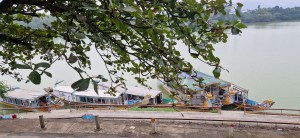 The Mausoleum of Emperor Tu Duc is located about 7 kilometres from the Imperial Citadel, which in turn is located about 4 kilometres from the Thien Mu Pagoda. This Pagoda was a symbol of the fight for the right of religious freedom in the 1960’s.
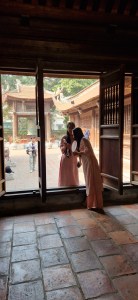 The first university in Vietnam was the Temple of Literature, established in 1070 in Hanoi. By that time, Vietnam had already regained its independence, but Chinese culture was still predominant. The university was based on Confucius’ teachings and it included a Temple in his honour. The buildings and the yards were designed in a Chinese-like structure and there are many bonsais in vases scattered around. Again, Elizabeth noticed young people dressed with traditional garments taking artistic photos with the same ownership attitude.
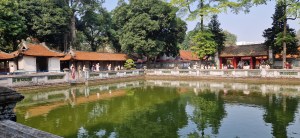 The old university is a reminder of the old days in modern Hanoi. As Elizabeth was walking through the yards, she compared what she was seeing to what was surrounding, outside that premises. The country’s capital was pulsing with present-day vitality and yet they remained traditional. It was like they would remain the same as they were for thousands of years, but would take what was good from modern life. Like motorbikes and scooters, for example. Bicycles were replaced by them as they are faster and petrol is subsidized. When on the road, no one stops, but everyone respects everyone else. Elizabeth was fascinated by watching how motorbikes, cars, and even people would cross paths without getting angry and without accidents. It was incredible.
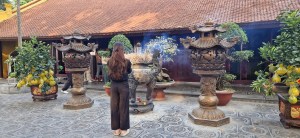 Buddhism was another Chinese legacy. This religion seemed to be more important as Elizabeth travelled north. There were many pagodas and temples and she didn’t know why they were named differently. So, she asked and was told that pagodas were Buddhism’s worship places, like the One Pillar Pagoda and the Ba Da Pagoda in Hanoi. Temples were built to pay tribute and honouring real people who had an important role in society like teachers (for example, the Temple of Literature that honours Confucius) and military commanders, or deities (for example, the Quan Thanh Temple that honours a Taoist deity).
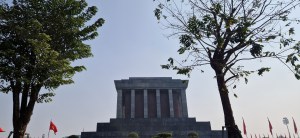 Since 1010, except for the period between 1802 and 1902, Hanoi has been the capital of Vietnam. It changed its name a few times and it endured different rulers: Vietnamese, French, and even Japanese, when they occupied the country between 1940 and 1945. Today, the country is ruled by the National Assembly, whose members are elected directly by the people via elections. Then, those members elect the Prime-Minister and the members of Government. The citizens do not vote in parties, as there is only one party, but directly in those individuals who decide to run for elections. Once elected, they represent the people of the region where they were elected. The parliament is located opposite the old Presidential Palace, built by the French, which is situated next to the Ho Chi Minh Mausoleum.
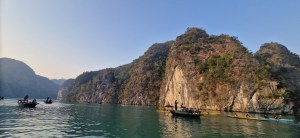 A visit to Vietnam could not be completed without going to Ha Long Bay. Located about 150 kilometres east of Hanoi, this
  The pyramids! Miss Honeypraise was looking forward to seeing them. However, when searching about the country, she realized there was much more to see and visit. She was going on a tour with a travel agency for logistics and safety reasons. Considering that there was a “Tourism Police” in the country to make sure tourists were safe at all times, Miss Honeypraise thought it would be better not to risk going by themselves. Mr Theodore Williams, who was going with her, was her best-friend-turned-boyfriend and this was going to be their first trip together.
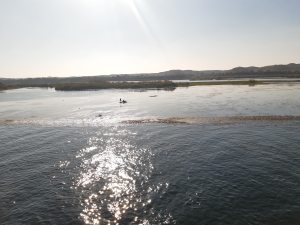 Navigating up the Nile, it was easy to imagine one had gone back in time, to the time of the Pharaohs. There were still many agricultural areas along the shore, where there were people walking around with their donkeys. The boats going up and down were also similar with the ones used in Ancient Egypt and some would carry fishermen working in the old ways. Kids would jump from the boats into the water and they would laugh happily and carelessly. When the Pharaohs ruled this land, the traffic was much more intense, the boats were brighter and more colourful, the farm lands would be full of activity, loading the boats with crops.
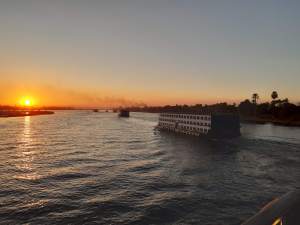 “You seem very contemplative”, said Theodore, sitting on the chair next to Clarissa.
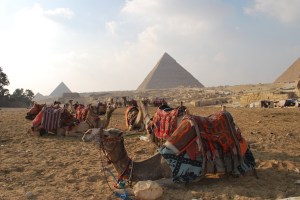 Cairo was founded as the capital of Egypt when the Arabs invaded the country. It was located not far from the old capital Memphis, the city that became the capital when the two kingdoms, the Upper Egypt (in the south) and the Lower Egypt (in the north), came together as one realm. During this time, the Giza Pyramids were built, along with other pyramids and monuments in the region. It was later that it was decided to bury the Pharaohs in the Valley of the Kings to avoid thefts. Not far from the Valley of the Kings, a new capital emerged: Thebes. After its decline, the capital became Luxor, which thrived from Thebes’ ruins. Luxor is where the full splendour of Ancient Egypt can be glimpsed. Many buildings have been destroyed over the centuries, but the ruins unveil what they may have been at the time. They are still magnificent and one can only imagine the full scale of its majesty.
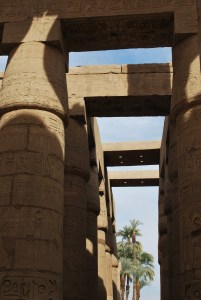 Starting in Luxor, the Nile cruise takes visitors to different key spots along the river. The adventure starts at the temples of Karnak and Luxor, which are connected by a road with lined Sphinxes at both sides (partially destroyed now) and are characterized by tall columns and huge statues. These make anyone feel small, which was probably the goal. Pharaohs wanted to show how magnificent they were and how important it was to respect religion. After all, the Pharaohs were also the religious leaders. Therefore, many temples were built, usually by the water. This was important due to the frequent religious parades, which took place on boats.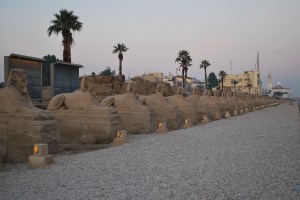
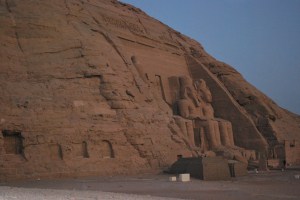 The Temples of Abu Simbel and Philae were two of the historical monuments that had to be relocated when the Aswan High Dam was constructed, resulting in the rising of the waters of Lake Nasser. The monuments could have been submerged if it wasn’t for the specialized work carried out by the UN, responsible for financing the project. This was not an easy task. Once a year, the sun enters the main Temple of Abu Simbel and illuminates the statues located deep inside. UN specialists had to recreate this unique feature when relocating the Temple, which they did (with a very slight variation).
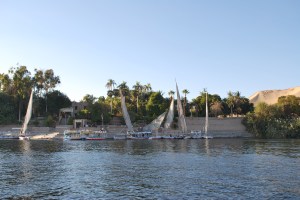 The Temple of Abu Simbel is the closest to the border with Sudan and it is located in the Aswan region, a region different from other Egyptian regions, full of cataracts and islands along the river. One of these islands is the Elephantine Island, located right in front of the region’s capital, Aswan (named the same as the region itself), where boat traffic is especially intense. No wonder. This was once an important trade point with Sudan and the administrative centre of the former independent region named Nubia, which has been under Egypt control for many centuries. Yet, they maintain their culture intact, namely in some typical villages located in the island, full of their colourful houses.
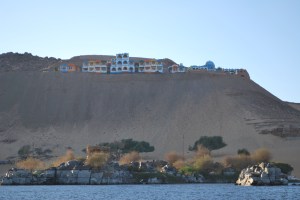 “That concludes our trip to Egypt”, said Theodore. “From Alexandria, in the north, to Abu Simbel, closer to the border with Sudan, it’s about 1300 km along the Nile River. 1300 km with 3000 years of ancient history.”



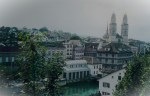 At some point, Swiss men were on the verge of being humiliated internationally as almost all European countries had already allowed women to vote. In the meantime, Swiss women kept pushing and presenting initiatives while peacefully protesting on the streets. After much internal and external pressure, men finally approved the right for women to vote in 1971, even though in some Cantons this would only become official 20 years later…
 Everyone knows what a sandwich is and everyone has eaten one. No mystery there. Some people have heard the story of how Earl Sandwich wanted to have something to eat without having to leave the gaming table. Hence, the name. True or not, eating bread with something inside is something that people have been doing probably since bread was invented.
 Nowadays, ice-cream is part of our daily lives. We can buy them in specialized stores, on the street, and in the supermarket. We can eat them on a plate, on a glass, on a cup, or on an edible cone. Besides the traditional flavours (vanilla, chocolate, strawberry), many new ones are being made (imagination is the limit). In fact, there are people who are paid to discover new mixes, so basically their job is to taste ice-cream. Pretty cool, yeah? There are also ice-cream cakes and baked ice-creams (look for “baked Alaska”).
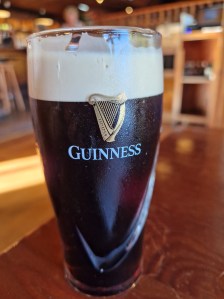 Nothing speaks Irish internationally more than Guinness beer. This is no coincidence. Arthur Guinness was a visionary and he wanted to brew such a beer that would be internationally recognized as an Irish product for many years to come. Hence, the choice of a harp as the symbol of the brewery. Yet, this is not just any harp, it is the “Brian Boru” harp, which you can see in the Long Room at the Trinity College Library in Dublin. It’s a medieval harp that stood the test of time and became the true symbol of Ireland. You can find it as the symbol of the Irish Government (adopted after the independence from England in 1922) and on Irish coins.
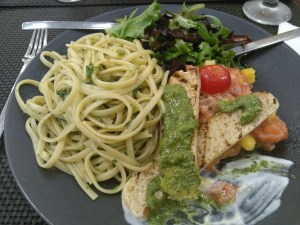 A mother or grandmother cooking pasta on the stove is a childhood image of all Italians. All mothers and grandmothers have their speciality and their unique way of cooking it. A family secret that should never be known to anyone, only passed onto the next generation.
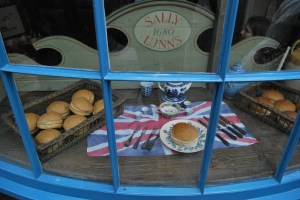 If the thermal baths, for which Bath is famous, began with the Romans, “buns”, which nowadays are a famous English delicacy, were invented by a French woman. Or so it says the shop where these buns were supposedly invented. In fact, the origins of Sally Lynn’s buns are not proven, but the
  Tea is drunk everywhere in the world and there are many cultural ceremonies related to it in different countries, like the Traditional Japanese Tea Ceremony in Japan, the Afternoon Tea in England, and the Maghrebi Mint Tea, in North Africa. All of these ceremonies aim to welcome guests and be a moment of relaxation and socialization with friends and family.
 WORDS IN IDEAS