Writer

A writer is someone who writes, but writing is not as easy as it seems. One has to know the language well enough to not make grammar mistakes and one has to know how to organize the ideas in order to build a logical text that its target audience will easily understand.
There are different types of writers. The most noticeable are the authors, those who write books that are published. If the books are not published, they are not authors. However, sometimes “writer” and “author” are used interchangeably. Authors are seen as creators, even when it’s non-fiction, and the term can be applied to other artists. In literature, they can be called novelists, poets, short story writers/authors, playwrights, non-fiction writers/authors. There are also writers who are not recognized as authors, but are published. These are the ghost-writers. Song writers can be considered poets, like Bob Dylan who was awarded the Nobel Prize of Literature in 2016.

Speaking of the Nobel Prize in Literature, there are lots of prestigious (and not so prestigious) literature prizes in the world. There are also national and local prizes, European prizes, bookshop prizes, prizes sponsored by brands that have nothing to do with books. From all of these, the top of the tops, the one every author wants to win, is the Nobel Prize. Then, there are others which are reputation builders: the Pulitzer Prize and the Booker Prize. If you want to keep up with the best in literature, but don’t have much time to check all the prizes, focus on these three.

Actually, the Pulitzer Prize started as a prize to award outstanding journalists; it was later extended to include fictional and non-fictional authors. Journalists, especially newspaper journalists, are another type of writers. Often newspaper journalists become book authors for both fictional and non-fiction books. One of the most well-known is Ernest Hemingway, who won the Nobel Prize in Literature in 1954.

Academics can become authors as well, as an extension of their research. Academic research implies a lot of writing. Like journalists, academics aim to investigate a theme and make their discoveries available to the public. The style is different, though. While journalists can write in a more creative and attractive way and they base their writings on sources, academics have to be very rigorous and base their writings on vast bibliography and scientific studies.

Then, there are the bloggers and the content writers, whose mission is to “feed” the internet. Technical writers are responsible for manuals, help guides, instructions, specifications, plans, and similar documents. There are those who write reports and white papers. Copywriters focus on marketing and advertising and screenwriters are those who give the lines to the characters in films and TV series.

A final note for editors and translators: the former use their writing skills to correct and improve the texts others have written and the latter make texts available to speakers of other languages.


Homeland, patrie, Heimat, patria, pátria

It is a well-known fact that Europe was devastated many times due to numerous wars throughout the centuries and, consequently, frontiers changed frequently. At that time, kingdoms and empires were really a collection of principalities and counties. The rulers of those territories would pledge their allegiance to the King or the Emperor and they were under their authority from then onwards. Common people didn’t feel they belonged to a country or that they had a nationality. They would feel they would belong to a religion or a region.

Nationalism is a political ideology that aims to make people believe they have a national identity superior to all others. This means that only a group of people (those who are part of a certain identity and possess certain characteristics) are part of a “nation”. On the other hand, patriotism is the love for one’s country and includes everyone who was born there (or acquired its citizenship) regardless of the characteristics they may have. The difference may be thin, but it does exist.

Below, we will discuss patriotism in a linguistic (and cultural) perspective.

In English (Homeland) and in German (Heimat), the country where people are born is considered their “home”. In fact, when they are abroad and they say they are going back to their own country they usually say they are “going home”. Latin languages like Spanish, Italian, French, and Portuguese use variations of the Latin word patria, which means “country of birth”. That is a fact. In some countries, like in Germany and in the Netherlands, homeland can be called as fatherland whereas in other countries, like in Latvia and in Russia, it can be called as motherland. In these countries, the homeland is seen as a parent who nurtures and takes care of them since they were born and it will always be there for them.

Each country has two main dimensions of action: inside the country and outside. Their designation depends on how they see the world.

1) These are the departments, offices or ministries related to matters inside the country

. USA | Homeland Security
. UK | Home Office
. Australia | Home Affairs
. Germany | Bundesministerium des Innern und für Heimat [Federal Ministry of the Interior and Community]
. France | Ministère de l’Intérieur et des Outre-mer [Ministry of the Interior]
. Italy | Ministero Interno [ Ministry of the Interior]
. Spain | Ministerio del Interior [ Minister for Home Affairs]
. Portugal | Ministério da Administração Interna [Ministry of Home Affairs]

As we can see, in English speaking countries, the department/ office/ ministry related to these matters are called “Home”. Once again, we can confirm that the country of birth is like home for them and they manage country matters as they manage their own home. In fact, one of the most important economic indicators, the Gross Domestic Product (GDP), also refers to “domestic”, that is, home. In Latin countries the GDP is Gross National Product (word-by-word translation). They don’t use home-related words in any case.

Latin countries designate this ministry (all of them refer to them as ministry and not as a department or an office) as the Ministry of the Interior (with some differences), which also happens in Germany. Interestingly, in the latter, the Ministry is called “Federal Ministry of the Interior and for the Homeland” (word-by-word translation), but they are officially translated by “Federal Ministry of the Interior and Community”. For some reason, they decided to replace “Homeland” by “Community” in the English version. Here we again see that these countries tell exactly what the matters are about: the interior of the country.

2) These are the departments, offices or ministries related to matters outside the country

. USA | Department of State
. UK | Foreign, Commonwealth & Development Office
. Australia | Foreign Affairs and Trade
. Germany | Auswärtiges Amt [Federal Foreign Office]
. France | Ministère de l’Europe et des Affaires Étrangères [Ministry for Europe and Foreign Affairs]
. Italy | Ministero degli Affari Esteri e della Cooperazione Internazionale [Ministry of Foreign Affairs and International Cooperation]
. Spain | Ministerio de Asuntos Exteriores, Unión Europea y Cooperación [Ministry for Foreign Affairs, European Union and Cooperation]
. Portugal | Ministério de Estado e dos Negócios Estrangeiros [Ministry of State and Foreign Affairs]

The names for the departments/ offices/ ministries related to matters outside the country have much more differences between them. The USA calls it “Department of State”, which is weird as they seem to not consider international relations as an international matter. In a way, UK also has a vision that it is their responsibility to develop the world, especially the countries belonging to the Commonwealth (the former British colonies).

Italy and Spain are also interested in international cooperation, not as their responsibility, but as a partnership. Spain and France consider the European Union and Europe (this difference is not by chance) important enough to be part of the name of the ministry.

In Portugal, the current government also linked the State with the Foreign Affairs. Interestingly, in Portuguese, the Ministry is called “Ministry of State and Foreign Business” (word-by-word translation), which means that this ministry is about international business. International trade is also a great concern for Australia.

Alien

For most people in the world, aliens are those little green creatures that may come from Mars, or somewhere else from space. For English speakers, aliens are everyone and everything which is foreign. So, yes, everyone is an alien the minute they leave the country where they were born. According to the Merriam-Webster Dictionary, alien comes from the Latin word (via French) aliēnus, meaning “belonging to another”. Foreign comes from the Latin word (via French) foris, meaning “from outside”.

Both concepts reinforce the idea of “us and the others”. “We” have a certain culture and the “others”, from the outside, have another. That is pretty obvious in the stories of extra-terrestrials. The little green creatures are either violent (they want to dominate the world and exterminate humans) or naïve (they want to understand humans and become one of them). In the latter, the extra- terrestrials are “accepted” only because they value humans’ culture and see it as better than their own.

Naturally, this is not only applied to people from different countries. It is widely known the controversy a member of Buckingham Palace initiated when repeatedly asked a person where she was from and she kept replying she was from London. This can come to a surprise to many people, but it is actually very common in the UK. For the British, everyone who hasn’t had a family that has been born in the UK since the beginning of time is a foreign and they will always be, regardless of how long they have been living in the UK. There are British people and there are aliens. Both don’t mix.

On a larger or smaller scale, this happens in all countries that used to have an empire and had colonized other countries. They “dominated” the aliens… or they were the aliens that invaded those countries to dominate them? In any case, although colonization has ended, there is still a feeling that there are those who were the colonizers and those who were colonized. Of course, theoretically at least, everyone is equal now and everyone is trying to get along, living side by side as if nothing had happened. However, this is not working very well.

Yet, there could be aliens among people from the same country. Like in the movies, when aliens take a human body and possess it, there are also fellow countrymen that belong to another culture. This can be a different social class, a different subculture, a different regional perspective. Strangeness within can be as real as they were from a different country. Or the strangeness may be even greater because those people should be “like us”. The fact they aren’t can be problematic for some people, especially when aliens are seen as monsters.


Keyword: EVIL | “The Help”, by Kathryn Stockett

Kathryn Stockett was born in Jackson, Mississippi, USA, in 1969, in a time when there was segregation of black people by white people. The irony was that white children were raised by black maids, and black maids would raise them with love. However, after those white children would grow up, they would discriminate against all black people, including the black maids who had raised them. In the book “The Help”, the author intended to show that exact reality, a reality she knew very well. She was one of those white children who were raised by a black maid.
Mississippi was where the racial issue was most dramatic (in a way it still is) and Jackson, as the state capital, was the centre of it all. The story of this book revolves around two distinct groups of women who, although living close to each other, don’t mix: the white rich women and the black poor women. These black women are hired as housemaids and babysitters by the white women. Little things are shown that portray things as they were: even though they are the ones who clean white people’s toilets, black maids are not allowed to use those toilets, they have to use the toilet outside the house.

As the story unfolds, we get to know the lives of both groups of women and especially how different their lives are. We follow a young white woman who returned home after graduating from university and wants to find out what happened to the black maid that had raised her and suddenly had disappeared. She comes closer to the black maids that serve in the houses of her white married friends. She then builds a friendship with one of those black women, someone who has a vocation to write and tell stories. The young white woman decides to write a book together with the black woman and both of them soon discover how dangerous and scary that simple job is. But they don’t give up, and they start to collect stories of black maids serving white people.

“The Help” is about the writing of that book with the maid stories. It’s about injustice and discrimination, segregation and inequality. It’s also about true friendship and false friendship, people being evil while thinking they are being good, and the courage it takes to change things.


Evil

Etymologically, evil means everything which is not good: wars, diseases, misfortune, crime, mistreatment, abuses, shortcomings, disabilities, irresponsibility, inconsistency, disloyalty, immorality… ugliness and poverty. You name it. For example, “pretty” is good and “ugly” is evil (but, in truth, pretty people can be evil and ugly people can be good).

When we are little, we are told that there is Good and Evil in the world. Children’s stories are filled with battles where Evil tries to dominate the world, but Good always prevails, even when all seems lost. Good doesn’t want to dominate, only Evil does. Good doesn’t want to fight, it only does it to stop Evil. As we grow up, the stories become reality and the metaphors we’ve learned help us navigate the world. Supposedly, we should aim to do Good and fight Evil whenever we encounter it. However, Evil is smart and seductive and we end up joining the Dark Side most of the time.

Here’s where Evil sometimes takes you to the Dark Side: when it becomes righteous. In the name of Good, people become Evil. Wars are a great example, especially wars in the name of God or, most ironic, in the name of peace. Censorship is another great example: to promote morality and good behaviour, one takes away everyone’s freedoms. The feeling of being superior to others, for whatever reason (race, wealth, high morality, religion, being older, being prettier, being more competitive, being more successful, being smarter…), leads people to belittle others, to dehumanize, to be cruel.

There are many theories and philosophies, stories and points of views, rational justifications and religious beliefs about what is evil and what is good. Some say good can be evil and that evil can sometimes be necessary in order to do good. The concept of “Realpolitik” emerged as a way to explain why sometimes governments pursue “evil things”. It kind of justifies the doing of “necessary evils”, stating that governments have to do what they have to do regardless of ideals, what is right, or the values defended by them.

Basically, the concept of what is evil and what it is not revolves around power. So, to maintain power (“dominance”), people might “have to” resort to Evil. This is not just true to governments, it also applies to individuals. People can become cruel not only to retain power, but also to comply with the norm, especially in institutionalized environments. The “herd mentality” and the crowd psychology demonstrate and study how people can be led to behave in a certain way. Obviously, in the latter, if the behaviour is Good, then it can be a good influence. The problem is to distinguish what is Good and what is Evil and, most importantly, to avoid be influenced by Evil.

Evil is everywhere, but, then again, so it is Good.  

Keyword: PLACES | Exotic food

Exotic means foreign. So, basically, all food which is not traditional in your own country can be considered exotic food, including the traditional food of the neighbouring country. However, especially for travellers, exotic is usually applied to food so strange we question ourselves if we would be able to eat it.

Nowadays, the Internet is full of websites, videos, lists, advice and tips about food around the world. The strangest it is, the greatest emphasis it has. In a time when “experience” is more important than “feeling” or “knowledge”, having what may be considered “weird experiences” beats them all. So, people go and film themselves eating insects, insides of animals, and all things considered disgusting.

Exotic food can be marvelous and delicious. Think, for example, of tropical fruit like banana, coconut, mango, pineapple, papaya, and passion fruit. Or some traditional dishes, that are probably now available everywhere, like curry (originally from India), paella (originally from Spain), fish ‘n’ chips (originally from England), sushi (originally from Japan), pizza (originally from Italy), donuts (originally from USA), Peking duck (originally from China), moambe chicken (originally from Angola), tagine (originally from North Africa).

All these foods are daily food in their original countries and they give you a cultural insight of the country you may be visiting. For example, in Europe, when going on field trips, people (and especially children) usually take sandwiches with them to eat during the day. In Japan, they serve sushi. In some countries, the traditional Christmas dinner is based on fish, while in others it is based on meat. In the USA the Thanksgiving dinner is traditionally a roasted turkey whereas in China people usually eat dumplings to celebrate New Year.

Each country also has their typical desserts, for example: tiramisu (in Italy), cinnamon rolls (in Sweden), Apfelstrudel (in Austria), baklava (in Turkey), brownies (in United States), sesame balls (in China), tres leches cake (in Mexico). Besides trying the desserts, you might as well try typical drinks such as: mango lassi (in India), apple cider (in England), bubble tea (in Taiwan), sangria (in Spain), coconut water (in Brazil), sake (in Japan).

Exotic ideas for your exotic trip.


Freedom

Every year on 25th April there is a parade in Lisbon, the capital of Portugal, to celebrate the coup d’état that ended dictatorship in 1974. Since then, this day is called Freedom Day and people walk down Freedom Avenue to celebrate Freedom. So, yes, freedom means a lot to Portuguese people, even for those generations who were born in a democratic regime and never witnessed dictatorship (thankfully!).

In a way, everyone knows what freedom is, even if they struggle to define it in words. The Oxford English Dictionary has 15 entries with different examples from different periods of time. Basically, freedom means not having constraints. Portuguese people instinctively understood this on 25th April 1974, when they learned that the military were there to end the highly restrictive regime they were living in.

If you look up the meaning of the word freedom, you will find many different types of freedom and many associated concepts. It is also interesting to note the relationship between freedom and responsibility. As an example, you can read the (small, but meaningful) article of Seth Godin about it. At a time when the far-right is rising again throughout Europe and other parts of the world, it is worth recalling three fundamental types of freedom we all must fight to maintain.

The first is Freedom of Speech, which is the freedom of saying what you want without fear of retaliation, prosecution, or punishment. In the workplace, it is the freedom to state your opinion about the matter being discussed without fear of being devalued just because you are a woman, you are young, you are not part of the privileged group of people who make decisions (and play golf together). It is the freedom of drawing attention from your boss about a procedure that is not working right or it is heading to a disastrous outcome without fear of being fired, being blamed for it, being told not to say anything because that could raise alarms no one wants to be raised. In social life, it is the freedom of talking to your friends about anything without fear of someone outside the group listens and denounces you to the police (and you being arrested for it), your friends stop talking to you because you said something different from everyone else, being marginalized because “you’re weird”. However, as stated in a poster in the 2024 Freedom parade in Portugal, “hate speech is not freedom of speech”, meaning, you are free to say whatever you want as long as you respect other people. Insulting, humiliating, dehumanizing, inciting to violence is not freedom of speech.
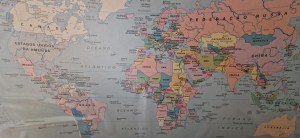
The second is Freedom of Press, which is the freedom for journalists to publish or broadcast what they think is important without any kind of censorship or external interference. States or companies (trying to “maximizing profit”, for example) that control what should be published or broadcasted are violating this principle. This doesn’t mean that all pieces should be published or broadcasted. The role of editors is to choose what and in what order should the pieces be published or broadcasted. The violation of the freedom of press is when someone from outside (a politician, a public official, the owner of a company) tries to replace the editor in such a task (or pressures them to do what they want). In addition, journalists should not be threatened or killed because they are doing their job. In conflicts, and especially in wars, journalists are clearly identified precisely because of this. Of course, journalists must have strong evidence (documents and/or reliable sources) to support their information. Releasing information without verifying it first can be considered defamation or lying. This can hurt the reputation of the journalist or the media where they work.

The third is Freedom of Association, which is the freedom of you to associate with whoever you want to discuss something, do something, or defend a cause. It ranges from a simple book club, where a (small or big) group of people come together to talk about books, or a group of friends that gather once a week to play a sport, to an association aiming to do something that can transform society for the better (for example, end poverty, end the mistreatment of animals, end domestic violence, encourage cultural education, encourage sport activity, defend the environment). This includes political parties. In a free country, people have the right to state and defend their opinions and beliefs as long as they respect other people’s views. Democracy is made of a plurality of parties. In a country where some political parties are forbidden, other freedoms such as freedom of speech or freedom of press are compromised as well, for sure.


Places, lieux, Orte, lugares

When learning a foreign language, it is advisable to use it in context. That is why books and classes have simulations of situations such as “in the airport”, “meeting new people”, “daily routine”. You can do the same in real situations. Imagine you are going to travel. You can recreate the “in the airport” scenes and write and perform them in the language you are learning. All you need is the vocabulary, simple sentences, and a willingness to practice.

The airport is a good place to start. From there, you can go to different countries and different sceneries. You can make up travels, describe trips you have already made, or journeys you are about to start. You can also talk about your city or your country. The possibilities are endless.

Below we provide a list of vocabulary that you can use (in a pdf, which you can download) and some examples in English, French, German, Spanish, and Portuguese. You can compare and get inspired.


Let’s start with a very simple example, which can be completed step by step.

(EN) I live in a city.
(FR) J’habite dans une ville.
(DE) Ich wohne in einer Stadt.
(ES) Vivo en una ciudad.
(PT) Vivo numa cidade.

A city is located in something bigger, like a municipality:

(EN) I live in a city, which is located in a municipality.
(FR) J’habite dans une ville située dans une municipalité.
(DE) Ich wohne in einer Stadt, die zu einer Gemeinde gehört.
(ES) Vivo en una ciudad, que está situada en un municipio.
(PT) Vivo numa cidade, que se situa num município.

Instead of going from smaller to bigger, you can go from bigger to smaller:

(EN) The world has five continents. Each continent has several countries. Each country has several regions. Each region has several municipalities. Each municipality has several cities.
(FR) Le monde compte cinq continents. Chaque continent compte plusieurs pays. Chaque pays a plusieurs régions. Chaque région compte plusieurs municipalités. Chaque municipalité compte plusieurs villes.
(DE) Die Welt hat fünf Kontinente. Jeder Kontinent hat mehrere Länder. Jedes Land hat mehrere Regionen. Jede Region hat mehrere Gemeinden. Jede Gemeinde hat mehrere Städte.
(ES) El mundo tiene cinco continentes. Cada continente tiene varios países. Cada país tiene varias regiones. Cada región tiene varios municipios. Cada municipio tiene varias ciudades.
(PT) O mundo tem cinco continentes. Cada continente tem vários países. Cada país tem várias regiões. Cada região tem vários municípios. Cada município tem várias cidades.

You can talk about your favourite places in the world:

(EN) I love the beaches in the Dominican Republic, but every winter I go to the mountains in Switzerland.
(FR) J’adore les plages de la République Dominicaine, mais chaque hiver je vais dans les montagnes en Suisse.
(DE) Ich liebe die Strände der Dominikanischen Republik, aber jeden Winter gehe ich in die Berge in der Schweiz.
(ES) Me encantan las playas de la República Dominicana, pero todos los inviernos voy a las montañas de Suiza.
(PT) Adoro as praias da República Dominicana, mas todos os invernos vou às montanhas na Suíça.

You can play with the cardinal points:

(EN) Switzerland is located in the centre of Europe. In the north is Germany, in the east is Austria, in the south is Italy and in the west is France.
(FR) La Suisse est située au centre de l’Europe. Au nord se trouve l’Allemagne, à l’est l’Autriche, au sud l’Italie et à l’ouest la France.
(DE) Die Schweiz liegt in der Mitte von Europa. Im Norden ist Deutschland, im Osten ist Österreich, im Süden ist Italien und im Westen ist Frankreich.
(ES) Suiza está situada en el centro de Europa. Al norte está Alemania, al este Austria, al sur Italia y al oeste Francia.
(PT) A Suíça está situada no centro da Europa. A norte fica a Alemanha, a leste a Áustria, a sul a Itália e a oeste a França.

Once you have enough practice in building isolated sentences, you can start building little texts. You can also build your own list of vocabulary. The best way to do this is by topics.

Cartography

Nowadays there are many people who can’t get around in a car without using the GPS. Funny enough, 30 years ago not many people would have heard about Global Positioning Systems. Back in the earliest days, the error between one’s position and the position given by the satellite was big enough to require a series of calculations. Today’s systems do the calculations automatically and way more accurately, so we don’t need to worry about it.

GPS shows where you are, where you want to go, and which route you should take on a map. Today, maps are digitally designed, but mapping is still an art. Cartography (which comes from the French word carte, meaning “map”, and graphy, meaning “draw”) started in prehistoric times. Back then, humans would draw maps on cave walls to determine hunting and fishing grounds. Slowly, the drawing of maps got better and during the Age of Discovery they became essential. Exploring the world in search of raw materials and precious goods has led to an explosion of different maps. These maps were especially used for navigation purposes, but soon geographers were drawing maps reflecting what they were discovering all over the world on land.

Gerardus Mercator was a geographer that lived in the 16th century. He is famous for the Mercator project, which is basically the map we all know and use these days. At the time, it was the most accurate, particularly for navigation purposes. This projection was the result of extensive travelling and many mathematical calculations. Today, this map is contested because it does not respect the true proportionality of continents and countries. For example, Greenland is too big and Africa is smaller than it actually is. Many other projections have been made, especially in the 20th and 21st centuries. One of the most controversial is the Gall–Peters projection, which is a kind of Mercator’s with the right proportionalities.

Google maps have revolutionised maps for the general public because it made them interactive. You can zoom in and zoom out, have different views, analyse different routes. It is not perfectly accurate, but it is enough for people to use it with confidence. Currently, there are many other similar platforms that provide the same services. It now seems that maps are essential for our life: to go from point A to point B, to run on the street, to find the best route, to locate something.

In a globalised world as it is today, it is fundamental that we know the location of the countries, the cities, the villages. In politics and international relations, maps have become crucial to understand the complex relationships between countries, which are limited by their own geography. Although the concept of geopolitics is relatively new, geography has always been important in war (therefore, at some level, in politics, as war is a political matter). The Chinese war general Sun Tzu mentioned it in its book “The Art of War”, which dates from the 5th century.

The idea of mapping the world has expanded to other areas. There are projects to map the ocean and even the universe.


Keyword: PLACES | “Prisoners of Geography” by Tim Marshall

“Prisoners of Geography” is a book about geopolitics. It is written in a very easy-to-read manner, but with all the depth needed to fully understand what really is going on in the world. Most of the time, reporters fail to give us the news with the necessary depth for us to comprehend the events which are unfolding. Many grey areas are left unexplained and many layers remain to be unveiled.

In this book, we can find answers to some of the most pressing geopolitical issues that shape the world today. Why is Russia always looking to expand its territory and influence the neighbouring countries? How is China challenging the USA as a world superpower? How did the USA become a world superpower? Other topics are also explored about Europe and the geography that shaped its nations, Africa and its difficulties for developing itself economically, the Middle East and its eternal conflicts, India and Pakistan and their constant mutual threats as well as their relationship with Afghanistan, the history of Korea’s division, Japan after the World War II, the geographical reasons why Latin America struggles in the global economy… and the Arctic. The readers’ view of the world will definitely change.

Tim Marshall is a British journalist specialized in foreign affairs. He was in the field during the Balkan wars in the 1990s, Kosovo’s bombardments in 1999, and the “Arab Spring” in 2010. He also followed on site the wars in Iraq, Afghanistan, Libya, and Syria. Besides reporting throughout Europe, USA, and Asia, he was a Middle East Correspondent in Jerusalem and a Europe Correspondent in Brussels. After more than 30 years interviewing different people, from those in the field doing the fighting to world leaders making the decisions, he now dedicates himself to writing and analysing.

Tim Marshall wrote a second book, “The Power of Geography: Ten Maps that Reveal the Future of Our World”, detailing issues regarding some of the regions analysed in the first book plus other regions that were not included, like Australia… and the Space. Then, he furthered the Space topic in a third book, “The Future of Geography: How Power and Politics in Space will Change our World”.
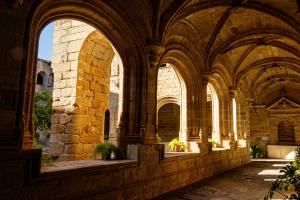
 

Keyword: MONASTERY | Bread

One of the most widespread foods, bread is greatly differentiated from region to region. As a base of probably all countries’ diets, it is sometimes a synonym of food or meal. For this reason, bread is metaphorically used on several occasions. It is a token of sharing and socializing, a way of saying that people are earning money, a religious symbol.

Bread is as old as the Neolithic. Back when humans settled in the same place and began farming and raising livestock, mixing flour (crushed grains) with water seemed a very good idea to make a nutritious food. Since then, it has evolved in terms of the flour used and the ingredients added. Egyptians found out that if the dough would ferment, the bread would be lighter. Romans invented the concept of bakery shops: shops specialised in baking bread to sell to customers. Then, during the industrial revolution, bread began to be mass-produced. Nowadays, it is recognised that artificial ingredients are not healthy and new solutions are being sought. Furthermore, people with allergies can already choose types of bread that take that into consideration.

Although quite ancient, bread has managed to remain modern. Sandwich, pizza and calzone, bun, toast, crouton are some of the dishes based on bread, but there are also soups, salads, main dishes or even desserts. You can buy bread everywhere and you can also bake it at home. There are even machines to help you with it. If you are imaginative, you can bake your own bread using different types of flour and adding original ingredients.

A life without bread is unthinkable for the majority of humankind. The truth is, few things make you feel at home like the smell of fresh bread. Therefore, bread has a past, but also a future, definitely. What future that will be, we will have to wait and see.


Monastery

Today, the need to “disconnect” and to “isolate” from the world is increasingly advertised as the solution for the stress caused by the Internet and social media. Technologies are modifying the way we work, the way we live, and the way we entertain and relax. Going to the countryside and spending some time in an isolated house seems to be the cure for the diseases related to this reality. You can go to a yoga retreat, to a SPA weekend, or to a holiday week with your family. The options are endless.

The idea of isolating oneself from society is not new. Centuries ago, it was applied for those who wished to dedicate themselves to religion. This is true not only to Christianity, but also to other religions like Buddhism, and Hinduism. The concept is the same: monks go to live, permanently or temporarily, in a building in the middle of nowhere to pray, study, and work. “Monk” comes originally from the word monos, which means “alone”. A “monastery” is the place where “monks” live. Originally, it came from the Greek work monazein, which means “to live alone” or a “hermit’s cell”. In a way, monks were “forged” in the idea of being hermits, those who went to live in caves totally alone and without any contact with the outside world. However, in monasteries, monks usually live in a community, although they have their own “cell” where they sleep and spend some time alone, like a bedroom. And celibacy is mandatory.

Monasteries are usually located in idyllic places, surrounded by nature, often on top of mountains. Curiously, the connection between “God” and “nature” is very strong. The top of mountains is considered to be closer to “Heaven”, thus, closer to “God”. And it is true that by being in the middle of nature one is further from the noisy society and it is easier to concentrate on divine matters.

Meditation is regularly practised by Buddhist and Hindu monks whereas Catholic monks pray several times a day. Although a little different, the aim is similar: to detach oneself from earthly matters and give yourself to something beyond oneself. Besides praying/meditating, work is also very important, especially cultivating vegetables and aromatic herbs, cooking, and producing beverages. Delicious desserts, cheeses, bier, and wine are among well-known monks’ creations. They had time to think about it during theology’s breaks. They also had time to copy important books and built distinguished libraries.

Monks are men and live in monasteries. In the case of women, they are called nuns and live in convents. In addition to the same roles as monasteries, convents had another role in society. Before disobedient women were considered hysterical and were locked up in psychiatric institutions by their fathers or husbands, they were locked up in convents and forced to follow a “life of faith” as a solution for their “sins”. Although contact with the outside world was cut, many nuns would become pregnant. Then, they would say it was the Holy Spirit who impregnated them. Yet, the truth was different and sometimes the babies were actually from monks… as monks and nuns would work together many times. All in the name of God.
 

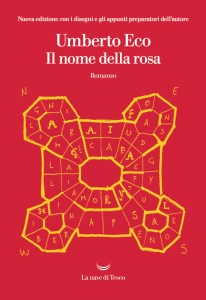
Keyword: MONASTERY | “The Name of the Rose” by Umberto Eco

In the Middle Ages, Friar William of Baskerville arrives at an Abbey to address a matter related to a dispute within the Catholic Church. Shortly after, dead bodies start to surface in a very sudden and mysterious way and soon it becomes clear that those friars were murdered. A serial killer is on the loose and William of Baskerville is put in charge of the investigation. He can only count on his analysis and deduction skills, and the help of Adso of Melk, a novice travelling with him.
As the investigation unfolds, we learn that the dead men have strange ink stains on their bodies and that they were poisoned. What the ink means and which was the poison remains a mystery. A mystery is also the library of the Abbey. This library safeguards some of the rarest editions of valuable books and it is unique in the world. It had been constructed as a labyrinthine, and only authorized persons are allowed inside: knowledge is power and power must be contained.

Time is running out. Bodies keep showing up and Inquisition is on William of Baskerville’s heels. In the meantime, all paths of the investigation lead to the library. The dead bodies seemed to be related to the library and, to solve the crimes, William and Adso must solve the library riddle.

Umberto Eco was a Professor at the University of Bologna specialized in medieval literature and philosophy. This period of history and his great interest in sign processes and meanings influenced not only his academic work, but also his work as a writer. “The Name of the Rose” was his first and most famous novel, which combined all these elements. It was a success so great that a film was made only six years after the book was published. Sean Connery played the role of William of Baskerville and Christian Slater (a very young actor at the time) played the role of Adso of Melk.

Six novels followed this first book and many literary awards. He also developed work as a translator and was a brilliant scholar. His private library was so unique that it was the subject of a documentary. The most peculiar characteristic is that the content of all books in his library was false. Umberto Eco thought false books were far more interesting than books narrating true facts because they were more imaginative. After his death, the books were donated by the family to the University of Bologna.


Lawns, cherries, cows, and chickens

Proverbs or sayings are one of the best ways to get to know the culture of a country, or a language. A language is developed according to the place where it is born. That is why snowy countries have many words for snow and words and expressions related to the sea are common in coastal countries. Of course, with colonialism and the imposition of European languages in other parts of the world, this got a little distorted. However, European languages are evolving differently in each part of the world where they were introduced. This means that European languages are adapting themselves to other realities. That is why we have British English, American English, and Australian English, for example. It is the same language (English), but with specificities in each region. Even British English is not as harmonious as people might think.

As people are similar everywhere, some proverbs or sayings have the same meaning although they are presented differently, according to the reality of each language. On the other hand, there are those which are unique and don’t have a direct equivalence. When translating these, chances are they need to be explained rather than translated.

Let’s analyse a practical example, comparing an English proverb with its equivalent in French, Germany, Spanish, and Portuguese:

The grass is always greener on the other side of the fence.

Gardens are very important in England, especially the private little gardens attached to individual houses. Together with the weather, gardening is the top topic of conversation. These gardens are usually limited by fences, which are also the boundary between gardens. It is part of human nature to compare what we have with what others have. Usually, we believe that other people’s lives are better than ours (partly because each person tries to show that their own life is better). So, by comparing the grass of their own garden with the neighbour’s grass, people are led to believe that the neighbour’s grass is greener, thus, more beautiful.

In French, the expression with the same meaning is:

L’herbe est toujours plus verte ailleurs.
TRANSLATION word by word: The grass is always greener somewhere else.

Basically, the metaphor is the same, but a little more wide-ranging. Instead of referring to the little garden next door, they talk about any grass anywhere else but there. It could be the grass from the nearest village or the grass on the other side of the country. Everywhere is better than where one is.

In Germany, the equivalent expression is:

Kirschen in Nachbars Garten schmecken immer besser.
TRANSLATION word by word: Cherries in the neighbour’s garden always taste better.

In Germany, the comparison is not about grass, but cherries. This means that German people have fruit trees in their backyards and value them more than gardens. Probably, the kids often go to other people’s property and steal fruit. Why cherries and not other fruit? As cherries like cold, the fact that it snows abundantly in Germany makes it perfect weather for them.

In Spain, it isn’t about grass or fruit trees, but animals:

Vacas ajenas dan mejor carne.
TRANSLATION word by word: Other cows give tastier meat.

Cows are very important in Spain. Besides fighting bulls, Spanish people like to eat beef. So, raising cattle is a popular activity and the quality of beef is very important.

Finally, in Portugal, the expression is also about farm animals, but a different kind of animal:

A galinha da vizinha é mais gorda que a minha.
TRANSLATION word by word: The neighbour’s chicken is fatter than mine.

In the Portuguese countryside, everyone has chickens. Everyone, no exceptions. So, chickens are very important as they provide eggs and meat. The aim is to get them fat because the fatter they are, the more meat will be there to cook.

Deceit

Deceit is “an act of keeping the truth hidden, especially to get an advantage” (Cambridge Dictionary). This means that people deceive with a purpose. They want something and think that only by deceiving others will they get what they want. “Hidden the truth” can mean “lying” or “omit”, although some people say that “omitting” is a way of “lying”. There are many reasons for lying or omitting. In fact, deceiving is a daily activity. From little lies (for example, telling someone we meet on the street that we are fine when we are not), to living a double life and lying about it to everyone. Some say that a lie is a lie and it doesn’t matter if it is a little one or a big one. Some say that those who tell little lies are also capable of telling big ones. The truth is: everyone lies.

Treachery is the worst kind of deceit. According to the Cambridge Dictionary, it is the “behaviour in which a person deceives someone who trusts them”. The main difference from a “simple lie” is related to “trust”, that is, you are lying to someone who believes in you, who thinks you are being true and cares about you. For example, if you say you are fine to someone you find on the street, this person doesn’t necessarily trust you or really cares. Treachery is like stabbing someone’s trust. The deceit is more serious and, thus, has more dramatic consequences once revealed. This is valid regarding personal relationships and actions against one’s own country. In the latter, it is called treason and it is considered a crime. Spies deliberately pretend to be someone they are not in order to gain the trust of those who possess the information they need to pass on to the enemies. The enemies, thus, get an advantage they wouldn’t otherwise.

People can betray the trust of other people in other contexts, like in friendship or in love. They can also betray their own principles and values, when they act against what they believe and/or against their own feelings. Sometimes, people even lie to themselves. This means that one can betray themselves knowingly or they can find arguments to justify it (hence, lying). Honesty with oneself and with others is very difficult due to various reasons such as expectations, pressure, fear, politeness, shame, wanting to be accepted or to belong… even feelings of wanting to protect oneself or others.

Another type of deceit is manipulation, which is “to control someone or something in a clever way so that they do what you want them to do” (Cambridge Dictionary). This can be done by distorting the truth so the other person believes in false information and acts accordingly. In this case, it’s not just about deception, but also control. People can manipulate other people, but a State or an Institution can also manipulate a large number of people. In the latter, you can say they are “brainwashing”.


Keyword: DECEIT | “Fatherland” by Robert Harris

What if Hitler had won the war and succeeded in achieving his terrible plans?

The story of “Fatherland” starts in 1964. Preparations are ongoing for a glorious celebration of Hitler’s birthday. We are presented to Nazi Berlin and its grand new monuments built in honour and to serve the new regime. In the meantime, a body is found and Xavier March is called to investigate it. He is a regular German policeman who is not very happy with his job. His lack of enthusiasm with Nazism leads his colleagues to avoid him and his family to desert him. That’s the reason why it is Xavier March investigating the murder; everyone else is too busy with important things: the celebration of Hitler’s birthday.

The case is deemed unimportant, but soon he realizes that it is not an ordinary murder. During the course of the investigation, he meets a foreign journalist who tells him disturbing things about the regime, something about massive murder in concentration camps… At first, he does not believe her, but he keeps on thinking about what she said and tries to uncover the truth.

Robert Harris tells the story from the point of view of a regular person, fully integrated in the system, but one that can pay attention to what lies beyond. As a “normal” person, he believes in the Nazi propaganda, partly because he has no reason not to. After all, there are no other sources of information. When he meets a foreign person, with information unavailable in his country, he starts questioning everything. What she is telling is too unbelievable. He doesn’t even comprehend it. However, he starts thinking, connecting the dots… and he goes on investigating although he is not allowed to do so. The investigation puts his life in danger, but he pushes forward. Until, one day, he discovers the horrifying truth.

The book is based on the fact that the German population was completely unaware about the concentration camps and portraits how people were required to comply with the regime. Those who did not were sidelined, maybe even arrested by the Gestapo and tortured. Eventually, they were killed. Even those who would comply could be killed anyway. No one was safe and people would do anything to survive.

As a former journalist, knowingly or not, Robert Harris shows how important free press is, to investigate in depth and denounce all wrong doing of the State, regardless of the regime. Authoritarian regimes want their populations to be kept in the dark, and be ignorant. So, they feed people with propaganda and they force them to be part of organizations where they can mould their brains. We can see this in Xavier March’s son. He thinks he is doing the best he can do for his father, believing his father needs to see reason. He doesn’t know better, but he should.

The role of the American journalist is the opposite of Xavier March’s son. She represents the free press that investigates and denounces. She shows the truth and how it is important for people to be informed.
 

Key place: USA’s EAST COAST | Sandwiches

Everyone knows what a sandwich is and everyone has eaten one. No mystery there. Some people have heard the story of how Earl Sandwich wanted to have something to eat without having to leave the gaming table. Hence, the name. True or not, eating bread with something inside is something that people have been doing probably since bread was invented.

The most basic sandwich you can do is to spread butter on a slice of bread. From there, you can add ham, cheese, jam… and another slice of bread. Then, you can add another slice of bread, making a kind of a double sandwich. If you fancy vegetables, you can add lettuce, tomato, grated carrot… In order to be more substantial, like a lunch or a dinner, you can put mayonnaise, a boiled egg (or a fried egg), meat or fish.

Sandwiches can be as different as your imagination. However, there are pre-defined types and some typical sandwiches per country. In The Netherlands, for example, they put the French croquette between two slices of bread and called it broodje kroket (croquette sandwich). As great fish eaters, and directly from their colonial heritage, they also have the broodje bakkeljauw, which is a sandwich with fried cod and is based on Suriname cuisine. In England, the Afternoon Tea usually comes with various sandwiches, namely the famous cucumber sandwich. They look like miniatures and can be displayed in those three-tiered dishes, like the mini-cakes. Then, there is the world-renowned club sandwich, which was invented in New York, USA. And speaking about the USA, they were also the inventors of putting the hamburger between two slices of bread.

Sandwiches can have different forms: rectangular, triangular, round, squared, baguettes. You can also design animals or other figures with different ingredients, or serve it as an “open sandwich” (the bread is the base and the ingredients seem to be escaping from it). All types of bread are allowed, and you can choose to have a healthier sandwich or one full of calories with lots of sauce or jam.

Options are endless, enjoyment is granted, fun is a plus.


Mercantilism

The word “mercantilism” comes from “merchant”, a person who buys goods to resell them. Merchants make money with the profit of the sale (the amount of money that is left from the sale after all expenses related to the buying and selling are paid). Since the beginning of time people have bought goods somewhere in order to resell them somewhere else. The Silk Road is a great example of this, these routes were very slow, very expensive, and full of dangers.

The world changed in the 15th century. Until then, in Europe, the economy was based on feudalism, a system where Lords owned vast agricultural lands and received a rent from the farmers who actually worked those lands. The lands were given by the King, in exchange for some service worthy of them (like becoming Knights, going to war, and being successful). Back then, merchants were considered an inferior class. Like the farmers, they existed only to serve the King and the Lords, to provide them with goods from far away.

The Era of Discovery aimed to expand the land of European Kings and, consequently, expand their wealth. The “mother land” would send people to the lands of the “new world” (the settlers) and the idea was for them to serve the King in a similar way as the Lords. However, they failed to foresee the role of merchants. While they became the intermediaries between the settlers and the King and the Lords, trade routes became less long and less expensive, and maybe a little less dangerous.

Long story short, merchants started to make a lot of money. And with wealth, came power. They organized themselves in guilds and companies, like the Dutch West India Company. These guilds and companies were owned by the State, but they acted as they were independent. Wealth increased exponentially, both for the State and the merchants. This led to a shift in the economy and feudalism gave way to mercantilism. In countries where agriculture was not as important, trading became the core business of society. This is what happened in The Netherlands, and which gave rise to the Dutch Golden Age.
Then, in the 18th century, came the Industrial Revolution and the economy shifted again. Trade was still the main focus, but this time the profits were to go to “capitalists”, people who had capital to invest in factories that would produce goods to be sold. The difference is that these capitalists were individuals and they would “compete” with other individuals/capitalists for the customers whereas in mercantilism, trade was made by the State and there was no competition.

Nowadays, capitalism is still the base of the economy.


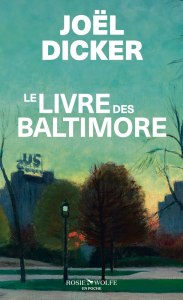
Key place: USA’s EAST COAST | “The Baltimore Boys” by Joël Dicker

Harry Quebert was Marcus Goldman’s mentor when Marcus Goldman was a student and an aspiring writer. Harry Quebert had become a great writer, not in the most honest way, as we learn in the book “The Truth about the Harry Quebert Affair”. The mentorship gave rise to a good friendship, but the friendship came to an end due to the “Affair”. At the beginning of the “Affair” book, Marcus Goldman has a writer’s block and goes to visit Harry Quebert in his house by the beach in search of help. He is under pressure from the publisher to write a second book and he has no ideas. Witnessing first hand all events that led to Harry Quebert’s downfall, he reluctantly writes the book about the crime investigation that took place.
This second book is also a success. The first book had been inspired by his friendship with his cousin when they were kids and had been a huge success. When “The Baltimore Boys” starts, Marcus Goldman is trying to write his third book and… he has no ideas. In the meantime, he receives a call saying his uncle had died. He then goes to Florida to his uncle’s house and revisits his friendship with his cousin: how appearances can be deceiving, how never-told-words can become misunderstandings, and how basic human emotions can lead to thoughtless and disproportionate actions.

The Goldman’s family had two branches: the “poor” branch, living in New Jersey, and the “rich” branch, living in Baltimore. Marcus was part of the New Jersey branch, but he would go to Baltimore whenever he could, to spend time with his cousin. They were joined by a friend of his cousin, who became a non-official Marcus’ cousin. There was also a girl, who caused troubles, and a tragedy, that changed everyone’s lives. It turns out that the girl is, in fact, Marcus’ lost love. By chance, Marcus finds out that she is living not far from his uncle’s house… but she is engaged to be married.

Joël Dicker takes us on a journey between the past and the present, where the present is conditioned by the past and the present can change the course of the future. A Swiss national, he spent many childhood summer holidays in Maine, USA. This experience inspired some of his first novels such as the famous “The Truth about the Harry Quebert Affair”, which has turned into a successful TV series. Besides “The Baltimore Boys”, “The Alaska Sanders Affair” also includes characters of “The Truth about the Harry Quebert Affair”. In his first novel set in his home town, “The Enigma of Room 622”, Joël Dicker is the main character of the story and pays tribute to his editor who had just died. With the death of his mentor, he decided not to have any other editor, and, thus, established his own publishing house: Rosie & Wolfe.


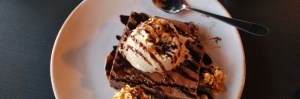
Key place: LONDON, UK | Ice-cream

Ice-cream is probably a national food in Italy, where you can find good gelato everywhere. Gelato is a specific ice-cream type. Other types are sorbet, frozen yoghurt, sundae, soft ice-cream, frozen custard… What differentiates each type is how they are made. You can also find national types of ice-cream in some countries. Sorbet, for example, is based on fruit and it is an Italian version of the Persian sherbets. Frozen yoghurt uses yoghurt instead of milk or cream and it is a USA invention.

Existing since ancient times, ice-cream boomed in the 19th and 20th centuries when new techniques allowed it to be widely commercialized. Before, it was a special dessert for the rich, when its confection was too expensive, but, when the production costs decreased (much due to refrigerators), it became available to anyone. Just imagine 18th century aristocracy eating ice-cream for dessert as it was a distinct delicacy…

Agnes Marshall (1855-1905) was an English cook who understood the potential of ice-cream. She wrote and published two recipe books about it and invented the first ice-cream machine. She also created a cone from almonds to be eaten together with the ice-cream, what she called “cornets with cream”. This was the first version of the ice-cream cones we all know today. Agnes was a real pioneer and visionary not only in what ice-cream was concerned, but also in terms of cooking in general. Together with her husband, she bought a cooking school in her name shortly after a law was issued allowing women to own property. This school thrived, much due to her travels around the country giving lectures and advertising the books she published. A true entrepreneur, she did not stop innovating and she even founded a human resources company for people who wanted to hire cooks, complementing, thus, her activities in the school.

Nowadays, ice-cream is part of our daily lives. We can buy them in specialized stores, on the street, and in the supermarket. We can eat them on a plate, on a glass, on a cup, or on an edible cone. Besides the traditional flavours (vanilla, chocolate, strawberry), many new ones are being made (imagination is the limit). In fact, there are people who are paid to discover new mixes, so basically their job is to taste ice-cream. Pretty cool, yeah? There are also ice-cream cakes and baked ice-creams (look for “baked Alaska”).
 

Tourism

Since the beginning of human settlements people have travelled from settlement to settlement for trade purposes. While doing business, these people would share new cultures, new languages, new views of the world. These merchants lived for travel and would always be on the move. Then, during Ancient Greece and the Roman Empire, people started to travel for pleasure. They would go on a “circle”, meaning they would go somewhere and back again. However, these “tours” were only for a selected few.

Somewhere during the Middle Ages, the Grand Tour began to take shape. Members of the upper class got into the habit of travelling through Europe to educate themselves about painting, sculpture and ancient architecture. Each group of people would decide the length of time and the itinerary, often hiring a guide to accompany them. Paris and Italian cities like Venice, Florence, and Rome, were usually part of the trip. Switzerland, especially Geneva, was included in some of the most daring and intrepid journeys.

In the 19th century, due to the development of railways, the price of travel decreased and accessibility increased. This meant that people from the middle class were also able to afford to travel, making the business around tourism to flourish. The tourism industry was born and mass tourism followed. In fact, the travel agencies’ tours are a modern version of the Grand Tour, adapted to a large number of people and very limited in time. Nowadays, you would probably have to do several of these tours to make one old Grand Tour.

Today, many people are keen to distinguish between “tourists” and “travellers”. “Travellers” are those you want to meet people from different countries, who want to immerse themselves in the culture and learn about it. “Tourists” are those who just go and see what is presented to them. In reality, people who did the Grand Tour wanted to learn about art and ancient culture, but they did not wish to immerse themselves in the culture. They were known for criticising the “natives” and would only get along with their countrymen. Pretty much like tourists nowadays.

So, tourism has been around for a long time. It has evolved and now the possibilities are endless. People go touring for all kinds of purposes all over the world. There are pre-defined tours, but you can also plan your own voyage. Different budgets will provide you different trips to different destinations. For the same destination, you can choose different means of transportation, hotels, services. And, if you can afford it (in terms of money and time), you can replay a Grand Tour of your own making.
 

Key place: LONDON, UK | “The Cuckoo’s Calling”, by Robert Galbraith

Cormoran Strike is a former military policeman who lost part of his leg in Afghanistan. He became a private detective without much success and now he has a huge debt to pay. On top of that, he has just ended his troubled relationship with his long-time love and, as he lived with her, he now has nowhere to live. Therefore, he spends his nights in his own detective office. To make things worse, he found out that the temp agency he used to work with has just sent him a new temporary secretary without asking him. He doesn’t have any money to pay her, but he feels bad for her, as it is not her fault the agency got mistaken. He decides to employ her for the week she was promised.

Robin Ellacott has just moved to London to live with her boyfriend and she is looking for a permanent job. In the meantime, she is taking temporary jobs while she goes to interviews. Strike’s office is her most recent post and her first day there is also her first day as a bride to be; her boyfriend had proposed to her the night before. Although she arrives overwhelmed with happiness, the first impression of her temporary employer is not very pleasant and she can’t wait for the week to be over and leave.

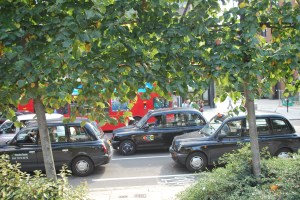
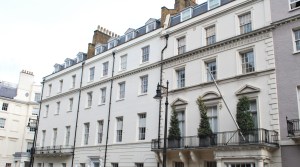
London is the stage of all the action. Strike’s office is located in the trendy Soho, at the heart of the city. On the same day, the brother of his childhood, and dead, best friend knocks on the door to ask him to investigate the murder of his sister, which was ruled a suicide. The case has nowhere to go, but the client promises him a lot of money, enough money to pay Strike’s debt and the one-week salary of his new employee. He reluctantly accepts the case and heads to Mayfair, the city’s poshest borough, where the wealthiest people in the country, and maybe in the world, live.
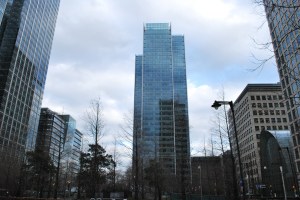
Throughout the story, the reader follows Cormoran and Robin as they walk, and sometimes take the tube, around London to find out the truth about the affair. Not everything is what it seems and all details matter. During one week, the case gets solved and both our protagonists change their lives.

“The Cuckoo’s Calling” is the first book of a series by Robert Galbraith, the pseudonym of J.K. Rowling for crime fiction. After the huge success of the Harry Potter series, she wanted to write something different. She wrote “The Casual Vacancy”, a fictional story about the events that follow the death of a parish councillor in a rural town. This was a success, but what she really wanted was to write detective stories. However, she wanted to test if she was good enough, if her detective stories were not sold just because J.K. Rowling wrote it. So, she sent the book anonymously under the name of Robert Galbraith and got published. However, the journalists found out the truth and the sales of the books escalated. The freedom of anonymity is gone, but the series is solid and growing.


Key place: ITALY | Wine

Italy is one of the largest wine producers in the world and Tuscany is one of the largest and most prolific wine regions in Italy. Wine has been produced in this region since before the Roman Empire. Rome was not that far away (from Florence to Rome is about 217 km), and this region was ideal to produce the precious nectar that Romans loved so much. Therefore, wine production in this region boomed and it has never stopped since.

Despite all technological advances, producing wine is still an art. For starters, it depends on nature: rain, temperature, sunlight, bugs… and the type of soil is also important (which is different from region to region). That is why it is so important to know where and when the wine was produced. Exceptional weather results in exceptional wine whereas bad weather makes bad wine. Tuscany has good soil for growing grapes and also good weather conditions.

Choosing the right time to reap the grapes is crucial. Grapes transform acid into sugar, which will be later turned into alcohol. If the grapes are reaped too soon, the wine will be too acidic. If they are reaped too late, there will be too much sugar, producing a too alcoholic wine. Therefore, producers start tasting the grapes about a month prior to their harvest to decide the exact date of the big day. Then, people have to cut the grapes in a certain way and prepare them to be transported also in a certain way. All details matter because everything will influence the quality of the wine.

Wines are defined by their grape variety and by their type. The most well-known varieties are, for example, Chardonnay, Merlot, and Pinot Noir, but many more are available. As for their types, they can be white, red, rose, sparkling, or dessert. The distinction between the different types of wine comes from the process rather than the colour of the grapes. One of the best-known sparkling wines is Champagne, named after the region where it was originally produced. This wine is usually made with Pinot Noir, Pinot Meunier, and Chardonnay grapes. Porto wine is a dessert wine, named after a city near the region where it was originally produced (the Douro Valley). It can be made from a great variety of grapes, but the most common are the Touriga Francesa and the Touriga Nacional.

Lastly, the same wine can produce different styles, which depend on how long the wine ages and where this process occurs. Wine that ages in wooden barrels will taste differently from a wine that ages in other types of barrels. The time they age can also be decisive on the resulting style. After this process is considered finished, the wine is bottled. It is no coincidence that wine is bottled in a certain type of glass and closed with a cork. As mentioned above, all details matter. Finally, the way wine is stored also hugely influences the preservation of quality. Hence, the cellars.

True wine connoisseurs take all this information into consideration when choosing the right wine. And there is no “one” best of them all. It all depends on the purpose and personal preferences. Well, yes, there are annual awards for those considered “the best”. However, when choosing the right wine for your dinner, for example, there are many factors to consider. For starters, the type of food you are eating. In general, fish match better with white wine and meat with red wine. However, it all depends on the kind of fish/meat and how it is cooked…

Difficult? Well, yes, but with training and experience comes wisdom.  

Bank and Banking

According to the Merriam-Webster Dictionary the word “bank” comes from the Italian word “banca” meaning a table where money was exchanged. In early days of trading (meaning the early days of human settlements), people would exchange goods for goods directly. However, at some point, this became impracticable, especially when dealing with distant settlements. Thus, coins were introduced, which were usually made of gold and/or silver, therefore, their value was calculated based on its material. However, coins were different from place to place and people needed to go to the “banca” to exchange it. This process was very informal and usually performed by merchants, who used to travel a lot.

Then, people found that they needed a place to store their money, a safe place that is. And what safer place was there than the religious temples, guarded by the gods themselves?… Priests were soon lending money to people and robbery started to happen. Things became more serious during the Roman Empire, when buildings were designated especially for storing money and lending money became a common practice. Everyone could lend money and get it back, usually at very high rates. Those who engaged in such activities in small scales were called “usurers”.

During the Medieval Times and Renaissance, Italians consolidated their vocation for trading between themselves and the outside world. At the same time, Kings and Popes (and nobles, too) were increasingly resorting to debt to pay their grand projects. Back then, Italy was not a united country as it is today. The cities were independent and some of them, like Florence, were very rich. Using all their knowledge about trading, exchange of money, and lending, Florentine families, like Bardi and Peruzzi, founded the first official banks. Later, they were completely surpassed by the Medici, who founded what was soon the biggest bank in Europe. At this point, “usurers” were already looked down upon and the word became a bad name.

So, this is how banks of deposit (people needed to store money in a safe place) and exchange banks (people needed to change coins to pay for goods in other places) came to be. Banking activity came about with the necessity of people to get loans to pay for their projects in advance.

 
For more information about the history of banking:


Key place: ITALY | “A Room with a View”, by E. M. Forster

Lucy is an English middle-class young lady that visits Italy with her unmarried cousin Charlotte. When arriving in Florence, disappointment awaits them. They were expecting an authentic Italian hotel, but they find that the hotel is actually managed by an English woman and is full of English guests. In addition, they were given the wrong room: they specifically asked for a room with a view to the river, but they got a room at the back. This was the beginning of several misunderstandings based on English prejudices. However, Lucy discovers a whole new world inside of her that will change her perspective of the world. Something happens in Florence, between her tours around the city, which she will try to forget before returning home. Once there, she tries to go back to her former life, unsuccessfully.

E. M. Forster travelled extensively, especially through Europe. He also had a keen eye for people’s behaviour and was a sharp critic of English society, for his hypocrisy and class stratification. His writings reflected that so accurately that he was nominated for the Nobel Prize several times, but never won it.

“A Room with a View” is about the journey of Lucy, both to another country and of self-discovery. The book starts and ends in Florence, the symbol of such a change in her. All characters in the story have their own important role to play. There is a contrast between native Italians, with a free lifestyle, and English visitors, trapped in a meaningless life full of rules that they themselves struggle to follow. Also, there are English people from different classes and we are informed on the prejudices between them. Lucy wants to fit in, and she almost succeeds if it was not for a certain (impertinent?) young man.

The book was published in 1908, when it was fashionable for the members of the English high society to travel around Europe (and other members of the middle class, with money). In 1985, the book was adapted to the cinema, starring Helena Bonham Carter as Lucy and with the participation of Maggie Smith, Judi Dench, and Daniel Day-Lewis. There is also a 2007 TV movie based on the book.

Key place: PARIS, FRANCE | Le croissant

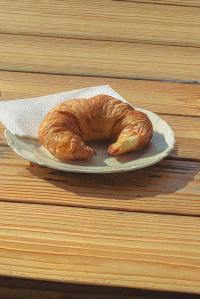
People can eat croissants at breakfast, in the afternoon, with tea or coffee, at lunch or as a snack, as bread or as a sweet. You can eat it by itself or add cheese, ham, butter, jam, cream, chocolate, spinach…. It is typically made with puff pastry (laminated dough filled with butter), which gives it that crunchy feeling we all love. Nowadays, there are different types of croissants, with different types of dough, but the shape is usually the same: a crescent shape.

“Croissant” means “crescent” in French. And “croissant” is a very typical French delicacy that has become incredibly popular. Except it was originally Austrian… and it only came to be in the 19th century, when an Austrian man opened a pastry shop to sell Austrian delicacies in Paris. These delicacies were based on a typical Austrian bread, with centuries of existence, which had a crescent shape.

No matter. “Le croissant” changed enough to become a French product that has been “exported” to the whole world and it is now quite different from that typical Austrian crescent bread. And, because food is always evolving and changing, croissants gave rise to many other similar delicacies, like the pain au chocolat. In truth, nowadays, you may find pastry called “croissants” without the typical crescent shape, but the spirit remains.

In literature, you can find some books with “croissant” in the title. Usually it is a romance, but it can be a rural crime mystery. However, most likely they are all set in France. There are also some references to croissants in films and TV series. Probably the “coolest” scene in the movies is when Meryl Streep (or rather, her character) bakes croissants from scratch.


Revolution

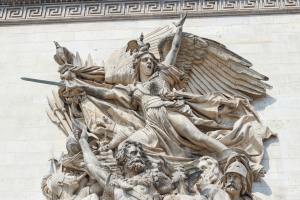
Probably the most well-known revolution is the French Revolution. This revolution was, in fact, a symbol of the collapse of the feudal system that took place throughout Europe at the time. The date of 14th July 1789 is usually referred to as the date of this revolution, but, in truth, the revolution began before that and ended much later, about ten years later or so. Can you pinpoint a precise date for a revolution? No, you cannot. In this case, the 14th July 1789 was actually the Storming of the Bastille, when the people that were fighting on the streets suddenly entered into the Bastille, which was a political prison at the time. Today is commemorated as the National Day in France.

A Revolution is, in fact, a long process that completely transforms society. In the case above, the feudal system was abolished and the monarchy ended, together with many other profound changes that occurred at the same time. This is different from a revolt, which is “to renounce allegiance or subjection (as to a government)” (Merriam-Webster dictionary). A revolt, or an insurrection, lasts less than a revolution and aims to a certain goal. It can succeed or fail when changing something specific. Some revolts could become revolutions (like the French Revolution, which began as a revolt, or several revolts, and grew until it turned into a real revolution), or at least they can have such a goal. If they fail in becoming a revolution, they are just revolts.

Revolts imply violence, but revolutions may not. For example, the Digital Revolution, which refers to the undergoing changes in today’s society from analogical and mechanical technologies to digital technologies, is not violent. Due to new technologies, the way we live, work, and are entertained is getting profoundly different little by little.

Then, there are specific types of revolts that can have certain names depending on the context. According to the Merriam-Webster dictionary:

  • “REBELLION implies an open formidable resistance that is often unsuccessful.”
  • “UPRISING implies a brief, limited, and often immediately ineffective rebellion.”
  • “MUTINY applies to group insubordination or insurrection especially against naval authority.”


Key place: PARIS, FRANCE | “Das Parfum”, by Patrick Süskind

Paris, 18th century. 51 years before the French Revolution, Jean-Baptiste Grenouille is born in the most stinking place in the most stinking city of the most stinking Kingdom: a fish market in Paris. This is how the story of the most exquisite perfumer begins.

Grenouille has no body smell and, because of that, he is feared. People are not afraid of him, they just feel he is different in a completely and unbeknownst way and just keep their distance. No one knows, except Grenouille himself, that he has an enormous gift: he can smell and precisely categorise all the smells (good and bad) in the world. He can also detect the tiniest fragrance that has travelled from far away. For Grenouille, who has no moral values, only this gift matters. So, killing to acquire the body smell of a particular person is just a collection method, nothing more.
We navigate through this story of smells through fabulous descriptions and enumerations. First, we learn how he survived when all circumstances were against him, then we learn how, little by little, he discovered and developed his gift. In the end, his wish comes true and he becomes a perfumer’s apprentice. Well, not much of apprenticeship, as he already knows how to mix the smells to obtain the most marvellous perfumes. However, some of those techniques are going to be surprisingly helpful for him to advance in his exploration of his gift… and his final goal, which will have a dramatic ending.

Patrick Süskind wrote the book and there are films and TV series based on it, like the 2006 film with Dustin Hoffman as the perfumer master, and the 2018 TV series produced in Germany.


Key place: SIBERIA | Solyanka soup

Like most recipes, the origin of the solyanka soup is controversial (read here more about it here). It is believed it was a main dish back in the 17th century that turned into a soup in the 19th century. At that time, it became very popular, especially in taverns, and the way of cooking it was a hallmark of each cook. During the Soviet period, the soup was spread throughout the countries that were part of the Union, all the way to East Germany. Nowadays, it is still very popular here, with different versions according to the creativity of who cooks it.

Solyanka is a broth with many different ingredients and the ingredients that are added is what differentiates each version. Usually includes pickled cucumbers, sauerkraut, onions, and other vegetables, maybe potatoes and tomatoes, a lot of salt, fat and spices. Typically, it is a hearty soup with meat, but it can also have fish or mushrooms instead. However, it is mandatory to add sour cream when it is ready, just before it is served. Olives are also traditionally added.

The reason this broth was so popular in taverns was because it is great to eat together with vodka, and great to cure drunkenness (read here more about it) due to the quantity of fat it includes. Nowadays, you can find good choices in the supermarket, also as frozen food, but you still can find the best option in the restaurant.


Snow

For people who live in countries where there is not much snow or none at all, there is only snow and ice. Maybe we can add “frost”, the ice that forms in the early morning and usually damages crops. However, for people who live in “frozen” countries, recognizing different types of snow can be a question of life and death, literally. Therefore, people who live in countries like Greenland or within the Arctic Circle, have many more words for snow and ice, most of them may not even have a direct translation in other languages.

Snow is “rain” when temperatures are below the freezing point (0ºC). If there is no moisture, there is no snow, even when temperatures are really low. For example, in Antarctica, there are vast spaces called Death Valleys where there is no moisture, therefore, no matter how low the temperature is, there is no snow, ever. The level of moisture determines the type of snow and, ultimately, how dangerous it is. The temperature also influences as the ice crystals form differently under different temperatures. This is also true for ice, which, in a way, is a form of snow. Or better yet, snow is a form of ice. The difference is that snow is formed in air (hence, “frozen rain”) and ice is formed on the ground.

However, it is not only the level of moisture and temperature that determine the type of snow. There is also the snow that accumulates on the ground and then melts and then freezes again (hard-packed snow). The best snow for skiing is the snow that has just fallen when the weather is dry, but cold enough to freeze water (powder snow). Then, there are the types of snow that are more than one year old, but are still loose enough for skiing (firn snow). When this type of snow consolidates, it forms a glacier. Wet snow is a snow that is heavy with water, the best one for building snowmen. Drift snow is the snow that is “transported” by the wind and can cause avalanches.

 
Well, this is a very extensive subject. For more information, you can start by reading:


Key place: SIBERIA | “The Lost Pianos of Siberia”, by Sophy Roberts

Russians conquered Siberia between 1580 and 1778. In the meantime, in 1762, Catherine the Great became empress of Russia. This means that, when Catherine took the throne, almost all (and later all) Siberia was part of the Russian Empire. Under her ruling, Siberia acquired its status of “prison” and “exile”, but it was also invaded by a “piano fever”.
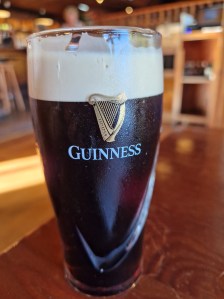
Sophy Roberts is a British journalist specialized in travel writing. When she heard there was lost pianos worth looking for in Siberia, she thought this was the perfect excuse to finally get to know this part of the world. What started as a piano quest, ended as a collection of stories about Siberia and the importance of music (and pianos) in the region. In truth, since Catherine the Great, music and pianos are entangled with Russian history and culture and it is impossible to talk about one without talking about the other.

This non-fiction book is a journey through time from 1762 to present days. Throughout its narrative, stories of pure horror go hand in hand with sublime stories of human endeavour. Catherine the Great was a huge fan of European culture and, in a time when pianos were the latest music technology, she adopted them and was the driving force to spread them to the entire Empire, even to the most remote and (almost) inaccessible places. At the same time, she was complicit with the slavery of her people and the use of Siberia for getting rid of dissidents.

Time passed by and dissidents kept rebelling and kept being sent to Siberia. However, these dissidents were educated people, with a love for music and the pianos. Therefore, when they went to exile, they made a point to take the pianos with them and educate people there. Then, during the soviet period, the state funded music schools to make the piano available to (literally) everyone. The “piano fever” gave rise to a whole piano industry for constructing pianos, fine-tuning them, learning how to play them, and enjoying them in every possible way.

Finding these old pianos was a journey to the most remote and isolated locations. There were amazing discoveries, great disappointments and also the possibility to connect people that loved the same pianos. Hearing their stories, the stories of the people connected to them, or simply the historical context in which each piano “lived” (and sometimes “died”) was the foundation of this book. Sophy Roberts was joined at times by the photographer Michael Turek. They also have a website dedicated to this book, where you can see some photos and videos, and hear some music played on a piano.


Key place: IRELAND | Guinness beer

Nothing speaks Irish internationally more than Guinness beer. This is no coincidence. Arthur Guinness was a visionary and he wanted to brew such a beer that would be internationally recognized as an Irish product for many years to come. Hence, the choice of a harp as the symbol of the brewery. Yet, this is not just any harp, it is the “Brian Boru” harp, which you can see in the Long Room at the Trinity College Library in Dublin. It’s a medieval harp that stood the test of time and became the true symbol of Ireland. You can find it as the symbol of the Irish Government (adopted after the independence from England in 1922) and on Irish coins.
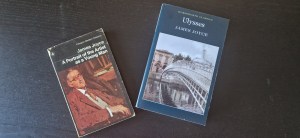
Founded in 1759 at St. James’s Gate in Dublin, where it is still being brewed today, Guinness is the most well-known stout beer in the world. Originally, when Arthur Guinness took hold of it, St. James’s Gate was an ale brewery, but he decided to change that and started producing a type of black beer. The final formula obtained in those early days was so unique that it gave rise to the “Irish Stout” style. To this day, “stout” is the only type of beer produced by Guinness. Their diversity is restricted to this condition, and they do not have that much diversity. When it is perfect, you do not need to change anything, right?

Back in 1945, Sir Hugh Beaver was hired as manager by the Guinness family and he underwent several changes that took the brewery to the next level. One day, while he was hanging out with friends at the pub, he engaged in a fierce argument about which was the fastest bird in the world. A conclusion was not reached, but an idea was born: to compile facts in a book to solve these kinds of questions. As the 1993 Nobel Prize in Literature, Toni Morrison, said, “if there is a book you want to read, and it is not yet written, then you must write it yourself”. That was exactly what Sir Hugh Beaver did. Well, he did not write it himself, but commissioned who did. That book was “The Guinness Book of Records”. The idea grew and grew and now is a yearly publication that confirms all kinds of records all over the world.


Folklore

The word “folklore” is a composition of two words: “folk”, which means “people” and “lore”, which means “knowledge”. Together they mean “the knowledge of the people”. In other words, folklore is the collection of all stories, music, rituals, traditions, and other cultural material that is informally passed from generation to generation in a certain region or within a certain people. A people’s identity is based on its folklore, which gives them a sense of belonging.

In Ireland, for example, folklore is deeply embedded in Irish identity. Although Celtics were spread all over Europe, Ireland is one of the regions where their culture remained, with roots that still feed the entire society. The Irish language, also known as Gaelic (the name of the Celtic branch that was settled in Ireland), is a Celtic language, the tradition of storytelling comes from the Celtic oral tradition, and the almost compulsory requirement for coming together to sing, dance, and play games was a Celtic custom.

Storytelling was crucial in a time when writing was not an option and there was a need to tell the great deeds of their ancestors. Nowadays, we can read what has passed in history books, which is written in a purely informative fashion. Back then, if the deeds were told in the same manner, those listening to it would not pay any attention. Besides, it would be very difficult to memorise everything. Therefore, stories were built, most of them based on mythology. This was also a good way to convey values, beliefs, and teachings. Today, this tradition is still prevalent and it results in amazing writers, poets, and playwrights.

After fighting wars and after the hard work in farms, Celtics would come together to have fun and relax. Music was extremely important to such a purpose, which would inevitably lead to a lot of singing and dancing. Celtics developed a very unique style, which everyone can identify today. Due to this tradition, it is still much alive, all Irish are in touch with these arts since their infancy and they start practicing them from a very early age, formally or informally. This leads to many professional actors, dancers, and musicians.

Sports were also very important as they were part of war training. It was a great way to keep fit and to train how best to beat the enemy… or defend the community. Celtics had their own games that are still played nowadays, with fierce competitions all over the country.

Rituals were also significant as they would determine the rules of living in community, hence the role of religion. Before Christianity arrived in Ireland, Irish people had their own religion, strongly related to nature and the seasons. For example, they would celebrate the arrival of spring, which established the beginning of sowing, and the harvest in autumn. These festivals, especially the harvest festivals, are still celebrated today.

Christianity was very well received in Ireland. Contrary to what happened in other regions in the world, the Roman Catholic Church did not erase the native culture to impose itself. Instead, the Catholic Church and the Celtic culture merged. Some rituals were replaced, but traditions such as storytelling, games, music, and dancing were kept. Nowadays, you find that Irish people are deeply Catholic and believe in Celtic mythology to the full.


Key place: IRELAND | James Joyce

You do not just read James Joyce; you become an Irish person that participates in the narrative.
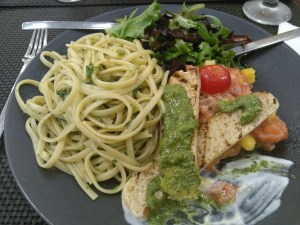
James Joyce was a true Irish man, to the core. More specifically, a Dublin man. Although he spent his life running away from his homeland and his background, his work was all about them both. It was not by chance that he said “When I die, Dublin will be written on my heart”. Although he had lost his religious faith very early in his life, he was strongly influenced by his Catholic education, maybe even traumatised. Furthermore, his father led the family to poverty mainly due to his heavy drinking. Both these themes are greatly portrayed in his work.

“Dubliners” was his first published work. It took him almost 10 years to get it published and he had to endure multiple rejections. The book is composed of short stories, although the last one, “Dead”, may be considered a novella. Nowadays, this possible novella is considered a masterpiece.

Each story aims to portray people living in Dublin, going about their own lives. The topic is different in each one and there is no interaction between the characters of different stories. Although it seems that the narrator is just describing the events that are unfolding, in reality the author is making us go beyond that and pay attention to what is not explicitly said, to what the main character is actually hiding. The situation could happen in any other city, but the choices characters make (the actions they decide to take or the things they decide to conceal) are based on Irish culture and can only be justified under that light.

His second published work, “A Portrait of the Artist as a Young Man”, is a fictional story that portraits his Catholic childhood and shows how much it influenced him and his life.

His masterpiece is “Ulysses”. Based on the “Odyssey”, by Homer, it describes a day of Dublin life. Most of the action is seen through the minds of the characters and each chapter has its own literary style. The aim of James Joyce was to portray Dublin in such detail that the city could be rebuilt exactly as it was from his book.

James Joyce died in Zürich in 1941, to where he moved from Paris after Nazis invaded it in 1940. “Finnegans Wake” was the last work that was published when he was still alive and it is considered an experimental book, where he plays with words to an extreme. He also left an extensive poetry work and many other fictional stories were published after he died.


Keywords: ROMAN EMPIRE | Pasta

A mother or grandmother cooking pasta on the stove is a childhood image of all Italians. All mothers and grandmothers have their speciality and their unique way of cooking it. A family secret that should never be known to anyone, only passed onto the next generation.
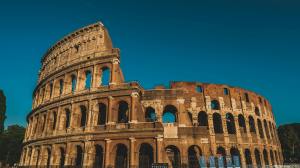
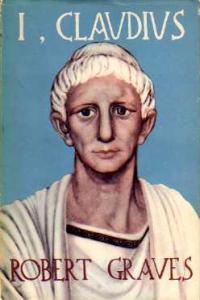
Pasta is unleavened dough. Once ready, you can do the shape you want, by hand or using a machine. You can also stuff it with meat, vegetables, or any ingredients that you prefer. You can use it fresh or dry. If you don’t want to prepare it at home, there are plenty to choose from in a supermarket. And the receipts? Besides the traditional ones, like spaghetti Bolognesi and lasagne, you can imagine and re-invent all you want. You can boil it or cook it in the oven. In the Roman Empire, people used to fry it.

There is nothing more Italian and the quantity of pasta consumed per capita is not as high as in Italy. However, apparently, pasta came from Asia and “travelled” with nomads to Europe. Well, a primitive version of it, at least. Once in Italy, it evolved to reach the diversity and importance it has today.

Yet, as or even more important, is the sauce. Ah, the sauce… Here is really where secrets lie. Even the most basic one, the tomato sauce, can vary enormously depending on the other ingredients you add. And, of course, the source of the ingredients is paramount. The flavour is completely different whether they are fresh or not.

One day, someone thought that pasta was so good it should be a dessert… Back in the Renaissance, pasta was a food only for rich people and sugar was a luxury item. Therefore, putting the two together was a question of time. Nowadays, with cooking promoted to art, imagination is the limit. You can have ravioli with chocolate, cannoli with cream (remember the “Godfather” film), fried pasta that looks like cookies…

So, when you go to Italy, be prepared to be amazed … and fatter, probably (remember the main character of “Eat, Pray, Love”…). You can also try it at home and eat it while watching a Western Spaghetti film. For those who are unfamiliar with the concept, Western Spaghetti films were cowboy stories produced by Italians and filmed in Italy. They were very popular in the 1960s and 1970s and featured many famous Hollywood stars, like Clint Eastwood.


Empire

According to the Merriam Webster Dictionary, an empire is “a major political unit having a territory of great extent or a number of territories or peoples under a single sovereign authority”. It comes from the Latin word imperium, meaning «“authority over family members and slaves exercised by the head of a household, supreme administrative authority, dominion, power exercised by a Roman emperor”, from imperāre “to give orders, exercise authority, hold political power” + -ium, deverbal suffix of function or state».

The Roman Empire was the second empire to exist in the world (the first was the Akkadian Empire), but it was one of the most effective. Starting as a Republic (from the Latin res publica, literally meaning “the thing of the people”), Rome was an independent city-state founded on top of a hill.

Battles with the neighbours were frequent. Julius Caesar, with his immeasurable ambition, became a member of the senate and an army commander, conquering many lands for the Republic. One day, he returned to Rome, but decided to take a legion with him, which was forbidden. The Rubicon River bounded the Italian domains within the Empire. Those who crossed it commanding an army were considered traitors and were sentenced to death. Julius Caesar knew this and he knew he could not go back on his decision after crossing the river. And so, the expression “crossing the Rubicon” (meaning “passing the point of no return”) was born. Julius Caesar crossed the river and civil war began. He took power and became a dictator. He was a dictator only for a few days… until he was murdered.

After some turbulent times, Gaius Octavius, the adoptive son of Julius Caesar, took the power and became the sole ruler of the Roman Empire. He named himself as Augustus, the Latin word for “majestic” or “great”. He also adopted his father’s name, Caesar. From then on, although it was not written as law, it became tradition for sons to succeed their fathers and be named as Caesar, like the “founder”. This denomination stuck and evolved to “czar” in Russia.

However, this was not the only legacy they left us. Buildings, roads, bridges are still there to be admired or used throughout Europe, Middle East, and North Africa. Many languages evolved from Latin, like French, Spanish, Italian, and Portuguese, and there are still Latin expressions in use (like status quo, alter ego, de jure, per capita, and vice versa, among many others). And speaking about Latin expressions, the law is full of them, partly because the current juridical system was based on the Roman one. Of course, we must not forget that the official names of plants and animals are also in Latin.

The Roman Empire, as such, ended in the 4th century. Since then, many other empires were born and died. Together with tales of grandeur, there are tales of atrocities and attempts to annihilate other cultures. For better or worse, empires change the territories they govern, but their end is certain.
 

Keywords: ROMAN EMPIRE | “I, Claudius”, by Robert Graves

Robert Graves was a poet and a writer. He also translated classic works and was a professor at the University of Oxford. His book “I, Claudius” was his most successful novel. It was written as it was Claudius himself writing it and it tells the story of the Roman Empire through his eyes, from his childhood to when he took office as Caesar. The events described were real, but the way they happened is fictional and myths and rumours were taken as real events. Assassinations, murders disguised as accidents, betrayals, conspiracies, and dubious and complicated family connections were hallmarks of the Roman Empire. You can find them all in this book, abundantly. When reading it, you feel like you are actually living in those times.
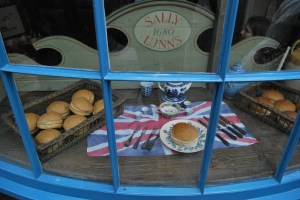
Claudius was a Roman Emperor, who was not supposed to have been one. He had a limp (thus the verb “claudicar” in some Latin languages) and a fragile health. He also stammered. Members of his own family, the Caesar family, despised him and kept him away from public gatherings. He watched 3 rulers come and go before he was called for duty when he was about 50 years old. The previous Emperor, Caligula, had murdered all male descendants of the first emperor, Augustus, but he spared Claudius for an unknown reason. Although there was not a written rule that a descendant would take the “throne” after the death of the Emperor, that was usually the case and, when Caligula was murdered, Claudius was the obvious choice.

The story begins with Augustus ruling. Born as Gaius Octavius, he was the successor of Julius Caesar and the first official Roman Emperor. He had a long reign, supported by his powerful wife Livia, who would literally do anything to keep her power. Claudius extensively talks about this couple because they kind of set the tone for subsequent rulers. In fact, all rulers up to Claudius, including him, were raised by them. As he tells his life story, how and why he became a historian and a writer, he also tells the story of Tiberius and Caligula, the two emperors before Claudius, from when they were kids to when they were murdered (and why and how they were murdered).

“Claudius the God and His Wife Messalina” is the second book of this short series and it tells the story of Claudius’ life as emperor.


Key place: BATH, UK | Sally Lynn’s buns

If the thermal baths, for which Bath is famous, began with the Romans, “buns”, which nowadays are a famous English delicacy, were invented by a French woman. Or so it says the shop where these buns were supposedly invented. In fact, the origins of Sally Lynn’s buns are not proven, but the “official” story makes sense. It says that Solange Luyon was a Huguenot, who fled from France to England in 1680 to escape prosecution. Arriving in Bath, she was employed by a baker and there she invented the bun, which was inspired by the French brioche. And, as English people have enormous difficulty pronouncing foreign names, she became Sally Lynn.
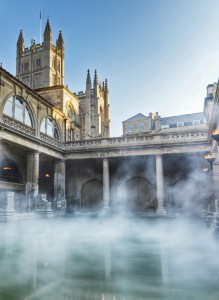
A bun is something between bread and cake. It is usually eaten with butter or jam, but it can also come with savoury toppings. Whether the story is true or not, the fact is that Sally Lynn’s buns are unique. Many have tried to copy it, with no success. Therefore, you need to go to Bath, UK, to try it. You can find them in one of the oldest houses in Bath, officially dated from 1482, conveniently located 200 meters from the Roman Baths. Actually, excavations have shown that food has been prepared in Sally Lynn’s place since the Romans. A small museum in the basement tells you the story.

So, when Bath turned into a famous resort in the 18th century, Sally Lynn’s buns were already well established and widely known, fitting very nicely in the new city concept. Everyone would eat there and probably ordered them to be delivered at home, for breakfast, for example. Jane Austen was one of those people and there is evidence that she really enjoyed them.


A glimpse of Bath

Visiting Bath is immersing yourself in the 18th century. As you walk through the streets, you can almost imagine carriages pulled by horses, people dressed in the latest fashion of that time… and gossip, gossip everywhere. Gossip about who had married who, and why; who had recently died, and who inherited the estate and the fortune; who had eloped with whom, and whose family’s name had been sent to the mud…

London was still London, of course, and “the season” was not complete without going there. However, Bath was the place to go. At least for those who wanted to be someone, but hadn’t got there yet. The competition with London was fierce, even though it was not even. A lot of investment was made to turn Bath into a great recreational resort. Three centuries later, the buildings are still there, with little changes in the scenery created at the time.

Why invest so much in Bath from all places? Due to its thermal waters. The Romans, those barbarians who tried to invade England and failed, were right after all. Before they were duly expelled from the country, they had time to build a grand thermal public building in Bath, which is still standing and fully operational nowadays. Hence the name Bath (where Romans would take their bath, publicly). Those barbarians knew what they were doing… The waters were indeed miraculous and everyone wanted to bathe in them and become cured from all diseases, real or fictional.

However, did people in the 18th century actually bathe in those waters and really became cured? After all, there was so little time for that, with all that gossip to be had, the shops, the afternoon teas, and the balls (oh, my goodness, the balls!) … It would not be surprising if people would forget about the thermal waters…


SPA

Photo by Colin Hawkins for UNESCO
It is generally believed (in what it was, in fact, a promotional strategy) that SPA would come from the Latin expression Sanitas Per Aqua [health through water]. This is actually wrong. Spa is the name of a city in Belgium, known for its mineral water springs. However, those who love names that come from Latin will be happy to know that the name of this town was probably given by the Romans: sparsa fontana [scattered fountain].

According to the Merriam-Webster dictionary, SPA is «a mineral spring; a resort with mineral springs; a fashionable resort or hotel; (…) a commercial establishment providing facilities devoted especially to health, fitness, weight loss, beauty, and relaxation; a hot tub with a whirlpool device». This dictionary also mentions that the first time SPA was used with this meaning was in 1610.

So, a SPA was originally a mineral water springs resort, a place where sick people would go to heal. Healing was made by drinking or bathing in the waters of that place, which possessed special and unique characteristics, beneficial to health.

Romans were known for their love for public baths, where they would socialize and take care of their health. When spreading their empire throughout Europe, they were the first to find the best thermal spots. Since then, people have not stopped seeking such healing places. Probably the one in Spa, Belgium, was the most famous at the time and “mineral water springs resort” became “SPA”, after the town.

Nowadays, the concept of SPA does not differ much from the Roman concept. It is not just for sick people, but for all those who want to stay healthy and fit. Indeed, some Roman facilities would include gyms, like today’s SPAs. Although SPAs may not include water, the majority has at least a swimming pool. And, of course, just like in Romans’ time, people can socialize and relax together, with all kinds of social and entertainment activities included.

In 2021, to honour and emphasise the importance of SPAs in Europe, UNESCO decided to turn into World Heritage 11 towns specially known for their mineral water springs: the Great Spa Towns of Europe. After extensive research, the list is now composed of cities from Austria (1), Belgium (1, which is Spa), Czech Republic (3), France (1), Germany (3), Italy (1), and the United Kingdom (1).


This article is part of the WORD CHRONICLES series
Word Chronicles are articles where the meaning of words, concepts, and perceptions are discussed.


Key place: BATH, UK | Jane Austen

Jane Austen is a world-famous writer known for her romantic novels. The love stories are the reason why most people read her books and why there are so many films and TV series based on them. However, that is not the reason why her books are considered brilliant. The descriptions (and somewhat criticism) of 18th century society are as accurate as they are timeless.

Creating stories since a young age, she only took it seriously when she was an adult. However, her sharp eye had been observing and her brain had been taking notes. By the time she wrote her six novels, her hands were ready to write what she had been processing. It is no coincidence that most of her books take place in the countryside or have main characters coming from the countryside: Jane Austen was born and raised in rural Hampshire. She also wrote stories set in Bath, a place where she hated to live. In fact, a few months before she died, she had started to write a new novel about a new SPA village, similar to Bath, as a critique to those people who went to resorts looking to cure imaginary diseases. Unfortunately, she only wrote the first chapter.

Her six novels tell tales of people who are living their lives within their communities until they get to know people from other communities. A kind of clash happens and love is born. However, this love is not possible for different reasons, but it usually revolves around money, prejudices, and social classes. Jane Austen masterly describes their struggles, how other people perceive their love story, and how everyone lives according to their own beliefs (and misjudgement of others). In the meantime, we learn about the drama that property law at the time could cause to families, the consequences of bad marriages, and how people would treat spinsters. There are also dishonest men and women who only want to marry for money. Family pressures their youngest to meet expectations or damages their prospects due to a certain reputation.

However, good people and good deeds are also present. Actually, it’s because of them that love triumphs in the end. Yes, love is strong, endures all difficulties, and overcomes all obstacles. Yet, it does need help and it does need people to defeat their preconceived notions. Maybe that is the message Jane Austen would wish to convey: focus on the essential, drop the absurdity. Nonetheless, she also stresses the importance of money. In fact, in her books, there are couples that married for love, but the lack of money turned that love into resentment.

In a nutshell, love is complicated and society is powerful.

 
The six novels of Jane Austen:

  • Sense and Sensibility (published in 1811)
  • Pride and Prejudice (published in 1813)
  • Mansfield Park (published in 1814)
  • Emma (published in 1815)
  • Northanger Abbey (published posthumously in 1817)
  • Persuasion (published posthumously in 1817)


Keyword: DESERT | Mint Tea

Tea is drunk everywhere in the world and there are many cultural ceremonies related to it in different countries, like the Traditional Japanese Tea Ceremony in Japan, the Afternoon Tea in England, and the Maghrebi Mint Tea, in North Africa. All of these ceremonies aim to welcome guests and be a moment of relaxation and socialization with friends and family.
The Maghrebi Mint Tea is drunk in cities and also in the desert (everywhere, basically). Like all teas, it is made by pouring boiled water on tea leaves. More precisely, they are green gunpowder loose tea leaves (a type of green tea). Mint leaves are also added, especially spearmint, and a lot of sugar too. When serving, the tea is poured as high as possible and the remaining stays brewing in the pot. Each new cup is stronger than the previous one and each person should drink three cups, according to tradition.

It’s not clear how this tradition came to be, but clearly it originated from international trading as the tea leaves come from China. North Africans adopted this Chinese drink and made it their own, with some changes. Now, the Maghrebi mint tea is so deeply rooted in their culture that it seems it has always been part of it. Interestingly, this mint tea is prepared by men and men alone (at least, according to tradition). It is usual to see men at cafe tables drinking tea with their friends or even making business. In the desert, they make the tea inside the tents at the end of the day to relax and socialize.

As all teas, it takes a lot of practice to get it perfect. Furthermore, each tea can be unique as other ingredients can be added. However, everyone can do it at home provided that they have the green gunpowder leaves and the mint leaves.
 

Nomad

Photo by Adam B. – Retrieved from Pexels
According to the Merriam-Webster Dictionary, a nomad is «a member of a people who have no fixed residence but move from place to place usually seasonally and within a well-defined territory». This concept applies, for example, to Bedouins, people that live in the desert, and Mongolians. The main reason why they move from place to place is because they herd animals (especially camels, in the case of Bedouins, and horses, in the case of Mongolians).

Nomads should not be confused with the merchants that used to cross the desert with goods to be sold on the other side. These caravans were very popular in the old days of the silk route and also in the Sahara Desert (think about the typical image of camels in line, full of goods attached to their back). While caravan merchants would go from one city to another, nomads would stay in the same place for a certain period of time, living in tents in the meantime.

Digital nomads modernised this concept. They too move from place to place and stay there for a certain period of time. However, instead of herding animals, they use technology to work remotely. And they do not usually live in tents, but in rented houses, although there are no rules in this respect. In fact, there are those who buy a camper van (brand new or an old one that they rebuild as they please) and literally move their house around.

The concept somehow expanded to also mean someone who roams without a purpose or a destination. However, this is different from a vagabond. A vagabond is someone who has no money, no professional occupation, and no place to live (they usually live on the street). Nomads have money and a profession, thus, they can pay for accommodation and supplies.

Being a nomad is not for everyone… but, then again, being in the same place doing the same things with the same people is not for everyone either. Before technology, people did not have much choice. If you were born into a nomad family, you would become a nomad, and if you were born, let’s say, in a farm, you would become a farmer. Of course, throughout the centuries, there were always rebels, people who did not accept their fate and would find a way to do what they really wanted (artists, mostly). However, nowadays, with new technology and the Internet, it gets easier to choose what you want to become. This does not mean that it is easy or without difficulties, for sure.


This article is part of the WORD CHRONICLES series
Word Chronicles are articles where the meaning of words, concepts, and perceptions are discussed.


Keyword: DESERT | “Dune”, by Frank Herbert

After being postponed due to the strike of writers and actors in the USA, “Dune: Part Two” will finally open in theatres around the world this month. Both Part One and Part Two were adapted from the first book of the series “Dune”, which is the name of the first book.

Paul Atreides is the son of the Duke, who, by imperial decree, has to take a new stewardship: the planet Arrakis. The entire family has to leave their home planet, a water planet, never to return. Arrakis is a desert planet, also known as Dune, with nothing but sand, gigantic worms, and spice. Spice is what makes this planet so valuable and worms are the creatures that produced it by interacting with the sand. Needless to say that those worms are deadly and harvesting the spice is extremely dangerous. The previous steward of Arrakis, who was removed by the emperor, is extremely wealthy due to the spice harvesting. Why did the emperor transfer this stewardship, banishing the previous Duke from his home planet and drying his wealth source? And why has the arrival of Paul Atreides been so anticipated by the people of Arrakis? And what role will the Fremen, the native people of Arrakis, have in the story?

“Dune”, by Frank Herbert, is considered a classic of science fiction and a cult book for many. In truth, this is just the first volume of a series of six. Many topics are intertwined and its brilliantly-achieved complexity is what makes this book, and the subsequent volumes, so epic. Things are never as they seem and the story takes several unexpected turns over and over again. For example, at the beginning of the book, the Fremen are presented as savages who do nothing but terrorist acts. When Paul Atreides is forced to flee from the ducal palace, he must take refuge with them. We then learn how Fremen have adapted to life in the desert, their relationship with the gigantic worms and also how water is central in their lives. Fremen also have the project of transforming the desert into a forest, which is actually achieved in a later book of the series, but with devastating consequences.

Of course, the story is not just about survival techniques and mega projects. There is a rebellion in the making that will change the whole empire and a mysterious organization of women that will have a crucial role in the process. These women dedicate their lives to the organization and use all their craft (natural and learned) to achieve their goals.

Unfortunately, Frank Herbert died before he could finish the series.

 
The six volumes of “Dune”:

  • #1 Dune
  • #2 Dune Messiah
  • #3 Children of Dune
  • #4 God Emperor of Dune
  • #5 Heretics of Dune
  • #6 Chapterhouse: Dune