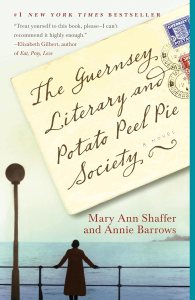

Keyword: MAIL | “The Guernsey Literary and Potato Peel Pie Society” by Mary Ann Shaffer and Annie Barrows

Ms Clara Smartest began the session summarizing the story of the book: “The author tells the story through the letters that are being exchanged between the main character, Juliet Ashton, and the other characters. Juliet is a writer and, naturally, she loves books. She is on a book tour when she receives a letter from a man living in one of the islands of the English Channel. He is contacting her about a book that used to belong to her. Conversation gets going and Juliet learns about an intriguing book club created unexpectedly during the Second World War. The letters are exchanged shortly after the war has ended and emotions are still running high.”
“It is easy for us nowadays to look back at that time and criticize what people did, during and after the war. I mean, common people. They were living in uncertain times and in fear. No one had any idea when the war was going to be over and they wanted to survive. Some tried to have fun and live to the fullest, without being concerned about the consequences. After all, they could be dead the next day. Others did what they had to do to feed themselves or their loved ones, especially feeding children”, said Ms Johanna Practicewell.

“Very true. But there were also very bizarre episodes as well. I think the book aims to focus on the funny ones, instead on the horror people were living in. In this case, the author focused on how creative people had to be just to be able to live their lives. Hence, the way the book club was created and, especially, its name”, said Miss Amelia Matterfis.

“And how they tried to encourage people by making fun of the war, kind of, like Juliet was doing with her books”, added Miss Martha Lovefeelings.

“The novel also shows how ‘fun’ was hand in hand with tragedy and loss. The story of the child is an example”, said Ms Johanna Practicewell. “That happened a lot. Sometimes the children were the result of love, but sometimes were the result of rape. In both cases, women were labelled as the enemy whores.”

“On the other hand, there were caring communities, whose members would protect the other members when something bad would happen to them. It is the case in this story”, said Ms Abigail Vooght. “Although, I think this is very rosy… Reality probably was crueller.”

“I had no idea that Guernsey had been occupied by the Nazis”, said Mr Matthew Barnepy. “Actually, I didn’t even know that island existed. And it is even more astonishing the fact that it is situated not far from the French coast, but it is in fact British. Occupying it should have made sense as it was a strategic location.”

“My surprise was the way the story was written: through letters. I didn’t even know that you could write a book like that, but then again, why not, right?”, said Mr Jeremy Toughready and laughed.

“It was a very popular genre in Jane Austen’s time. Actually, Jane Austen herself wrote a book using that technique, but she didn’t like it very much, so she dropped it”, informed Mr Mark Mindhearting.

“Wow. I had no idea”, said Mr Jeremy Toughready and many others agreed with him.

“Now, we can perhaps wonder if at that time the mail was that efficient. Naturally, it was more important than it is today. These days, we communicate digitally and the post offices deal more with packages than with letters. However, the war had destroyed most of what societies provided to the population. The mail never stopped being delivered (and a word of appreciation to all those who have succeeded in this great achievement), but may have not been so regular and not so fast”, added Mr Mark Mindhearting.

“I’ve watched the film”, said Sophia Vooght. “It was really good. In the film we can actually see a little clearer the brutality, but also how people would find ways to enjoy themselves, together, as a community. And to support one another, facing that horror. I can’t imagine what must have been like to see the Nazi army marching through the streets all of the sudden.”

“The love story is also interesting, isn’t it? I mean, they started writing to each other and then they fell in love… As a writer, Juliet was in her element, and Dawsey, the shy book worm, also found a way to express himself”, said Miss Martha Lovefeelings. “Plus, there’s the kid who found adoptive parents.”

“A nice story with a happy ending”, noted Leo Weave.

“But all traumatised, one way or the other”, added Ms Johanna Practicewell.

“War is always an awful thing. Even the positive, isn’t really, because it’s tainted by horror”, said Mr John Booklish, wrapping up.


** YOUR WORDS AND IDEAS **

By Isabella Muir | On 06 June 2025 at 07:59
Thanks so much for the excellent summary of the novel. I haven’t read the book, but I have seen the film several times. The story shines an important light on how dreadful it must have been for the people of Guernsey to suffer Nazi occupation for five long years. The story also highlights the threat of starvation that the people suffered, a threat that was only relieved when a Red Cross ship arrived with food supplies – but not until December 1944./p>

By Words in Ideas | On 06 June 2025 at 18:10
Thank you for pointing that out. Actually, that is related to the name of the book club. The film is really good and, although the book provides more details, it is very faithful to the book.


World domination

Thucydides is considered the “father” of history because of his book “The History of the Peloponnesian War”, which he wrote in the 5th century. Besides describing the war itself, in which he was an active participant, he also describes the context and behind-the-scenes political manoeuvres, portraits both sides of the conflict, and makes other considerations. The book is not finished, but the story of this war is known. In a nutshell, the Peloponnesian War was a conflict between a declining power (Sparta, home of the famous 300) and an emerging power (Athens). They were both fighting for world domination, which, in this case, was Greece.

Graham Allison studied Thucydides’ book and compared what was written there with other similar conflicts. Then, he coined the term “Thucydides’ Trap” to explain the phenomenon theoretically (which is to say, academically). His goal was to understand how the rising of China could impact the world and lead to a war with the USA. The conclusions…


Subscribe to continue reading

Subscribe to get access to the rest of this post and other subscriber-only content.

“Looking back into the future”, by Isabella Muir

I’ve been looking back as a way of looking forward! Studying history is a useful way to reflect on the past, to discover lessons that may be learned to prepare ourselves for the future. The more I look back, the more I can see that so many world events recycle themselves in a never-ending repetition of gain and loss.
My personal fascination with history is in events that affected Britain during and after the Second World War, and the more I learn, the more I see a familiarity in the arguments being posed today about the way forward for our increasingly fractured world.
But for now let’s focus on the 1960s, when more than a decade after the end of the Second World War, Britain was still reeling from the loss of life, the devastation, and the underlying fear that such hard-earned peace might be short-lived.
The sixties brought with it a generation of youngsters who believed they could put the past behind them and surge forward to a better life. Social and political attitudes began to change, with significant events acting as forerunners of even greater change.
I explore some of those changes in a series of fictional stories, entitled the Mountfield Road Mysteries where we meet some tenants who come to live in a tiny bedsit at Number 1, Mountfield Road, in the Sussex seaside town of Hastings. The tenants have little in common, except for their decision to rent a room from a certain Mr Humphrey, a landlord who is a stickler for traditions and protocols that were fast disappearing.
The first book in the series, Storms of Change [external link], is set in 1960. We meet Marcus Chase, a young man keen to throw off the constraints of his childhood and teenage years, breaking free from his home in London and moving south to Hastings.
He meets Fred and Gilly Barnes, the couple who rent the flat below, and is soon absorbed by their tales of adventure, impressed by their carefree attitude to life. But like everything in life, all is not as bright as it would first appear…
One year on, in Whispers of Fortune [external link], we meet Sally Hilton, a young woman who is certain 1961 could be her year.
‘You can be whoever and whatever you want to be,’ are her mother’s words to Sally throughout her childhood. But Sally doesn’t know who she wants to be. That is the problem.
When the thirty-fifth President of the United States is elected to office, Sally Hilton is worrying about the ladder in her stockings. It’s her only pair and needs to last until payday on Friday. In his augural speech, John F. Kennedy promises significant change to his fellow Americans. In Britain, the sense of euphoria is contagious. If not us, then who? If not now, when? Powerful words spill out from the skilled orator, and Sally Hilton, with her laddered stockings and empty purse, wants to believe they will make a difference. Change is coming, not just for Americans, but for the ‘free world’, whatever that means.
Then Sally notices a card in the newsagent’s window. It feels like a sign…
In the third book in the series, Flashes of Doubt [external link], we meet William Arnold. Forced into retirement, having to leave his cosy cottage and move to a tiny bedsit in Mountfield Road, Hastings, William Arnold wants nothing more than to remember the past, a time when he understood the world, when he had a role to play, a purpose. Then William meets sixteen-year-old Peter, a young lad who challenges William to revise his thinking completely…
The 1960s was a decade when young people were finding their voice and older people were struggling to come to terms with the newly defined ‘generation gap’.
Some say the ‘swinging sixties’ really took off in Britain in 1964, the year that saw the Beatles rise to international fame, but it was 1960 when the group first got together, playing sessions in the now world-famous Cavern Club in Liverpool by 1961. An explosion of talent emerged during the next few years, with a host of pop and rock artists, many whose music is just as popular today.
Mary Quant, among others, transformed the way young people dressed, as interior designers, such as Terence Conran, transformed the way many people furnished their homes, offering contemporary furniture at affordable prices.
As well as music and fashion, the growth of consumerism and the widespread availability of labour-saving devices meant people had more leisure time to enjoy.
It was also the decade when car ownership took off, with estimates suggesting the numbers of people owning cars rose during the decade from around nine million to fifteen million. Thinking back to my childhood, I recall so few cars passed by our house there was no danger for me to cross the road on my own at the tender age of eight. And yet, that same road now sees tens of thousands of vehicles pass along it every day, with young and old taking their life in their hands should they decide to venture from one side to the other.
A typical 1960s house was difficult to heat, with windows that let in as much of the weather as they kept out. Central heating hadn’t arrived for most families, leaving them with few options – a coal fire (with coal being an expensive commodity), a two-bar electric fire, which would eat up any money being put into the meter, or a paraffin stove with its fumes.
Young people had grown up in the shadow of war, with new threats being posed by the Cold War and growing tensions between the East and West. National Service was still in place, an experience that brought up conflicting emotions for many young men. What was right and what was wrong when it came to conflict? There were no easy answers then and many would say, there are no easy answers now.
With the threat of nuclear armaments circling, many young people joined the peace protests taking place across Britain. The term ‘teenager’ only entered into common usage in Britain during the 1950s. Around that time young people started to find their voice, with two distinct groups emerging: beatniks and teddy boys.
Both groups were strongly influenced by American music, Teddy Boys loving rock and roll, wearing long, draped jackets, and sporting the kind of hairstyle worn by Elvis Presley with his slicked back quiff, all kept in place with plenty of Brylcreem. Beatniks, by contrast, wore duffel coats and berets, long hair and preferred jazz. The ‘beat generation’ was said to have been inspired by writers such as Jack Kerouac, among others. Reacting to the experiences of the Second World War, this was a movement that sought to promote peace. Later in the sixties, the ideals promoted by beatniks were taken forward by another aspect of the counter-culture of that period – the hippies.
Both groups frequented coffee bars, vying over the jukebox. In the 1950s and 1960s, coffee bars were popular meeting places for teenagers. They were often the setting for live music, as well as the ubiquitous jukebox. Skiffle music was popular at that time, a type of jazz and blues-influenced folk music that was the precursor to British rock ‘n’ roll.
British teenagers made coffee bars their own; they were a cheap place to ‘hang out’, after all, coffee had no legal age limit. It’s said that London’s most famous 1950s coffee bar – the ’21s’ – famously launched, among others, Tommy Steele and Cliff Richard. In Liverpool, the Jacaranda club in Slater Street was a haunt for the Beatles in their early days, while Cilla Black waitressed at the Zodiac coffee bar in Duke Street, another musicians’ favourite.
Many women in their middle years who survived the Second World War came to realise they could achieve more with their lives than previously imagined. With so many men away fighting, women had taken on vital roles as mechanics, engineers, air raid wardens, bus and fire engine drivers. They took on dangerous work in munition factories and helped to build ships and aeroplanes. The end of the war brought an enormous change for them, as well as for the men who returned from the front. Attitudes had shifted, new horizons had opened up, and the years that followed confirmed that nothing would be quite the same again.
Aside from the changes that a strengthening youth culture brought about, Britain began to see the problems brought about by intensive farming, with nature beginning to suffer. Alongside the rise in car ownership, new towns were built where there was previously agricultural land. How much consideration was being given to the environment? We see the longer term effects now, with our loss of wildlife habitats and the very real fears about climate change.
Across the world, in China, as part of Chairman Mao Zedong’s ‘Great Leap Forward’ initiative that ran from 1958 to 1962, the Chinese people were ordered to eliminate rats, flies, mosquitoes, and sparrows. The order came as the authorities decided that these ‘pests’ were damaging crops and the sparrows were eating too much grain. Over that period some one billion sparrows were killed, including the total population of tree sparrows. However, it seems the Chairman’s plan would backfire. The sparrows were a vital part of the Chinese ecosystem, as well as eating grain, sparrows ate locusts. Without the sparrows the locusts flourished. By 1960, locusts decimated the rice crops, resulting in one of the worst man-made famines ever experienced. The exact numbers of people who died during the famine is unknown, but it’s suggested that it was between twenty and forty million people. It’s certainly a reminder that tampering with nature will inevitably create problems for our whole ecosystem, mankind included.
I will continue to explore the past, to learn from the good and the bad, and above all, continue to hope for a positive future. •

Isabella Muir [external link] writes novels, novellas, and short stories about post-Second War World Britain and she runs an independent publishing company, Outset Publishing. Some of Isabella Muir’s books are translated into Italian [external link] and Portuguese.


Keyword: WAR | War’s Propaganda

In 1622, the Sacred Congregation for Propagation of the Faith (known as Propaganda), was established to regulate the work of missionaries. Their mission was to spread the word of the (Catholic) Lord to the entire world. It was not always peaceful and the word was sometimes more imposed than spread. The term Propaganda evolved to mean “the spreading of ideas, information, or rumour for the purpose of helping or injuring an institution, a cause, or a person”. Nowadays, it pretty much means making people believe in ideas or false information for a certain purpose. The difference between propaganda and marketing (or advertising) is the aim. The first aims to make people believe in governmental lies for political purposes, the second aims to make people believe they need to buy products or acquire services they don’t really need.

War is an especially fertile ground for propaganda. Governments need to make people believe that war is absolutely necessary and, thus, they twist the facts or simply lie about them. Arthur Ponson was a Member of Parliament in Great Britain and he was one of the few who stood against the participation of his country in World War I. In truth, he spent his life advocating for peace and he was even physically and psychologically attacked because of it. In 1928, he published the book “Falsehood in War-time”, where he stated at the beginning of the introduction:

      Falsehood is a recognized and extremely useful weapon in warfare, and every country uses it quite deliberately to deceive its own people, to attract neutrals, and to mislead the enemy. The ignorant and innocent masses in each country are unaware at the time that they are being misled, and when it is all over only here and there are the falsehoods discovered and exposed. As it is all past history and the desired effect has been produced by the stories and statements, no one troubles to investigate the facts and establish the truth.

In this book, Arthur Ponson exposes the lies told by governments during the World War I. Based on this, in 2001, Anne Morelli summarized his work and published the book “The Basic Principles of War Propaganda” *. She explains each Principle and gives examples from other wars that took place after World War I, showing that the same techniques are still used today. This is also confirmed in a documentary from Spiegel TV called “Fake War”, under the perspective of the use of mass media in war propaganda. The first episode is about World War I and mentions some of the false events described by Arthur Ponson.

Before World War I began, photography was used to complement articles published in newspapers. Film, which had been discovered by the end of the 19th century, was also used for the first time for propaganda purposes. Staged scenes of atrocities carried out by the enemy served Principle #3, showing the enemy as evil and full of heartless creatures. It also prepared the population for war. In fact, the British Government had created the first (secret) propaganda department with the aim of conveying false information in a way that looked objective and true. The target was the Germans and the Germans failed to properly respond to this campaign. However, years later, the Nazis took propaganda to another level. Inspired by the corporation advertising, the Minister of Propaganda conceived a coordinated plan using newspapers, photography, radio and film to influence the minds of the German population (they also tried to influence foreign countries, but failed), feeding them with lies and manipulating their thinking.

In the Vietnam War, the situation was reversed. There were no restrictions on journalists’ movements and there was not any kind of governmental censorship. This did not mean that the USA Government had given up on official propaganda. By this time, television was widespread throughout the world and journalists were no longer limited to written articles, outdated photos, and staged films. The problem was that the lies conveyed in official statements were being systematically debunked on a daily basis by the images that were shown on television and by the photographs that were published in newspapers. The discrepancy between these images and the official statements was considerable, which resulted in huge demonstrations and protests in the USA.

This was a lesson that the USA learned very well. In the Gulf War and in the Iraq War journalists were no longer authorized to go to the front line and they had no information on what was actually happening. This time, all the Principles were successfully applied. Both the general public and the journalists were fed with lies they could not dispute. Therefore, the war looked perfectly justifiable. It was only later, when the USA finally left Iraq, that journalists were made aware of the consequences of the US invasion and all the atrocities committed.

The Internet, especially social media, is making it increasingly difficult to control information. Yet, it is also making it increasingly easier to spread false information. Nowadays, propaganda is more than ever being confused with authentic information, even when it is proven to be false. Furthermore, there is this idea that propaganda is something that is only produced by the other side. People from “the other side” are the ones who are being brainwashed. Those in “our side” who disagree with what is said about the other side are liars and traitors. If we look closely, this is Principle #10.

As Aeschylus, the Greek and so-called father of tragedy, said: “in war, truth is the first casualty”.


* The 10 Principles are:
1. We do not want war.
2. The opposite party alone is guilty of war.
3. The enemy is inherently evil and resembles the devil.
4. We defend a noble cause, not our own interests.
5. The enemy commits atrocities on purpose; our mishaps are involuntary.
6. The enemy uses forbidden weapons.
7. We suffer small losses, those of the enemy are enormous.
8. Recognized artists and intellectuals back our cause.
9. Our cause is sacred.
10. All who doubt our propaganda are traitors.


Keyword: WRITER | Ernest Hemingway

Instead of going to study in a university, Ernest Hemingway preferred to go and work in a newspaper as a journalist, where he learned how to write objectively and to-the-point. Then, before turning 20 years old, he tried to be recruited by the army to go and fight in World War I. As he was refused, he found another way to be involved in the war: as a driver for the Red Cross. He was injured in the war and, after spending a long time in a hospital and being rejected by the nurse with whom he had fallen in love, he returned to the USA. These events forged his whole life.

As a journalist, he went back to Europe many times as a foreign correspondent. He was stationed in Paris, France, for some time, but Spain was his favourite country. He covered the Spanish Civil War and World War II, when he landed in Normandy with the American troops on D-Day. In the meantime, he went to Africa to do a hunting safari and bought a boat to go fishing. He lived life to the full, survived wars and plane accidents, and travelled extensively, soaking everything and turning it into masterpieces, before he died in 1961. He had been born five months before the 20th century started and witnessed all major (and terrified) events of the century.

Deep inside, he saw himself as a writer. Reporting was a way to achieve this (and make some money) and all his adventures were food for his novels and short stories. He wrote them in a style that was innovative at the time and had been inspired by his reporting: objective, without sentiment, with short sentences and without adjectives and adverbs. His mastery was in the rhythm of the words. Besides inspiring many subsequent writers, he was awarded the Pulitzer Prize and the Nobel Prize, mostly due to his best work, named “The Old Man and the Sea”. This was the last work to be published while he was still alive and it is considered his best work. It tells the tale of a fisherman that goes fishing and his struggle to catch a fish. The story is very simple. It’s in the way it is written, what it tells and what it implies, where genius lies. However, other books written by Hemingway are as good (or, at least, almost).

“A Farewell to Arms” is a vivid description of his experience in World War I and aims to show the reader how war is in reality. It is heavily based on his own experience. The main character drives ambulances like he did and he falls in love like Hemingway did. Although the descriptions of the war are authentic, the romantic connection is not (maybe he wrote what he wanted to have happened).

Also about war, but this time in the guerrilla point of view, “For Whom the Bell Tolls” is about an American who joins the Spanish resistance during the Civil War. It’s an intense account on how it is like to face death on a daily basis. These fighting men and women live lifetimes during short periods of time, living each day as if it could be their last, which would prove to be correct in most cases.

Inspired by his time as a foreign correspondent stationed in Paris, “The Sun Also Rises” (or “Fiesta”) is about how young people got lost after World War I ended. Starting in Paris, the narrative takes the reader (via characters) to Spain and the bullfighting, an event very dear to Hemingway’s heart. They also go to the south of France and Madrid, roaming from place to place without purpose and without feeling.

Those who wish to know how Hemingway’s hunting safari was, can read “The Green Hills of Africa”, his journal of the journey. However, if you don’t want to know details of chasing and killing animals, skip it. In any case, it is a beautiful view of the Africa landscape, and an insight on how humans can preserve (or destroy) nature.

Sources:

Keyword: DECEIT | “Fatherland” by Robert Harris

What if Hitler had won the war and succeeded in achieving his terrible plans?

The story of “Fatherland” starts in 1964. Preparations are ongoing for a glorious celebration of Hitler’s birthday. We are presented to Nazi Berlin and its grand new monuments built in honour and to serve the new regime. In the meantime, a body is found and Xavier March is called to investigate it. He is a regular German policeman who is not very happy with his job. His lack of enthusiasm with Nazism leads his colleagues to avoid him and his family to desert him. That’s the reason why it is Xavier March investigating the murder; everyone else is too busy with important things: the celebration of Hitler’s birthday.

The case is deemed unimportant, but soon he realizes that it is not an ordinary murder. During the course of the investigation, he meets a foreign journalist who tells him disturbing things about the regime, something about massive murder in concentration camps… At first, he does not believe her, but he keeps on thinking about what she said and tries to uncover the truth.

Robert Harris tells the story from the point of view of a regular person, fully integrated in the system, but one that can pay attention to what lies beyond. As a “normal” person, he believes in the Nazi propaganda, partly because he has no reason not to. After all, there are no other sources of information. When he meets a foreign person, with information unavailable in his country, he starts questioning everything. What she is telling is too unbelievable. He doesn’t even comprehend it. However, he starts thinking, connecting the dots… and he goes on investigating although he is not allowed to do so. The investigation puts his life in danger, but he pushes forward. Until, one day, he discovers the horrifying truth.

The book is based on the fact that the German population was completely unaware about the concentration camps and portraits how people were required to comply with the regime. Those who did not were sidelined, maybe even arrested by the Gestapo and tortured. Eventually, they were killed. Even those who would comply could be killed anyway. No one was safe and people would do anything to survive.

As a former journalist, knowingly or not, Robert Harris shows how important free press is, to investigate in depth and denounce all wrong doing of the State, regardless of the regime. Authoritarian regimes want their populations to be kept in the dark, and be ignorant. So, they feed people with propaganda and they force them to be part of organizations where they can mould their brains. We can see this in Xavier March’s son. He thinks he is doing the best he can do for his father, believing his father needs to see reason. He doesn’t know better, but he should.

The role of the American journalist is the opposite of Xavier March’s son. She represents the free press that investigates and denounces. She shows the truth and how it is important for people to be informed.