
 Words in Ideas website was launched on March 3rd, 2024 with a single purpose: to understand the world through the meaning of words. Human societies are based on language and language is based on the cultural background and the geographical region where it was born and/or evolved. The same word can have different meaning due to the different evolutionary path it has taken in a different geographical region. For example, English was born in England, but it has taken different evolutionary paths in Australia, in the USA, and in all other countries which were under the United Kingdom administration at some point in history. Likewise, Latin evolved differently in Italy, France, Spain, Portugal, and Romania, but it also influenced other languages, like English.
Words can clarify and they can deceit. Going back to the source and analysing its evolution was the challenge Ana Catarina Palma Neves, the author of this website, proposed herself. The articles were based on three main components: a book chosen according to a keyword, the analysis of a specific word, and the cultural background of a concept, every month. The first two years (2024 and 2025) had different approaches and 2026 has currently taken another avenue.
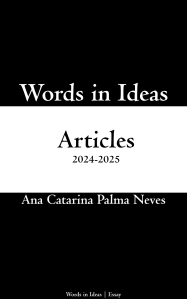
To celebrate the third year of existence, a compilation of articles related to the word meaning and the cultural background components was made and published in the book “Words in Ideas: Articles 2024-2025”. Online, some articles are available to the general public and some are only available to subscribers. In the e-book, you can read them in a sequence (or randomly) without restrictions.
Where is the e-book available?
- Search at BAKER & TAYLOR
- Search at BORROW BOX.
- Search at CLOUDLIBRARY
- Search at GARDNERS
- Search at ODILO
- Search at OVERDRIVE
Read the book, check the website.
 WORDS IN IDEAS