Best of “Foreign Lands”

Dear Readers,

After renewing its website, “Words in Ideas” is preparing its 3rd year of fresh new articles, starting in October. While you wait, you can read (or re-read) the best articles under the category “Foreign Lands”. These articles aim to compare languages and cultures.


During the first year, articles described some traditional food around the world. Here are the 5 best:


In the 2nd year, we followed the discoveries of a group of language learners. Here are the 5 best:


This 3rd year, “Words in Ideas” will discuss some cultural crossroads.

 
If you wish to comment or send suggestions, please fill in the form at the end of each website page.

Thank you!
Words in Ideas
https://wordsinideas.com/
 

Best of “The Intrepid Book Society”

Dear Readers,

After renewing its website, “Words in Ideas” is preparing its 3rd year of fresh new articles, starting in October. While you wait, you can read (or re-read) the best articles under the category “The Intrepid Book Society”. This “Society” is a fictional book club, analysing a book per month according to a keyword or a key place.


During the first year, articles were written as reviews. Here are the 5 best:


In the 2nd year, fictional members discussed the plots between themselves. Here are the 5 best:


This 3rd year, “Words in Ideas” will test your knowledge (or, hopefully, making you curious in reading) the book of the month.

 
If you wish to comment or send suggestions, please fill in the form at the end of each website page.

Thank you!
Words in Ideas
https://wordsinideas.com/
 

The religion, la religion, die Religion, la religión

“So, ‘religion’ comes from the Latin (what a surprise!), meaning ‘scrupulous, conscience, honour and loyalty’. This means that it was a kind of moral conduct that people would follow by worshipping God”, said Jack. “During prehistoric times, there were many deities, God and Goddesses, each one representing a natural phenomenon, a quality, or an activity. For example, there was a God for thunder, a Goddess for beauty, a God for war, and a Goddess for hunting. Later, it emerged other religions that focused on only one God. Religions tend to personify the gods, representing them as if they were human beings, so people can identify with them and better understand the message being conveyed”.

“Whatever the religion you choose, you need to have faith, which basically is a belief in something for which there is no proof”, said Sophia. “Latin-related languages distinguish between ‘faith’ and ‘belief’, but German and Nordic languages don’t.”

“That’s interesting. Why is that?”, asked Elizabeth.

“I don’t know, but this reminds me of the war between the Roman Catholic Church and the Protestants. Protestant countries were the ones where there is no distinction. Maybe they are not very keen on believing in things without some kind of rationale”, said Sophie, shrugging her shoulders.

“Did you know that ‘Carnival’ was a big feast that Catholics would hold before the 40 days of penitence and fasting until Easter? They took the opportunity of that day to eat and drink as much as they could (especially meat) to endure the sacrifice that was coming”, said Jack.

“Fasting was only mandatory for those who couldn’t pay the fee to skip those duties…”, noted Elizabeth.

“Speaking of Christianity, when Jesus was alive, ‘bible’ designated a set of books that were bound together. I guess the other ‘bibles’ were lost or the term was glued to the importance of the book we now call the Bible”, said Michael. “It is interesting that the term has evolved to another meaning in slang language. When we want to say that one specific book is the foundation of a specific field of study, we call it the ‘bible’ of that field. For example, some say that the bible of economics is the famous book ‘The Wealth of Nations”, by Adam Smith”.

“Speaking of evolution of terms”, said Leo, smiling to Michael, “temple, as we all know, is the physical place where religious people worship God. Muslims worship Allah (that’s how they call God) in Mosques. Well, ‘mosque’ comes from the Arabic word masjid, which means ‘temple’. Minaret is the tall tower, which is part of the Mosque. The purpose of the tower is to call the congregation to pray. Catholic Churches have bells. The Muslim call for prayer is made by the Muezzin, who is the person who ‘sings’ at the top of the Minaret. They now have loudspeakers, so the Muezzin doesn’t need to go up there anymore. However, the Muezzin is not just anyone, he is chosen especially for that task due to its ‘singing’ qualities. Yet, he undergoes specific training after being chosen”.

“All Mosques are oriented towards Mecca because that’s where the Kaaba is located. Every Muslim is obliged to make a pilgrimage at least once in their lifetime to walk around the Kaaba. This pilgrimage is called Hajj. The Kaaba is a huge black cube with nothing inside. It is a symbol”, added Elizabeth.

“When Muslims and Catholics were engaged in war centuries ago, Muslims called ‘infidel’ to Catholics, and to all who didn’t share their faith. Catholics called ‘heretics’ to everyone who didn’t believe in their God“, added Jack.

“According to Statista, in 2022, Christians represented 31.6% of the world population and Muslims 25.8%. The third biggest religion is Hinduism, representing 15.1%. Hinduism is the oldest religion still in existence and it is practised mainly in India. At the beginning, there were no formal rituals or organization, just a set of written documents, now dated thousands of years”, said Sophia.

“A kind of ‘bible’, then”, commented Elizabeth.

“The religious teachings were called ‘doctrine’, especially those from the Catholic Church”, said Jack. “Nowadays, ‘doctrine’ can be used in other domains such as politics, the law, or military”.

“Anything to do with ‘doctor’?”, asked Elizabeth, laughing.

“Well, actually, yes. ‘Doctrines’ were taught by ‘doctors’”, replied Michael, looking at his computer. “This word comes from Latin and it then meant ‘teacher’. At the time, a ‘doctor’ was an eminent scholar specialized in a field of study. Nowadays, a doctor is someone who has a PhD, which, in a way, meets its original meaning.”

“Ok, this is interesting”, said Leo, looking at his computer. “The word ‘sin’ comes from Old English, which is similar to another word that comes from Old German. Probably, it is a similar word in German and in Nordic languages. However, the English language has a word that comes from Latin and it is similar to the word for ‘sin’ in Spanish, Italian, French, and Portuguese. You may have never heard of it, but you have surely heard the word ‘impeccable’, which means ‘flawless’. If ‘sin’ is something that goes against the laws of God, ‘impeccable’ is following the laws of God to the letter”.

“We could be here for a week talking about words related to religion and everyday words that come from a religious background. Unfortunately, it is time to go”, said Jack and everyone prepared to leave.


** YOUR WORDS AND IDEAS **

By Isabella Muir | On 26 May 2025 at 14:45
It’s fascinating to see the way so many of the topics you choose for your articles seem to mirror the topics of my studies. Just last week we were exploring the way that ‘religion’ is dealt with in historical research, and the difficulties with bias and subjectivity. Your article highlights the complexity of meaning – which is in itself full of subjectivity, as well as historical implications! What fun!

By Words in Ideas | On 27 May 2025 at 16:44
Yes, I think they are two fascinating and complementary perspectives: history and language! Combining the two gives new leads on what the future may be?

 

Keyword: RELIGION | God or no God, is that the question?

God is a supreme being that is above all other beings. Religion is a system that sets the rules for worshipping God. It is possible to believe in God and not follow a religion such as it is possible to follow a religion without really believing in God. Religions are social spaces that give people a place of belonging and an identity in society. Being part of such a community and following its rituals bring a sense of security and stability that is important for mental well-being.

Although nationality and religion are two separate concepts, religion is so deepened and entangled in a country’s identity that many people think religion is part of the national identity. However, even in religious countries, there are nationals who choose a different religion. This is the reason why Article 18 of the Universal Declaration of Human Rights states that people have the right of freedom of religion, including change of religion.

Before there were states with full sovereignty, people belonged to borderless communities, for example, tribes or clans. Some of these communities were bonded by blood, which was strong enough to keep the community together. Family is still very important nowadays and loyalty to the family is deemed paramount. Yet, people sometimes would change families due to marriage, due to orphanage (they would be adopted by a different family), or due to some other reason. Besides, different family members could have different ideas about the future of the community.

Religion was (and it is in some cases) the glue that would keep the community together, especially in the case of communities not bonded by blood. In a time when science was not very developed, religion gave the answers; when there were no therapists, religion provided mental support; when there was no humanitarian aid, religion helped people in need. In return, religion would demand loyalty and exclusivity, exercising its power by making people believe in dogmas, making threats and even terrorizing them. If someone would “sin”, God would punish him/her, religion would state. If someone would neglect the Church, God would destroy him/her crops. And if someone would change religion, he/she would be cursed forever.

Ritual ceremonies are designed to anchor believers to the Faith. Besides having a social component that helps people bond with each other, rituals are important to keep people calm and stable, encouraging them to face and overcome difficulties and challenges. For example, praying is a balsamic action to avoid despair, panic, and the feeling of powerlessness. There are also ceremonies of initiation and milestone achievements, providing a sense of purpose and evolution.

In the name of religion, many atrocities were carried out, for example: the Crusades (Catholics vs Muslims), Inquisition (Catholics against everyone else), the Thirty Years’ War (Catholics vs Protestants). In these examples, the aim was for the Roman Catholic Church to obtain power. Recently, we are witnessing Muslim fanatics carrying out acts of terrorism to gain a foothold on the world stage. There are also some local cults, whose spiritual leaders isolate the community from the world and commit all sorts of crimes. None of this has anything to do with religious purposes. Religion is a peaceful endeavour aimed to help its community.

If in the past it would be difficult to find someone who did not believe in any religion, nowadays it is very common to stumble across someone with no religion whatsoever. Societies today provide structures to support citizens in areas where religions used to dominate. Thus, religion is increasingly seen as an option and not as a duty. However, it is also common to find those who believe in God, but do not follow any religion. And then, there are the agnostics, who have doubts about the existence of God, and atheists, who do not believe in God at all.

Religion is important for believers, but those believers do not have the right to impose their religion on others. Likewise, it is not right to deny a community or a specific person the practice of the religion of their choice. There are different reasons why an individual chooses a certain religion (or no religion at all), family tradition may be the first one. Yet, if someone does not believe in God, he/she should not be judged by those who believe. Faith, in the sense of a “firm belief in something for which there is no proof” is personal: whether you believe or you do not. Non-believers should also not try to convince believers they are wrong. Rational arguments will not work in one way such as emotional arguments will not work in the other way. However, fanaticism of all forms is not religious and should be fought by everyone.


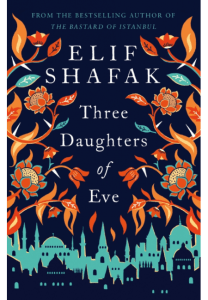
Keyword: RELIGION | “Three Daughters of Eve”, by Elif Shafak

Written by the British-Turkish author Elif Shafak, “Three Daughters of Eve” tells the story of Peri, a Turkish young woman who goes to the UK to study in Oxford. Daughter of an ultra-religious mother and an agnostic father, she witnesses her brothers taking different paths. Her older brother rebels against the system and is imprisoned and tortured, leaving him traumatized for life. Her younger brother follows a religious path, like his mother, with many pitfalls. Peri tries to stay neutral, with tragic consequences. In Oxford, she becomes friends with two young women from other Islamic countries, with different attitudes towards religion. She also meets Professor Azur, hoping he could help her with her questions about God, but instead that path leads to a scandal.

“I don’t know much about Turkish society, but, from what I gather from the book, it seems there is a great divide between those who fiercely defend the religious regime and those who fiercely fight it”, said Ms Clara Smartest.

“It seems there are a lot of problems in Turkey. The opening scene is told with many notes. I guess it is for the readers who are ignorant about Turkey to understand exactly the meaning of that scene within a bigger picture. There are other scenes taking place in present-day Istanbul that contribute to show us the bigger picture”, added Mr John Booklish.

“The family scenes are very insightful, too”, noted Miss Martha Lovefeelings. “A marriage was destroyed due to religion. The woman has become increasingly religious and the man stopped believing in it. At some point, they were no longer talking to each other”.

“That was reflected in their children”, said Ms Clara Smartest. “One was influenced by the mother, the other was influenced by the father, and the daughter was caught in the middle. She found a way to flee and went to the UK, only to find the same problems she was trying to escape”.

“I don’t think she was trying to escape. I think she was trying to find answers. She was very confused and enrolled in Professor Azur’s class to clarify those questions, in vain”, said Mr Jeremy Toughready.

“It’s interesting to see the different perspectives women have on religion in Islamic countries. Shirin is Iranian and she doesn’t believe in religion. You can say she turned into a true Western person. Mona is an Egyptian-American true Muslim and likes to use the scarf on her head. Mona talks about the prejudice people have about her choice. If women should dress the way they want, women that want to wear the scarf shouldn’t be criticized. Actually, at the beginning of the 20th century, it was unthinkable for Europeans to leave their houses without a hat on their heads, men and women. And in the middle of that century, women usually used a scarf on their heads, including Queen Elizabeth II, from the UK. I think this novel puts the question where the question is: how religion can negatively affect people’s lives. It’s not about the scarf, it’s about false beliefs which lead people to hurt themselves and others”, said Miss Amelia Matterfis.

“I agree”, said Ms Johanna Practicewell. “In this case, it was not Mona who hurt the others, it was Professor Azur, who probably is not even Muslim. His twisted vision of the world led to several conflicts and disastrous consequences”.

“Elif Shafak considers herself as Turkish, although she was born in France and lived in several European countries as well as in the USA. Apparently, the time she lived in Turkey was decisive for her identity. Yet, she has a different view from people who have only lived in Europe or from people who have only lived in Turkey. Therefore, she sees Turkish reality from the outside, with inside information. Sometimes, people with these capacities can see things that those fully immersed in the environment can’t see. I believe she intended to show this with her characters. Peri is the one who moves in both worlds and realizes how difficult it is for people to look at things from the other’s point of view, hence all the misunderstandings and the conflicts”, said Ms Clara Smartest.

“It also shows how people can come into conflict with themselves. Peri ended up having the life she was trying to avoid”, said Ms Abigail Vooght.

As usual, the Society’s members discussed the ending and imagined different ways for the novel to be finished. This time, they also imagined different ways to continue the story. Afterwards, they discussed their lives and how religion had or had not influenced them positively or negatively.

“Religion can have a strange effect on people. Those who truly believe in it can’t see a world beyond it and have difficulty in understanding other religions. Those who doubt about the existence of God may spend their entire lives with that conflict, if they come from a background where religion is important. People who don’t believe in religion can also clash with religious people and be pressured to ‘be part of the flock’. Some countries have a religious regime and others don’t, but even those that don’t have a dominant religion. Therefore, the questions presented in this book are relevant for many people”, concluded Mr John Booklish.

“I think this is a perfect ending to our meeting. Before you go, please note that the book for next month is ‘The Guernsey Literary and Potato Peel Pie Society’, by Mary Ann Shaffer and Annie Barrows”, said Ms Clara Smartest.


** YOUR WORDS AND IDEAS **

By Isabella Muir | On 9 May 2025 at 09:10
It certainly sounds like a thought-provoking book and one I should to be massive TBR pile!! :))

By Words in Ideas | On 10 May 2025 at 11:43
It makes us think, indeed! 🙂