
Family is a classic topic of every language learning syllabus. The members of “The Foreign Land’s Explorers” approached it the usual way initially, but they wanted to go further. So, they made a new table with terms related to family, but which were not learned in regular language classes. They built a table, knowing it was just a reference. Each word should not be taken as exact equivalents to the other languages. Once they had the table, they constructed the same sentences in every language, for example: “the spouses become parents and constitute a household with their offspring”.
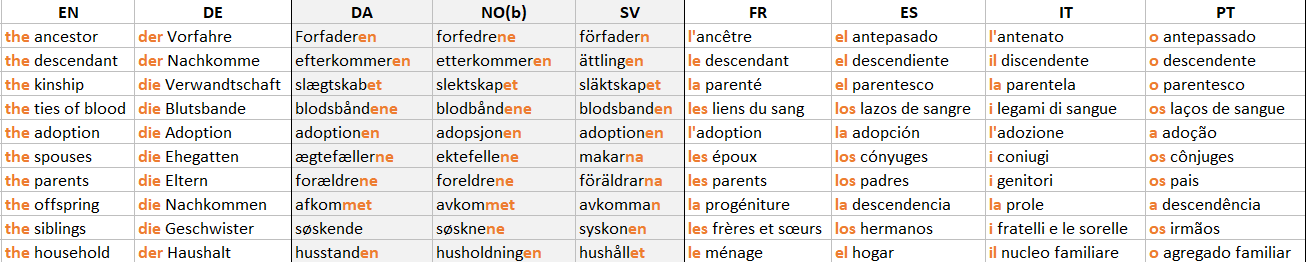
“Ah, ‘offspring’ in Italian is ‘prole’”, noted Leo. “Did you know that ‘proletariat’ comes from the Latin word ‘proletarius’, which means someone belonging to the lowest (and poorest) class that would only be considered as ‘citizen’ if they had children? I guess ‘children’ here would mean labour force or soldiers. Therefore, ‘prole’ in Italian comes directly from the Latin word meaning ‘children’”.
“Sometimes people don’t realize how much Latin language has influenced European languages, all of them”, said Elizbeth. “For example, ‘adoption’ is similar in these languages and comes from the Latin word ‘adopto’, which is the combination of ‘ad’ and ‘opto’. ‘Ad’ means ‘to’ and ‘opto’ means ‘choose’. So, basically ‘adoption’ is ‘to choose’”.
“I may be wrong, but it seems that word is the only word here in the table to come from Latin in what German, Danish, Norwegian, and Swedish are concerned”, noted Sophia. “Interesting that ‘offspring’ in Nordic languages is ‘of coming’. Well, in English it has a similar meaning: getting out of where they were made. Like the rivers that leave the place where they were ‘born’ and run until they reach the sea. They ‘come’ from somewhere.”
“Knowing where you come from has always been very important. Look at Royal families. Being part of a Royal family can determine if you will lead the country or not, whether you want it to or not”, said Elizabeth.
“Some Kings have renounced the post, so it’s not inevitable. But, yes, for them, it is something that is always there, since childhood. And they are also pressured to have a ‘prole’, a male heir to the throne and some ‘spare’ male children, just in case something happens to the oldest. It’s not exclusive for poor people, although it is different, of course”, added Michael.
“Poor people provide the labour force in sequence. Rich people build dynasties to rule the poor people. It is the system of castes. Once you are born in one, you have to play your role regardless of your wishes”, said Elizabeth.
“That is not entirely true nowadays”, said Sophia. “Royals can now marry commoners and commoners can aspire to climb the social ladder”.
“Dynasties still have weight in society. Being a son or a daughter of an important family is always a mark, even if that person follows a different path”, said Michael.
“Ok, remember I told you that we use more Latin-based words than we realize? Well, I checked the word ‘dynasty’ and it is actually a Greek word, although it was stolen by the Latin language’”, said Elizabeth.
“Let me see”, said Michael, looking at her computer and starting to read. “It says that a dynasty is ‘a succession of rulers of the same line of descent’ and it gives China as an example. Then, it says it can also be ‘a powerful group or family that maintains its position for a considerable time’. It meets what we were saying, I think”.
“Royal families are a reference. They are a symbol of continuity, tradition, and identity”, said Sophia. “That’s why they are so important for people. People see them as the leaders of the nation. It’s no coincidence that the countries’ history timeline is told through dynasties, especially in China. They say ‘this was done during this Dynasty’. For example, the Great Wall of China was constructed during the Ming Dynasty. You need to know when they ruled to know the respective period of time. In Europe, you talk about epochs, like Ancient Times, Medieval Times, Renaissance.”
“Well, in Europe, history is also made of dynasties, although they are named ‘Houses’, like in ‘The Game of Thrones’”, said Elizabeth and laughed. “For example, the House of Habsburg was one of the most influential families in European history. In the UK, the House of Tudor is one of the most famous Royal families due to King Henry VIII and his six wives. The current UK’s Royal family is the House of Windsor. And, of course, there were prominent families that didn’t belong to any Royal family, like the Medici, who ruled Florence for many years”, said Elizabeth.
“In the USA, they also categorize their history periods according to presidential administrations: the President Obama’s administration, the President Biden’s administration…”, noted Michael. “Actually, the story of the name ‘President’ is curious. When the USA became independent, they had to choose a name for their Head of the State. ‘King’ was suggested, but they didn’t want to give ideas of grandeur to a man who should be feeling humble. So, they decided to give him the name of ‘someone who chaired meetings’. They thought it was humble enough. Not any more”.
“Well, they also have dynasties of some sort there, like the Bushes and the Kennedys…”, said Leo. “Like the Medici, these families became powerful after they had become very rich.”
“In the end, money rules the world. And, sometimes, the families who have it”, concluded Jack.
** YOUR WORDS AND IDEAS **
By Isabella Muir | On 30 April 2025 at 12:08
Some very interesting insights into the meanings of ‘family’ – a term that has changed significantly over the centuries. Nuclear families (often blood relatives) contrasts with ‘blended’ families, where a wide range of relationships come together. It would be interesting to explore how ‘family’ contrasts with ‘community’ – both can be supportive networks, but both can be just the opposite!
By Words in Ideas | On 01 May 2025 at 21:19
That would be very interesting, yes. “Blended” families is a good term – maybe in future “blended” will replace “nuclear”?…
 WORDS IN IDEAS