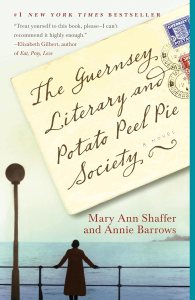
 Ms Clara Smartest began the session summarizing the story of the book: “The author tells the story through the letters that are being exchanged between the main character, Juliet Ashton, and the other characters. Juliet is a writer and, naturally, she loves books. She is on a book tour when she receives a letter from a man living in one of the islands of the English Channel. He is contacting her about a book that used to belong to her. Conversation gets going and Juliet learns about an intriguing book club created unexpectedly during the Second World War. The letters are exchanged shortly after the war has ended and emotions are still running high.”
“It is easy for us nowadays to look back at that time and criticize what people did, during and after the war. I mean, common people. They were living in uncertain times and in fear. No one had any idea when the war was going to be over and they wanted to survive. Some tried to have fun and live to the fullest, without being concerned about the consequences. After all, they could be dead the next day. Others did what they had to do to feed themselves or their loved ones, especially feeding children”, said Ms Johanna Practicewell.
“Very true. But there were also very bizarre episodes as well. I think the book aims to focus on the funny ones, instead on the horror people were living in. In this case, the author focused on how creative people had to be just to be able to live their lives. Hence, the way the book club was created and, especially, its name”, said Miss Amelia Matterfis.
“And how they tried to encourage people by making fun of the war, kind of, like Juliet was doing with her books”, added Miss Martha Lovefeelings.
“The novel also shows how ‘fun’ was hand in hand with tragedy and loss. The story of the child is an example”, said Ms Johanna Practicewell. “That happened a lot. Sometimes the children were the result of love, but sometimes were the result of rape. In both cases, women were labelled as the enemy whores.”
“On the other hand, there were caring communities, whose members would protect the other members when something bad would happen to them. It is the case in this story”, said Ms Abigail Vooght. “Although, I think this is very rosy… Reality probably was crueller.”
“I had no idea that Guernsey had been occupied by the Nazis”, said Mr Matthew Barnepy. “Actually, I didn’t even know that island existed. And it is even more astonishing the fact that it is situated not far from the French coast, but it is in fact British. Occupying it should have made sense as it was a strategic location.”
“My surprise was the way the story was written: through letters. I didn’t even know that you could write a book like that, but then again, why not, right?”, said Mr Jeremy Toughready and laughed.
“It was a very popular genre in Jane Austen’s time. Actually, Jane Austen herself wrote a book using that technique, but she didn’t like it very much, so she dropped it”, informed Mr Mark Mindhearting.
“Wow. I had no idea”, said Mr Jeremy Toughready and many others agreed with him.
“Now, we can perhaps wonder if at that time the mail was that efficient. Naturally, it was more important than it is today. These days, we communicate digitally and the post offices deal more with packages than with letters. However, the war had destroyed most of what societies provided to the population. The mail never stopped being delivered (and a word of appreciation to all those who have succeeded in this great achievement), but may have not been so regular and not so fast”, added Mr Mark Mindhearting.
“I’ve watched the film”, said Sophia Vooght. “It was really good. In the film we can actually see a little clearer the brutality, but also how people would find ways to enjoy themselves, together, as a community. And to support one another, facing that horror. I can’t imagine what must have been like to see the Nazi army marching through the streets all of the sudden.”
“The love story is also interesting, isn’t it? I mean, they started writing to each other and then they fell in love… As a writer, Juliet was in her element, and Dawsey, the shy book worm, also found a way to express himself”, said Miss Martha Lovefeelings. “Plus, there’s the kid who found adoptive parents.”
“A nice story with a happy ending”, noted Leo Weave.
“But all traumatised, one way or the other”, added Ms Johanna Practicewell.
“War is always an awful thing. Even the positive, isn’t really, because it’s tainted by horror”, said Mr John Booklish, wrapping up.
** YOUR WORDS AND IDEAS **
By Isabella Muir | On 06 June 2025 at 07:59
Thanks so much for the excellent summary of the novel. I haven’t read the book, but I have seen the film several times. The story shines an important light on how dreadful it must have been for the people of Guernsey to suffer Nazi occupation for five long years. The story also highlights the threat of starvation that the people suffered, a threat that was only relieved when a Red Cross ship arrived with food supplies – but not until December 1944./p>
By Words in Ideas | On 06 June 2025 at 18:10
Thank you for pointing that out. Actually, that is related to the name of the book club. The film is really good and, although the book provides more details, it is very faithful to the book.




 WORDS IN IDEAS