Best of “Foreign Lands”

Dear Readers,

After renewing its website, “Words in Ideas” is preparing its 3rd year of fresh new articles, starting in October. While you wait, you can read (or re-read) the best articles under the category “Foreign Lands”. These articles aim to compare languages and cultures.


During the first year, articles described some traditional food around the world. Here are the 5 best:


In the 2nd year, we followed the discoveries of a group of language learners. Here are the 5 best:


This 3rd year, “Words in Ideas” will discuss some cultural crossroads.

 
If you wish to comment or send suggestions, please fill in the form at the end of each website page.

Thank you!
Words in Ideas
https://wordsinideas.com/
 

The family, la famille, die Familie, la familia

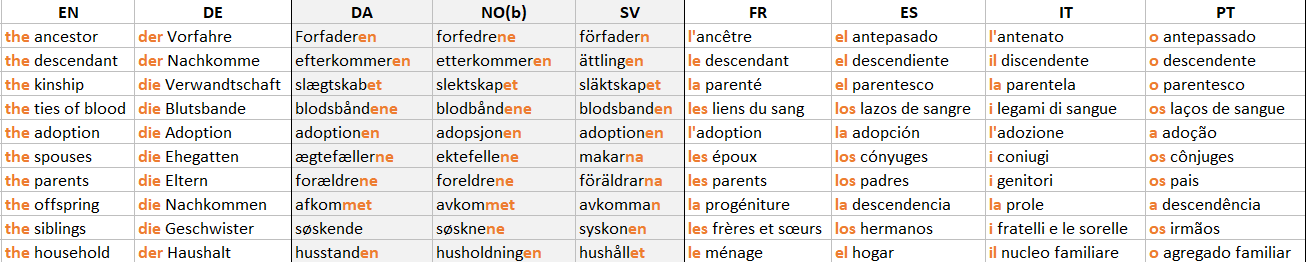
Family is a classic topic of every language learning syllabus. The members of “The Foreign Land’s Explorers” approached it the usual way initially, but they wanted to go further. So, they made a new table with terms related to family, but which were not learned in regular language classes. They built a table, knowing it was just a reference. Each word should not be taken as exact equivalents to the other languages. Once they had the table, they constructed the same sentences in every language, for example: “the spouses become parents and constitute a household with their offspring”.

[click to enlarge]

“Ah, ‘offspring’ in Italian is ‘prole’”, noted Leo. “Did you know that ‘proletariat’ comes from the Latin word ‘proletarius’, which means someone belonging to the lowest (and poorest) class that would only be considered as ‘citizen’ if they had children? I guess ‘children’ here would mean labour force or soldiers. Therefore, ‘prole’ in Italian comes directly from the Latin word meaning ‘children’”.

“Sometimes people don’t realize how much Latin language has influenced European languages, all of them”, said Elizbeth. “For example, ‘adoption’ is similar in these languages and comes from the Latin word ‘adopto’, which is the combination of ‘ad’ and ‘opto’. ‘Ad’ means ‘to’ and ‘opto’ means ‘choose’. So, basically ‘adoption’ is ‘to choose’”.

“I may be wrong, but it seems that word is the only word here in the table to come from Latin in what German, Danish, Norwegian, and Swedish are concerned”, noted Sophia. “Interesting that ‘offspring’ in Nordic languages is ‘of coming’. Well, in English it has a similar meaning: getting out of where they were made. Like the rivers that leave the place where they were ‘born’ and run until they reach the sea. They ‘come’ from somewhere.”

“Knowing where you come from has always been very important. Look at Royal families. Being part of a Royal family can determine if you will lead the country or not, whether you want it to or not”, said Elizabeth.

“Some Kings have renounced the post, so it’s not inevitable. But, yes, for them, it is something that is always there, since childhood. And they are also pressured to have a ‘prole’, a male heir to the throne and some ‘spare’ male children, just in case something happens to the oldest. It’s not exclusive for poor people, although it is different, of course”, added Michael.

“Poor people provide the labour force in sequence. Rich people build dynasties to rule the poor people. It is the system of castes. Once you are born in one, you have to play your role regardless of your wishes”, said Elizabeth.

“That is not entirely true nowadays”, said Sophia. “Royals can now marry commoners and commoners can aspire to climb the social ladder”.

“Dynasties still have weight in society. Being a son or a daughter of an important family is always a mark, even if that person follows a different path”, said Michael.

“Ok, remember I told you that we use more Latin-based words than we realize? Well, I checked the word ‘dynasty’ and it is actually a Greek word, although it was stolen by the Latin language’”, said Elizabeth.

“Let me see”, said Michael, looking at her computer and starting to read. “It says that a dynasty is ‘a succession of rulers of the same line of descent’ and it gives China as an example. Then, it says it can also be ‘a powerful group or family that maintains its position for a considerable time’. It meets what we were saying, I think”.

“Royal families are a reference. They are a symbol of continuity, tradition, and identity”, said Sophia. “That’s why they are so important for people. People see them as the leaders of the nation. It’s no coincidence that the countries’ history timeline is told through dynasties, especially in China. They say ‘this was done during this Dynasty’. For example, the Great Wall of China was constructed during the Ming Dynasty. You need to know when they ruled to know the respective period of time. In Europe, you talk about epochs, like Ancient Times, Medieval Times, Renaissance.”

“Well, in Europe, history is also made of dynasties, although they are named ‘Houses’, like in ‘The Game of Thrones’”, said Elizabeth and laughed. “For example, the House of Habsburg was one of the most influential families in European history. In the UK, the House of Tudor is one of the most famous Royal families due to King Henry VIII and his six wives. The current UK’s Royal family is the House of Windsor. And, of course, there were prominent families that didn’t belong to any Royal family, like the Medici, who ruled Florence for many years”, said Elizabeth.

“In the USA, they also categorize their history periods according to presidential administrations: the President Obama’s administration, the President Biden’s administration…”, noted Michael. “Actually, the story of the name ‘President’ is curious. When the USA became independent, they had to choose a name for their Head of the State. ‘King’ was suggested, but they didn’t want to give ideas of grandeur to a man who should be feeling humble. So, they decided to give him the name of ‘someone who chaired meetings’. They thought it was humble enough. Not any more”.

“Well, they also have dynasties of some sort there, like the Bushes and the Kennedys…”, said Leo. “Like the Medici, these families became powerful after they had become very rich.”

“In the end, money rules the world. And, sometimes, the families who have it”, concluded Jack.


** YOUR WORDS AND IDEAS **

By Isabella Muir | On 30 April 2025 at 12:08
Some very interesting insights into the meanings of ‘family’ – a term that has changed significantly over the centuries. Nuclear families (often blood relatives) contrasts with ‘blended’ families, where a wide range of relationships come together. It would be interesting to explore how ‘family’ contrasts with ‘community’ – both can be supportive networks, but both can be just the opposite!

By Words in Ideas | On 01 May 2025 at 21:19
That would be very interesting, yes. “Blended” families is a good term – maybe in future “blended” will replace “nuclear”?…


Time changes in different languages

“Hi, guys!”, said Michael, taking his place at the table. “I read an article about how time is different in each language. Actually, the article is about a book that is based on research. Did you know that Chinese people set a timeline from up to down?”

“What do you mean?”, asked Sophia.

“So, in some crime stories we see on television, detectives draw a timeline on the board to understand what the victim did before he/she died, right?”

Michael waited to make sure everyone was on the same page. Then, he continued.

“They usually draw horizontally the line from left to right and write the events chronologically considering that the event on the left is the earliest and the one on the right is the latest. Those are Western TV shows. Well, if those TV shows were Chinese, that timeline would be drawn vertically in which the event on the top would be the earliest and the one at the bottom would be the latest.”

They all looked at Michael without saying a word.

“That doesn’t make any sense”, said Sophia at last.

“Indeed, it does. Western languages’ writing is from left to right. Therefore, we see time coming from the left to the right. Chinese people, at least traditionally, write from top to bottom, thus, they see time as coming from top to down”, replied Michael.

“So, languages whose writing is from right to left also consider time coming for right to left?”, asked Elizabeth.

“Yes. At least that is true for Hebrew, according to the study”, answered Michael. “In the article, they also say that for Aymara people, from the Andes in South America, and Mandarin speakers, the future is behind them because they can’t see it. What they can see is the past, which is in front of them”.

“It seems like they are walking backwards…”, noted Sophia.

“It kind of makes sense, if you think about it. We have memories of the past, photos, objects, experiences… It is as life opens up, as if it gets wider and wider as time goes by. Every step backwards reveals a little more of what we can’t see”, said Elizabeth.

“But we leave the past behind us and are walking towards the future! We move forward, not backwards!”, said Sophia, looking very confused.

“I guess that’s just how Western learn to see things. There are tribal languages that have no past nor future”, said Jack.

“So, how can they refer to the past and future?”, asked Sophia.

“Maybe they don’t need to. They live in the present”, said Michael.

“That sounds like one of those mindfulness things…”, remarked Leo, laughing.

“We all live in the present!”, said Sophia, who was getting really disturbed with the conversation. “But we have a past and plan for the future!”

“Ok. The article also states that Australian Aboriginal refers to objects as being in north, south, east, west, and all in between. For example, Sophia is north of the table. Actually, I have no idea if north is in that direction, but you understand what I mean”, said Michael as a way to change the subject a little bit.

“That’s more precise than saying on the right-hand side or left-hand side”, noted Leo.

“Yes. Maybe that’s why in London underground the lines are presented with the eastbound and westbound direction”, said Jack.

“It is very confusing for someone who can’t tell which way is east and which way is west…”, said Sophia.

“But it’s more precise, as Leo said”. Michael looked at Leo and nodded to agree with him. “There’s an example in the article that is: ‘the ball is on the left of the dog’ versus ‘the ball is on the dog’s left’. It seems the same, but the truth is that the ball is in the opposite direction. In Spanish there is no confusion. Spaniards don’t refer to the ball from the dog’s point of view.”

“It’s like the right bank of the river and the left bank of the river. I always ask myself ‘from whose point of view?’ If we say the north bank of the river and the south bank of the river is much simpler”, said Elizabeth.

“True, but, again, you have to know where north and south. I never do”, said Sophia.

“Australian Aboriginal have learned the cardinal points since they are children. We trust on GPS”, said Jack. “Maybe we are wrong and they are right.”

“Another curiosity mentioned in the article is that some languages see time as a volume and others as a line. For example, English people say ‘it’s been a long day’ and Spanish people say ‘it’s been a full day’. As in: ‘the day was longer than it usually is’ versus ‘the day had more events than it usually has’. Something like that”, continued Michael.

They stopped talking and wondered about it.

“Both are right, isn’t it?”, said Elizabeth finally. “If you end the day later than usual, it will inevitably have more events.”

“Not necessarily”, replied Leo. “During the same number of hours, you can have more events than usual. Or you can have fewer events during more hours…”

“That is all very confusing”, said Sophia.

“Imagine if you were bilingual… They switch from one way of seeing things to the other in a second!”, said Michael.

Sophia looked at him with a very desperate expression.

“Each country sees things in different ways. Australia is huge and it’s mostly a desert, so knowing the cardinal directions was essential for surviving. Spanish people focus on events while English people perceive the day as a sequence of events, and that sequence can be longer or shorter. Some languages state that we are walking towards the future, others see the past ahead”, concluded Jack.

“Some tribes don’t see a past nor a future. They only see the present”, added Michael. “Maybe they are right. The past is only in our head and the future hasn’t happened yet… There is only the present.”

“Not exactly. We walk forward towards the future. We plan the future, we visualise it. The past is behind us because we have already lived it. There is evidence about it all around us. Events happen in order, one after the other”, contradicted Sophia.

“Einstein was right: it’s all relative”, said Elizabeth.


** YOUR WORDS AND IDEAS **

By Isabella Muir | On 26 March 2025 at 10:02
Another fascinating article! Past, present and future – all determined by individual perspectives, affected by nationality, language and culture. I suppose it proves that nothing is static – almost that there are very few ‘facts’ just someone’s opinion (one man’s terrorist is another’s freedom-fighter). It also emphasises the wonder of language – which is just what your articles are all about!

By Words in Ideas | On 26 March 2025 at 14:56
Thank you so much! Indeed, we are not aware that our mother tongue, which shapes our culture, determines how we see the world. The words we use have weight and are highly revealing. Learning foreign languages is truly opening the door to see the world under another perspective! 🙂


The work, le travail, die Arbeit, el trabajo

“I declare the first gathering of The Foreign Lands’ Explorers open,” said Jack and everyone clapped and cheered. “The topic for today is ‘the work’.”

“’El trabajo’, in Spanish; ‘il lavoro’, in Italian; ‘o trabalho’, in Portuguese,” said Leo.

“’Le travail’, in French”, said Elizabeth.

“’Die Arbeit’, in German”, said Michael.

“’Arbejdet’, in Danish; ‘arbeidet’, in Norwegian; ‘arbetet’, in Swedish”, said Sophia.

“’Trabajo’, ‘trabalho’, and ‘travail’ come from Latin. The original word, at the time, was related to a torture instrument with three stakes. I have no idea how it progressed, but we can assume that there was a connection made somewhere by common people between ‘work’ and ‘torture’…”, explained Leo. “The Italian word comes from the Latin word ‘labor’, which was the official and standard word for ‘work’ at the time. In Spanish, French, and Portuguese a similar word also exists with a similar meaning, but usually is used in handcraft work or in the farming context. It makes sense because at the time most of the work was related with agriculture. In English, we can also see this word being used in some contexts, like in ‘labour market’.”

“Actually, there is a similar situation in German. The word ‘Werk’ also means work in a more formal manner, but it is mostly related with factories and the like. Both words ‘Werk’ and ‘work’ have the same origin. In English language the word ‘labour’ can be used, but it’s more commonly used in the farming context”, added Michael.

“Then, there is ‘job’, which can mean a task or an employment”, said Jack.

“In Spanish and in Portuguese the word is the same, but there is also the word ‘empleo’ and ‘emprego’, respectively, for ‘employment’, which is similar to English”, informed Leo.

“Yes, ‘employment’ was adopted to English via French, whose word is ‘emploi’. In French slang you can also say ‘boulot’”, added Elizabeth.

“Ok, what about ‘unemployment’? In Swedish is ‘arbetslöshet’, in Danish is ‘arbejdsløshed’, and in Norwegian is ‘arbeidsledighet’”, said Sophia. “Basically it means ‘without work’”.

“In German is not so different: ‘Arbeitslosigkeit’”, added Michael.

“In French is ‘chômage’”, said Elizabeth.

“’Chômage’?! Where that came from?”, asked Jack.

“It comes from the Latin word ‘caumare’, which means to take a break during the heat”, explained Elizabeth.

“That doesn’t seem to make much sense…”, laughed Sophia.

“Well, try working during the heat and you’ll probably start to see some sense…”, commented Jack. “We all have to learn the ropes with those who came before us.”

“Learn the ropes? What do you mean?”, asked Leo.

“It’s an idiomatic expression that means learning to do a job”, answered Jack. “It was used when new sailors had to learn how to tide the ropes in sailing boats.”

“As they say in Germany: ‘die Arbeit, die uns freut, wird zum Vergnügen’. This means ‘the work that we enjoy becomes pleasure’”, said Michael.

“Unless you ‘tombes dans le panneau’”, said Elizabeth. As everyone stared at her, she explained: “You can fall into a trap”. Then everyone went “Ahhhh”.

“You can always take a ‘föräldrapenning’, as the Swedish say. Or ‘foreldrepenger’, in Norwergian. Or ‘forældreorlov’ in Danish”, said Sophia.

“What exactly is that?”, asked Leo.

“Parental leave”, clarified Sophia.

“Oh, ‘congé parental’, in French”, said Elizabeth.

“’Permiso parental’ in Spanish; ‘congedo parentale’, in Italian; and ‘licença parental’, in Portuguese”, said Leo.

“’Elternurlaub’, in German”, said Michael.

“Well, you would have to have a child first…”, commented Elizabeth.

“I declare the first gathering of The Foreign Lands’ Explorers open,” said Jack and everyone clapped and cheered. “The topic for today is ‘the work’.”

“’El trabajo’, in Spanish; ‘il lavoro’, in Italian; ‘o trabalho’, in Portuguese,” said Leo.

“’Le travail’, in French”, said Elizabeth.

“’Die Arbeit’, in German”, said Michael.

“’Arbejdet’, in Danish; ‘arbeidet’, in Norwegian; ‘arbetet’, in Swedish”, said Sophia.

“’Trabajo’, ‘trabalho’, and ‘travail’ come from Latin. The original word, at the time, was related to a torture instrument with three stakes. I have no idea how it progressed, but we can assume that there a connection was made somewhere on the way by common people between ‘work’ and ‘torture’…”, explained Leo. “The Italian word comes from the Latin word ‘labor’, which was the official and standard word for ‘work’ at the time. In Spanish, French, and Portuguese a similar word also exists with a similar meaning, but usually is used in handcraft work or in the farming context. It makes sense because at the time most of the work was related to agriculture. In English, we can also see this word being used in some contexts, like in ‘labour market’.”

“Actually, there is a similar situation in German. The word ‘Werk’ also means work in a more formal manner, but it is mostly related with factories and the like. Both words ‘Werk’ and ‘work’ have the same origin. In the English language, the word ‘labour’ can be used, but it’s more commonly used in the farming context”, added Michael.

“Then, there is ‘job’, which can mean a task or an employment”, said Jack.

“In Spanish and in Portuguese the word is the same, but there is also the word ‘empleo’ and ‘emprego’, respectively, for ‘employment’, which is similar to English”, informed Leo.

“Yes, ‘employment’ was adopted to English via French, whose word is ‘emploi’. In French slang, you can also say ‘boulot’”, added Elizabeth.

“Ok, what about ‘unemployment’? In Swedish is ‘arbetslöshet’, in Danish is ‘arbejdsløshed’, and in Norwegian is ‘arbeidsledighet’”, said Sophia. “Basically, it means ‘without work’”.

“In German is not so different: ‘Arbeitslosigkeit’”, added Michael.

“In French it is ‘chômage’”, said Elizabeth.

“’Chômage’?! Where did that come from?”, asked Jack.

“It comes from the Latin word ‘caumare’, which means to take a break during the heat”, explained Elizabeth.

“That doesn’t seem to make much sense…”, laughed Sophia.

“Well, try working during the heat and you’ll probably start to see some sense…”, commented Jack. “We all have to learn the ropes with those who came before us.”

“Learn the ropes? What do you mean?”, asked Leo.

“It’s an idiomatic expression that means learning to do a job”, answered Jack. “It was used when new sailors had to learn how to tide the ropes in sailing boats.”

“As they say in Germany: ‘die Arbeit, die uns freut, wird zum Vergnügen’. This means ‘the work that we enjoy becomes pleasure’”, said Michael.

“Unless you ‘tombes dans le panneau’”, said Elizabeth. As everyone stared at her, she explained: “You can fall into a trap”. Then everyone went “Ahhhh”.

“You can always take a ‘föräldrapenning’, as the Swedish say. Or ‘foreldrepenger’, in Norwegian. Or ‘forældreorlov’ in Danish”, said Sophia.

“What exactly is that?”, asked Leo.

“Parental leave”, clarified Sophia.

“Oh, ‘congé parental’, in French”, said Elizabeth.

“’Permiso parental’ in Spanish; ‘congedo parentale’, in Italian; and ‘licença parental’, in Portuguese”, said Leo.

“’Elternurlaub’, in German”, said Michael.

“Well, you would have to have a child first…”, commented Elizabeth.

 
After this introduction to the topic, they decided to compare the name of some professions in different languages. They started with the firefighters.

While in the Anglo-Saxon and Nordic languages the focus is on fire (they are the people of the fire / those who fight the fire), in Latin languages the focus is on the pumps that were used at the beginning of firefighting (they are the people of the pumps).

Between ‘assistant’ and ‘host’ / ‘hostess’ or ‘steward’ / ‘stewardess’, there is not much difference.

In this case, except in the Spanish language, the expression is very similar to all other languages. “Journalism” was a term born in the 18th century in France and comes from “jour”, as in “report every day”. In Spanish, “newspaper” is “periódico”, hence the “periodista”.

In German and in the Nordic languages, the word refers to an instructor, someone who provides training for someone to acquire a skill, which has a similar meaning for “teacher”, although the root is different. The perspective is “to show how it’s done”. In Latin languages, the perspective is “someone who dominates an art and transmits its knowledge to their disciples”. In these languages, the teacher is regarded as a kind of “keeper of knowledge”. This is even more emphasised in Spanish, where the teacher is considered a “master”. Actually, in the other Latin countries, a teacher used to be called “master” and in some contexts it is still the case.

 
As it was getting late, they decided to wrap up. They could discuss and compare terms in different languages for hours, but they all had classes the next morning. However, when everyone was preparing to leave, Leo remembered something.

“Do you know the origin of the word ‘salary’?”

Everyone looked at Leo.

“Salt was extremely important during the Roman Empire. So, it was the reference to pay soldiers what was due to them. It was the ‘salt portion’ they could have. They still use that term in English, in Portuguese (‘salário’), in French (‘salaire’), and in Spanish in certain contexts (‘salario’).”

“If it’s a constant pay, for example every month, it’s ‘sueldo’. If it is an irregular pay it’s a ‘salario’”, said Elizabeth.

“Exactly”, confirmed Leo. “It’s similar in Italian: ‘salario’ is an hourly pay whereas ‘stipendio’ is a fixed pay”.

“That’s also similar in German. If it’s fixed it’s ‘Gehalt’ and if it’s variable it’s ‘Lohn’”, said Michael.

“Ah, in Swedish it’s ‘lön’, in Danish it’s ‘løn’, and in Norwegian it’s ‘lønn’”, added Sophia.

And, on that note, they reluctantly went back home.

 

Places, lieux, Orte, lugares

When learning a foreign language, it is advisable to use it in context. That is why books and classes have simulations of situations such as “in the airport”, “meeting new people”, “daily routine”. You can do the same in real situations. Imagine you are going to travel. You can recreate the “in the airport” scenes and write and perform them in the language you are learning. All you need is the vocabulary, simple sentences, and a willingness to practice.

The airport is a good place to start. From there, you can go to different countries and different sceneries. You can make up travels, describe trips you have already made, or journeys you are about to start. You can also talk about your city or your country. The possibilities are endless.

Below we provide a list of vocabulary that you can use (in a pdf, which you can download) and some examples in English, French, German, Spanish, and Portuguese. You can compare and get inspired.


Subscribe to continue reading

Subscribe to get access to the rest of this post and other subscriber-only content.