Best of “The Intrepid Book Society”

Dear Readers,

After renewing its website, “Words in Ideas” is preparing its 3rd year of fresh new articles, starting in October. While you wait, you can read (or re-read) the best articles under the category “The Intrepid Book Society”. This “Society” is a fictional book club, analysing a book per month according to a keyword or a key place.


During the first year, articles were written as reviews. Here are the 5 best:


In the 2nd year, fictional members discussed the plots between themselves. Here are the 5 best:


This 3rd year, “Words in Ideas” will test your knowledge (or, hopefully, making you curious in reading) the book of the month.

 
If you wish to comment or send suggestions, please fill in the form at the end of each website page.

Thank you!
Words in Ideas
https://wordsinideas.com/
 

Keyword: HAPPINESS | Women’s happiness

It is generally believed that happiness for women is to get married. Or better yet, to fall in love and then get married. This usually means that single women are miserable and are desperately looking for a man to love them. However, many married women (or not married, but in love with a man) are miserable and some single women are very happy with their lives and have no plans of changing such a status. Against this fact, the argument is invariably the same: happy single women are just pretending they are happy; deep inside they are eager to find someone to love them. So, no matter where the conversation begins, it always ends in the same place. It’s exhausting, really. Obviously, this question doesn’t apply to men. In fact, single men are often seen as people who are enjoying life, who are free and careless, especially the successful and rich ones. Apparently, they have no need for love. They can have all the women they want and that’s good enough for them. Only women have a (pathological) need for it, it seems.

Instead of considering that happiness is different for women and men, maybe we should consider that happiness is just different from person to person, regardless of being a man or a woman. Some people need to be loved to be happy and some people are happy with their jobs. Some people want to have children and others don’t. Some people want to get married and others don’t. Some people love to travel and change scenery every chance they get, others like to stay put, maybe having a holiday home. All this, regardless of being a woman or a man.

Happiness is when what it should be equals the reality of what is. In other words, it’s when everything goes well. This is different from those situations when apparently all goes well, but you have a feeling that something is wrong. We tend to ignore that feeling because rationally we think we shouldn’t feel like that. We live as there is a guide on how to live and how to be happy. And now there are apps that set goals for us and tell us how to achieve those goals. Instead of actually living life as it is, we spent our time trying to live the life we are supposed to live.

This is not just in our personal life, but also in our professional life. Especially now, with Chief Happiness Officers controlling people’s “well-being”. They make sure workers are feeling excited about the projects they are involved in, they enjoy the food and drinks provided for free by the employer, they go to office parties and don’t miss the team building workshops, the mindfulness sessions, and the sports events organised by the company. In some organisations, like Google, they even have a playground so people can relax during office hours and have fun. “Fun” is the key word. People are forced to have fun everywhere, smile all the time and show enthusiasm about everything. It’s stressful and exhausting.

Then, in their (rare) spare time, people are almost forced to show themselves having fun on social media: dinners with friends, idyllic weekends with lovers, luxurious holidays abroad. Besides, buying expensive objects is perceived as highlights of happiness. Every day, we are bombarded by ways of spending money and wealthy people are seen as examples to follow. Therefore, the plan is: getting a highly paid job in order to have enough money to spend it on all the things mentioned. Relationships with other people are like products to be consumed or theatrical stages to show off one’s wealth. Being admired is mistaken for being happy.

Expectations are also at the root of happiness (or unhappiness). We create many expectations about our lives, our jobs, our families, our friends. Partly, these expectations come from the “guide” about how to live and what to buy. Adverts show happy families (or happy young people) buying stuff and living in luxury as saying: “this is the happy life; this is your goal”. The expectation is, thus, if we buy that product, it will make us happy just like those people in the adverts. Experiences are the next level of this idea. It is not enough to buy a car; we now need to buy an adventurous car. It is not enough to go to the gym; we need to pay a personal trainer and sign up in triathlon and marathon events. It is not enough to travel abroad; we need to go to an exotic country and have an adventure. Always something more, always more exclusive, always more expensive.

For women, additional pressure comes from the expectation to become mothers. Drama can set in when women who want children have trouble getting pregnant. Fertility treatments, which are presented as an alternative, are painful, expensive, and draining. Draining for women and draining for their husbands or partners. And can drag on for years; more than one treatment may be needed. When they finally become mothers, the pressure is on for them to be “perfect moms”, whatever that means. They are considered “lucky” if they have the help of their husbands or partners, but still the responsibility on their shoulders is enormous.

All in the name of happiness. Is it worth it? Perhaps. Some people do find happiness in the middle of this chaos. Others just pretend (following the motto “fake it until you make it”). The truth is there are no rules to be happy. We made up rules to deceive ourselves or to help us cope with sadness and suffering. Thinking positive has its benefits, but, if its main objective is to ignore negative feelings, then it can be pointless. “Bad” feelings need to be felt alongside the “good” feelings. That’s how we see the difference. Sometimes they are intertwined. As the saying goes: «good things can come from bad situations». And vice-versa.


Keyword: HAPPINESS | The meaning of happiness

In the early 1990’s, after graduating, Christopher McCandless rejected society, gave his money away, and went to live in nature from what nature could provide. He wanted to be happy and isolated himself to go and look for it. Jon Krakauer wrote his story in the book “Into the Wild”, which was adapted to cinema by Sean Penn. Sadly, Christopher was found dead four months after he had settled in an abandoned bus in the middle of Alaska wilderness. He died alone. At the time, he had had no contact with anyone for a long time. In the diary he was writing, there was an interesting quote: “Happiness is only real when shared.”

This quote goes against the current neoliberal concept of happiness, which is extensively analysed in the book “Happycracy – How the science of happiness controls our lives”. At the beginning of the book, the authors Edgar Cabanas and Eva Illouz made use of the film “The Pursuit of Happyness”, starring Will Smith, to introduce such a definition. The film is based on Christopher Gardner’s true story, who was broken and homeless with a small child in his charge. Due to his determination, resilience, and optimism, he became a successful broker and a rich man with the help of nobody. Now, he is also a motivational speaker, sharing his experience and helping others to achieve the same as him. He is one of several motivational speakers and coaches that instruct people on what to do to become rich and happy. As happiness has become more important in society, the number of these professionals have increased in recent years. Currently, happiness is seen as individual-driven, the sole responsibility of each person, and disconnected from any social or economic circumstance. Yet, Edgar Cabanas and Eva Illouz emphasized the irony of how a man like Christopher Gardner, who “made it” alone, is now helping others achieve success in life.

Interestingly, Arnold Schwarzenegger, who is seen as a self-made man that moved to USA to achieve the so called “American dream”, recently wrote a book stating that success (and happiness) stems from being useful to others and having a purpose in life. In order to achieve our goals, people need the help of others and should give something back in return. Of course, ultimately it is up to each individual to achieve their own goals, but the underlying idea is that each individual is part of a community. Therefore, “making it” by yourself and alone, like Christopher Gardner did, it’s quite unusual.

The book “Happycracy” concludes that the current obsession with happiness has fed a very lucrative industry (or the other way around). National policies and management guidelines are now aligned to “positive psychology”, forcing people to be happy all the time and, in a way, blaming them if they aren’t. In some cases, managers argue that companies should only hire happy people and fire those who are not because happy people are more productive and resilient. Resilient to toxic cultures, for example, while remaining productive during the many hours overtime, they need to work to do “more with less”.

Every year the ranking of countries by life evaluations, included in the World Happiness Report, is announced in the media. It is based on «individuals’ own assessments of their lives», as said on the website. This means that it is highly subjective and relies solely on people’s perception: what seems very good for some, can feel very bad for others. Furthermore, people can respond according to what is expected rather than what they really feel. It is no coincidence that the top countries are the wealthiest in the world. There is a general perception that money brings happiness, thus, living in a wealthy country will mean being happy.

According to Edgar Cabanas and Eva IIlouz, the science behind the studies on happiness is faulty and can lead to wrong conclusions. The indicators based on happiness ignore economic and social indicators which directly influence people’s lives and can also influence their perception of what happiness is. For example, the wealthiest countries are the countries with the greatest social and economic inequalities. So, being poor in a wealthy country means being happy whereas being poor in a poor country means being unhappy? In reality, in the wealthiest countries, “happiness” increasingly means to isolate oneself: you can walk listing to music and disconnect from the world around you, you can practice meditation and mindfulness to look inside yourself, you can buy books and courses to learn the techniques to improve yourself and overcome the obstacles and the difficulties that make you unhappy. However, despite all of this, people are getting more and more unhappy and depressed. So, maybe this is not the path to true happiness.

Britannia states that «happiness, in psychology, is a state of emotional well-being that a person experiences either in a narrow sense, when good things happen in a specific moment, or more broadly, as a positive evaluation of one’s life and accomplishments overall—that is, subjective well-being». So, forget about isolating yourself via technology, always pursuing something unattainable, living in permanent dissatisfaction. Happiness is nothing like that, it’s much simpler: if you feel good and feel like smiling, then you’re happy. It could be about a specific thing or a specific memory, or it can be a general feeling about your life. Of course, you can fake it, you can just think you are happy, or you can convince yourself that you are. Usually, in these cases, you can keep it to yourself. However, if it is a true feeling of happiness, you want to share it with other people. You have the tools to distinguish the difference: don’t think and don’t analyse, just feel.


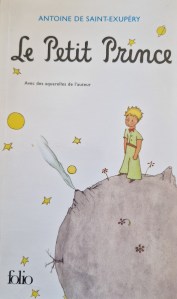
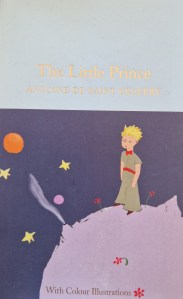
Keyword: HAPPINESS | “Le Petit Prince” [“The Little Prince”], by Antoine de Saint-Exupéry

“Thank you for coming, folks”, started Mr John Booklish. “Our book for this month is ‘The Little Prince’, by Antoine de Saint-Exupéry. This is the second most translated book in the world (the first is the Bible). Basically, the story is about an encounter between a pilot that crashes in the desert and an alien. This alien is a little boy that comes from a star far away and is travelling throughout the universe, meeting other aliens who live on different planets. Like him, those people live alone on their little planet and each one has a certain purpose.”
“A few remarks about the author before we give you the floor”, added Ms Clara Smartest. “Antoine de Saint-Exupéry was a pilot during the war and a courier, having crossed over the desert many times. He wrote several books, including one which stem from his nearly-dead experience after crashing in the desert. The description of his hallucinations is very interesting and lively. In a way, ‘The Little Prince’ also stems from such an experience, but reflects as well his concerns about the direction the world was heading. The thesis in the book is that grown-ups forget to be open to the world, as when they were kids, and understand nothing.”

“Martha, you may take the floor now. Tell us why you enjoyed the book so much”, said Mr John Booklish.

“Well, I think the Little Prince is really sweet. He is polite, but doesn’t let go of something he wishes to understand until he does. He is curious and is exploring the world with an open mind, ready to absorb what comes in his way. It’s a pity that only too late and when he was too far away he understood how much he loved his rose and how much his rose loved him.”

“Well, the rose was really annoying, wasn’t it?”, commented Mr Jeremy Toughready.

“She was acting like that because she wanted the Little Prince to pay attention to her”, replied Miss Martha Lovefeelings a little bit irritated.

“That didn’t work very well, did it? She made him go away.”

“He went away because he wanted to explore the universe.”

“That could be true, but if she wasn’t so annoying, he wouldn’t think of leaving, I’m sure.”

“Well,” interrupted Mr John Booklish, “let’s move on. Johanna, Mark, what do you think about the book?”

“I think the pilot was having a hallucination, which helped him to cope with the situation. He was alone, had just crashed in the middle of the desert, and needed to make a repair on the plane in record time. Imagining there was a boy there with whom he could talk to would be a good distraction”, said Ms Johanna Practicewell.
“It’s a beautiful fable about how adults lose sight of the most important things in life, like what love really is and how to make friends. Those people who the Little Prince met during his journey had become so focused on their purposes they had forgotten anything else. Therefore, the story aims to remind adults how it was to be a child, full of amazement and curiosity about the world”, said Mr Mark Mindhearting. “I especially like the fox. It’s like the voice of conscience we sometimes have in our mind, telling us to look closely, to become aware of what it is all about, really. It’s the fox that says the ‘essential is invisible to the eye’, as saying to look beyond what you can see with your eyes, that the important things, or better yet the most important things, are felt, not seen.”

“Yes! People usually don’t pay attention to feelings, it’s like they are blind”, said Miss Martha Lovefeelings with an indignant tone.

“Adults have responsibilities, children don’t. We need to focus on solving problems, not in guessing that some drawings represent elephants inside snakes”, commented Mr Jeremy Toughready. “The drawing does seem like a hat.”

“A hat with eyes…”, whispered Miss Martha Lovefeelings.

“Ok, people, it’s great that you have different opinions, but you don’t need to fight. This is just a book, nothing else”, interrupted Ms Clara Smartest. “Maybe this was the author’s goal when he wrote the story, to make people stop and think about their lives. Are we really paying attention to what is important to the people in our lives? Yes, people can be annoying, but, without them, life would be very empty.”

“I agree. All the people the Little Prince encountered during his journey lived alone. Yet, they didn’t notice it because they were so absorbed with the role they were performing. Do you really miss people if you don’t even notice they aren’t there?”, asked Ms Johanna Practicewell.

“Maybe, in time. If someone is too absorbed by his or her work, once they retire, they look around and there is no one there, no one to do things with, no one to share the wins and the fails…”, said Mr Mark Mindhearting.

They went on, discussing the ending. Some were sad because they hoped that the Little Prince would be rejoined with the rose. Others presumed that the Little Prince had found a way to get back home and lived happily with his rose.

“I’m afraid our time is almost up. There was much said to think about. And I guess the best endings are those which can have different interpretations”, said Mr John Booklish.

“True”, confirmed Ms Clara Smartest. “Before we wrap up, just to let you know that the next book will be ‘The Picture of Dorian Gray’, by Oscar Wilde. See you all (hopefully) in a month.”