
Dear Readers,
After renewing its website, “Words in Ideas” is preparing its 3rd year of fresh new articles, starting in October. While you wait, you can read (or re-read) the best articles under the category “Foreign Lands”. These articles aim to compare languages and cultures.

During the first year, articles described some traditional food around the world. Here are the 5 best:
- 1. Keywords: ROMAN EMPIRE | Pasta
- 2. Key place: IRELAND | Guinness beer
- 3. Key place: SIBERIA | Solyanka soup
- 4. Key place: USA’s EAST COAST | Sandwiches
- 5. Keyword: MONASTERY | Bread

In the 2nd year, we followed the discoveries of a group of language learners. Here are the 5 best:
- 1. The work, le travail, die Arbeit, el trabajo
- 2. The war, la guerre, der Krieg, la guerra
- 3. The beauty, la beauté, die Schönheit, la belleza
- 4. The family, la famille, die Familie, la familia
- 5. The religion, la religion, die Religion, la religión

This 3rd year, “Words in Ideas” will discuss some cultural crossroads.
If you wish to comment or send suggestions, please fill in the form at the end of each website page.
Thank you!
Words in Ideas
https://wordsinideas.com/
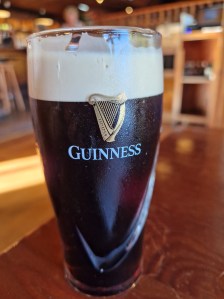 Nothing speaks Irish internationally more than Guinness beer. This is no coincidence. Arthur Guinness was a visionary and he wanted to brew such a beer that would be internationally recognized as an Irish product for many years to come. Hence, the choice of a harp as the symbol of the brewery. Yet, this is not just any harp, it is the “Brian Boru” harp, which you can see in the Long Room at the Trinity College Library in Dublin. It’s a medieval harp that stood the test of time and became the true symbol of Ireland. You can find it as the symbol of the Irish Government (adopted after the independence from England in 1922) and on Irish coins.
 WORDS IN IDEAS