The first meeting of The Intrepid Book Society was held on a chilly Sunday afternoon. Summer was definitely over, but winter was still far away. Instead of lazing on the sofa in front of television, the members of the Society put on their warm coats and headed to the local library. Mr John Booklish, the President and co-founder of the Society, was the first to arrive. He needed to open the library and prepare the room, which had been kindly made available for that purpose. Ms Clara Smartest, the Vice-President and co-founder, arrived shortly after and helped him by placing the chairs around and putting some drinks and biscuits on a table. The other members arrived on time one by one and they all sat on the chairs.
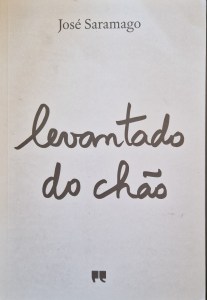 Mr John Booklish officially opened the meeting briefly introducing the book under discussion: “Levantado do Chão”, by Jose Saramago. Before he would go on about the story of the book, he made a bibliographical note about the author.
“Jose Saramago was born in Portugal into a family of landless farmers. As such, his family struggled financially. Even after moving to the capital, Lisbon, where they found slightly better living conditions, they always had little money to spare. As he grew up, Jose Saramago was unable to buy books, but he often went to the local library. He started to develop some literary knowledge and he later wrote his first novels. However, now with a family of his own to support, he had to work to make money. Thus, literary affairs were put aside. In the meantime, he got involved in political matters, which got him fired from his job. Luckily, he found a new job in a publishing house, where he worked in the operations department and as a translator. Later, he became a journalist for many years until he got fired again for political reasons.
“This time, he decided to dedicate himself to writing literary books. He moved to a place called Lavre, in the Alentejo region, to research for his first ‘serious’ book: “Levantado do Chão”. Although he had been born in Ribatejo (a different Portuguese region north of Alentejo) he could relate with the landless farmers that were the majority of the population there. The result was a story written in a totally different style. This was the first book of a new style, which was so unique he was awarded the Nobel Prize in Literature for it, many years later.”
After a little pause, Mr John Booklish added: “However, ‘Levantado do Chão’ is distinctive from the subsequent novels Jose Saramago wrote. Although the style is similar, contrary to the other novels, ‘Levantado do Chão’ is based on true events. It is a fictional story, but could have been a true one. The national and local events mentioned in the book happened. His other novels are based on ‘parables sustained by imagination, compassion and irony [that] continually enables us once again to apprehend an elusory reality’ (in the Nobel Prize official website). Therefore, ‘Levantado do Chão’ is a literary work like no other, which bore the seeds of his extraordinary literary work”.
“So, in a nutshell”, Mr John Booklish concluded, “this is the story of the Mau Tempo family (‘Bad Weather’ family). It starts somewhere at the beginning of the 20th century and ends somewhere after the 1974 Revolution. While we read about what is happening with the family, we also get to know about what is happening in Portugal at the same time because the political events directly affect the family. They all work the land, but they don’t have a land of their own. They work for the landlords when there is work to be done. When there is no work, there is no money, and no other way to make money. The landlords know this and take advantage of it by paying as little as possible, and forcing them to work from sunrise to sunset. Then, an idea emerges among the workers: to fight for better pay and less working hours. And here is when problems arise.”
At this point, Ms Clara Smartest decided to intervene, saying that the book was a political statement, a reflection of the author’s political involvement. After all, it was not by chance that he decided to write his first “serious” novel about his topic. He wanted to show how difficult the life of landless farmers was, a life of misery, without any hope of improvement. Well, at least during three-quarters of the 20th century. It also aimed to show how brutal the dictatorship was and the struggle farmers endured while fighting for better working conditions, which were due and fair.
 Although not disagreeing with this entirely, Mr Jeremy Toughready said that the story showed how resilient the farmers were, and how that helped create a strong will and a strong mind. They were prepared for everything that might come, not afraid of the consequences. They just went for what they wanted and for what they thought it was right, despite political affiliations. What he meant, he added, was that they did what they did not because of some political belief, but because it was just right.
Ms Clara Smartest agreed and said that was precisely the point. Political belief resulted from what people thought was right. Obviously, the landlords thought that the regime at the time was the right one because it defended their interests. That was why it only took the landlords to call the Guards for the farmers to be arrested.
Miss Martha Lovefeelings interrupted saying that was true, but the novel also talked about love. It was possible to find love even in the hardest possible conditions and to build families even with very little money. The family stayed together because of what they felt about each other and those feelings were what made them stronger. To this, Mr Mark Mindhearting strongly agreed and added that it showed how the toughest guys could also be capable of feeling the purest love.
Ms Johanna Practicewell, who was feeling bored with all that sentimentality, mentioned how interesting it was to see the evolution of the country from monarchy to republic and then ending in a dictatorship… until the revolution took place and everything changed. And yes, the story was about a landless farmer family, but at the beginning, the man who gave rise to the family was a drunken shoemaker, forced to move from town to town due to the troubles he would make wherever he went. Plus, he mistreated his wife and neglected his children. That was during the monarchy. Then, the men of the family changed tune during the republic and the dictatorship and women began to be treated with more respect.
Ms Clara Smartest said that was because of their political beliefs. The shoemaker didn’t have any political beliefs. Thus, he didn’t have any purpose in life.
Miss Martha Lovefeelings replied that taking care of his family should have been a strong enough purpose, but it wasn’t. He was just a bad man.
Mr Jeremy Toughready added that it was different times. Fighting tyranny had nothing to do with taking care of the family. It was a joint effort. Other people were relying on them. It would put everything in another perspective.
“Your family is relying on you”, exploded Miss Martha Lovefeelings.
“Yes”, said Mr Jeremy Toughready, “and that is why those men are more attentive to their families. Exactly. They realize that their fighting buddies are relying on them and they have responsibilities. They recognize they also have responsibilities towards their families because what they are fighting for will benefit them as well. It’s all connected”.
Mr Mark Mindhearting intervened saying that the shoemaker was a selfish man, he only thought about himself. He didn’t have the sense of community their children and grandchildren developed.
The debate went on for a while longer around these topics until Mr John Booklish closed the meeting. He thanked everyone for coming and he scheduled the next meeting for 3rd November, informing the book for the following month: “Das Boot”, by Lothar-Günther Buchheim.
All members confirmed it and left the library, still commenting on that month’s book on their way out. Ms Clara Smartest stayed behind to help Mr John Booklish to clean the room and close the door. Then, they said farewell until the next meeting.




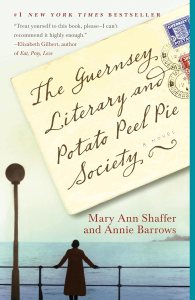 Ms Clara Smartest began the session summarizing the story of the book: “The author tells the story through the letters that are being exchanged between the main character, Juliet Ashton, and the other characters. Juliet is a writer and, naturally, she loves books. She is on a book tour when she receives a letter from a man living in one of the islands of the English Channel. He is contacting her about a book that used to belong to her. Conversation gets going and Juliet learns about an intriguing book club created unexpectedly during the Second World War. The letters are exchanged shortly after the war has ended and emotions are still running high.”
 WORDS IN IDEAS