
Einstein once realized that if a person and a ball would fall from a building at the same time, the individual would not be aware of the speed in which the ball was falling. For him/her, it would look like the ball would be still. The same phenomenon happens when we are in a speeding car. If a car next to ours is at the same speed, it seems we are both still. We are unaware of the space and the time passing by. This means that space and time are relative.
Objects in the universe are moving in a space-time continuum. As they move forward in space, time is also moving forward. We are not aware that Earth is moving, but it is. And we are not aware that time is passing unless we look at the clock or we watch the sun rise and set. For example, people lose track of time if they are living in a place where the sun is blocked and they do not have a watch (like in a bunker).
Seasons are dependent on the movement of Earth around the Sun. Through observation, humans realized that seasons would follow a cycle with four different phases. Astronomically speaking, solstices mark the most extreme points (Tropic of Cancer and Tropic of Capricorn), hence winter and summer. Halfway in each direction, the Sun goes through the equinoxes (on the Equator line), signalling Spring and Autumn.
Calendars were built as a way to measure this for agriculture purposes as it was necessary to plan when to sow and when to harvest. Different methods were used, and some are still in use simultaneously. The reference is the Gregorian Calendar, which is based on the movement of Earth around the Sun. After some adjustments, it was established that one year would correspond to a complete turn around the Sun. The year would be divided into 12 months and each three months would correspond to a season. Christianity determined the birth of Jesus Christ as the first year AD (Anno Domini, Latin for “in the year of the Lord”). That was 2025 years ago (or 2025 complete turns around the Sun). The years BC (Before Christ), or BCE (Before Common Era), are counted backwards from that first year.
There are other calculations, which consider other starting points. Assyrians are an ancient people from the Mesopotamia region (somewhere between today’s Iran, Iraq, and Syria) and are currently in the year 6773. According to the Hebrew calendar, Jewish people are currently in the year 5785. Buddhists are currently in the year 2565 and Persians in 1402. The Islamic Calendar is based on the Moon cycle and started its counting on the year the prophet Muhammad moved to Medina (the Hijrah). They are currently in the year 1446. In China, they built a calendar based on the lunar cycle, but taking the Sun cycle into consideration. Instead of indefinitely adding up years, they named them. The Chinese created a 60-year cycle combining the names of 12 animals with the 5 elements (wood, fire, earth, metal, and water). That was 4722 years ago.
Age (the number of years each individual has “completed the turn around the Sun”) is increasingly gaining weight for determining a person’s life. For any given age, there are certain types of duties and demands that are asked of people. It can be tough if you do not meet those age requirements and it can be a reason for discrimination. This is called Ageism. Discrimination towards older people is a known phenomenon, but it can happen at any age. Like many other discriminations, this one is “hidden” because these actions are considered “normal behaviour”. In other words, age discrimination is accepted. Like other discriminations, it should be censored.
For centuries, people organized their lives based on seasons because agriculture was the centre of their lives. Then, during the Industrial Revolution, people began to organize their lives based on years, months, weeks, days, and hours in a combination between the movement of Earth around the Sun (years) and the movement of Earth around itself (days). It was established that noon would be when the Sun would reach its highest point in the sky. The hours of the day were then calculated accordingly. Due to the rotation of Earth on itself, adjustments were made around the world to meet these criteria, hence time zones. Except in China. There, it was established that the whole country, which has five time zones, would use the same standard time. So, the Sun can reach its highest point in the sky in a different time, depending on the region.
Earth is about 4,500,000,000 years and homo sapiens exist for 200,000 years. In a way, there is no past and no future, only evolution. Earth has been evolving since its creation, going through different phases. Life on Earth has already been extinct five times in the “past”, but it was born again in different forms. If humans get extinct, Earth will keep moving through space and time and another type of life will be born.
We are connected with space and time as a tiny piece of a celestial object moving through the universe, interacting with other celestial objects. Whenever we take a step forward, a second has passed. If we travel to another country, we also travel into the “future”. Even when we are still, we are moving because we move with Earth, both in space and in time.
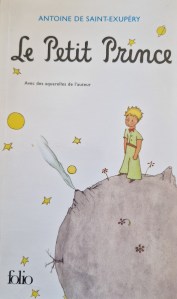 “A few remarks about the author before we give you the floor”, added Ms Clara Smartest. “Antoine de Saint-Exupéry was a pilot during the war and a courier, having crossed over the desert many times. He wrote several books, including one which stem from his nearly-dead experience after crashing in the desert. The description of his hallucinations is very interesting and lively. In a way, ‘The Little Prince’ also stems from such an experience, but reflects as well his concerns about the direction the world was heading. The thesis in the book is that grown-ups forget to be open to the world, as when they were kids, and understand nothing.”
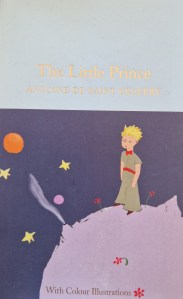 “It’s a beautiful fable about how adults lose sight of the most important things in life, like what love really is and how to make friends. Those people who the Little Prince met during his journey had become so focused on their purposes they had forgotten anything else. Therefore, the story aims to remind adults how it was to be a child, full of amazement and curiosity about the world”, said Mr Mark Mindhearting. “I especially like the fox. It’s like the voice of conscience we sometimes have in our mind, telling us to look closely, to become aware of what it is all about, really. It’s the fox that says the ‘essential is invisible to the eye’, as saying to look beyond what you can see with your eyes, that the important things, or better yet the most important things, are felt, not seen.”
 WORDS IN IDEAS