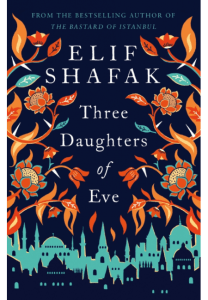
 Written by the British-Turkish author Elif Shafak, “Three Daughters of Eve” tells the story of Peri, a Turkish young woman who goes to the UK to study in Oxford. Daughter of an ultra-religious mother and an agnostic father, she witnesses her brothers taking different paths. Her older brother rebels against the system and is imprisoned and tortured, leaving him traumatized for life. Her younger brother follows a religious path, like his mother, with many pitfalls. Peri tries to stay neutral, with tragic consequences. In Oxford, she becomes friends with two young women from other Islamic countries, with different attitudes towards religion. She also meets Professor Azur, hoping he could help her with her questions about God, but instead that path leads to a scandal.
“I don’t know much about Turkish society, but, from what I gather from the book, it seems there is a great divide between those who fiercely defend the religious regime and those who fiercely fight it”, said Ms Clara Smartest.
“It seems there are a lot of problems in Turkey. The opening scene is told with many notes. I guess it is for the readers who are ignorant about Turkey to understand exactly the meaning of that scene within a bigger picture. There are other scenes taking place in present-day Istanbul that contribute to show us the bigger picture”, added Mr John Booklish.
“The family scenes are very insightful, too”, noted Miss Martha Lovefeelings. “A marriage was destroyed due to religion. The woman has become increasingly religious and the man stopped believing in it. At some point, they were no longer talking to each other”.
“That was reflected in their children”, said Ms Clara Smartest. “One was influenced by the mother, the other was influenced by the father, and the daughter was caught in the middle. She found a way to flee and went to the UK, only to find the same problems she was trying to escape”.
“I don’t think she was trying to escape. I think she was trying to find answers. She was very confused and enrolled in Professor Azur’s class to clarify those questions, in vain”, said Mr Jeremy Toughready.
“It’s interesting to see the different perspectives women have on religion in Islamic countries. Shirin is Iranian and she doesn’t believe in religion. You can say she turned into a true Western person. Mona is an Egyptian-American true Muslim and likes to use the scarf on her head. Mona talks about the prejudice people have about her choice. If women should dress the way they want, women that want to wear the scarf shouldn’t be criticized. Actually, at the beginning of the 20th century, it was unthinkable for Europeans to leave their houses without a hat on their heads, men and women. And in the middle of that century, women usually used a scarf on their heads, including Queen Elizabeth II, from the UK. I think this novel puts the question where the question is: how religion can negatively affect people’s lives. It’s not about the scarf, it’s about false beliefs which lead people to hurt themselves and others”, said Miss Amelia Matterfis.
“I agree”, said Ms Johanna Practicewell. “In this case, it was not Mona who hurt the others, it was Professor Azur, who probably is not even Muslim. His twisted vision of the world led to several conflicts and disastrous consequences”.
“Elif Shafak considers herself as Turkish, although she was born in France and lived in several European countries as well as in the USA. Apparently, the time she lived in Turkey was decisive for her identity. Yet, she has a different view from people who have only lived in Europe or from people who have only lived in Turkey. Therefore, she sees Turkish reality from the outside, with inside information. Sometimes, people with these capacities can see things that those fully immersed in the environment can’t see. I believe she intended to show this with her characters. Peri is the one who moves in both worlds and realizes how difficult it is for people to look at things from the other’s point of view, hence all the misunderstandings and the conflicts”, said Ms Clara Smartest.
“It also shows how people can come into conflict with themselves. Peri ended up having the life she was trying to avoid”, said Ms Abigail Vooght.
As usual, the Society’s members discussed the ending and imagined different ways for the novel to be finished. This time, they also imagined different ways to continue the story. Afterwards, they discussed their lives and how religion had or had not influenced them positively or negatively.
“Religion can have a strange effect on people. Those who truly believe in it can’t see a world beyond it and have difficulty in understanding other religions. Those who doubt about the existence of God may spend their entire lives with that conflict, if they come from a background where religion is important. People who don’t believe in religion can also clash with religious people and be pressured to ‘be part of the flock’. Some countries have a religious regime and others don’t, but even those that don’t have a dominant religion. Therefore, the questions presented in this book are relevant for many people”, concluded Mr John Booklish.
“I think this is a perfect ending to our meeting. Before you go, please note that the book for next month is ‘The Guernsey Literary and Potato Peel Pie Society’, by Mary Ann Shaffer and Annie Barrows”, said Ms Clara Smartest.
** YOUR WORDS AND IDEAS **
By Isabella Muir | On 9 May 2025 at 09:10
It certainly sounds like a thought-provoking book and one I should to be massive TBR pile!! :))
By Words in Ideas | On 10 May 2025 at 11:43
It makes us think, indeed! 🙂



 WORDS IN IDEAS