Cows gaze lazily at the high mountains surrounding them while taking full advantage of the sunshine. Soon it will be time to go indoors, when the snow starts falling from the sky. For the moment, there is snow only at the mountain summits. Down below, in the valleys, clusters of houses outline several villages and cities along the rivers and by the lakes. One couldn’t imagine that for centuries this region was the stage of fierce battles.
The Helvetians were a Celtic tribe that had settled here when Romans expanded their Empire throughout Europe. They couldn’t escape it, but they were granted enough autonomy to govern the different provinces of this land and manage the most important commercial routes that crossed the territory. This was a great experience for them, from which the Helvetians learned much. After the fall of the Roman Empire, they were invaded by the Germans, from the north, and by the French, from the west. In the meantime, the Helvetians, now converted to Christianity, agreed to fight in the German army in exchange for money and land. Yes, they had really learned how to make business.
Yet, their leanings would continue. Now part of the Holy Roman Empire, the former Helvetians were in charge of different pieces of land and, like in the Roman Empire, they enjoyed a certain degree of autonomy. However, this time, they came to the conclusion that they should work together to keep peace and economically prosper. A confederation began to take shape and Schwyz inspired them to become “die Schweizer” (the Swiss). To the first three “orte” (pieces of land), five more joined them in the 14th century. Ah, but men are greedy and selfish and internal battles for power were waged…
The next centuries were full of wars, inside the “Land of the Swiss” and outside. Fighting each other, fighting the invaders, and also serving as mercenaries in foreign armies were daily business. Finally, in the 17th century, Switzerland became an independent country de facto, kept out from other people’s wars, and dedicated themselves to agriculture, trade, bank activities, and watchmaking… until a French person named Napoleon and his troops invaded the Swiss Land and everything collapsed. The Old Confederation was dead…
… long live the New Confederation (after Napoleon had been expelled, of course). All the learnings were applied then. The “orte” became “canton”, each Canton became almost fully independent, and later the Confederation turned into a Federation. The Swiss people decided to focus on making money and not war, living in peace and harmony. In the meantime, they adopted the direct democracy political system, which means individuals decide by vote (via referendum or initiatives) the rules of the country. Oh, Switzerland looks like a very advanced country… except in what women are concerned.
It took 103 years of fighting, and a fear of “looking bad” internationally, for women to be granted the right to vote. It all started in 1868, when women in Zurich proposed to be granted the right to vote. They failed, of course, but they didn’t give up. An organisation was created and the fight turned national. Due to the direct democracy system, many petitions were presented to the Parliament. They were first ignored and then rejected over and over again by men (those who could actually vote), as men viewed women as not able to understand politics and whose place was at home taking care of the children.
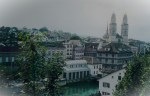 At some point, Swiss men were on the verge of being humiliated internationally as almost all European countries had already allowed women to vote. In the meantime, Swiss women kept pushing and presenting initiatives while peacefully protesting on the streets. After much internal and external pressure, men finally approved the right for women to vote in 1971, even though in some Cantons this would only become official 20 years later…
Ah, the peaceful Switzerland, with the placid lakes and the serene Alpine mountains, perfect for sanatoriums specialised in healing the body and the mind. A land where nothing much happens and people are focused on their farms and their business affairs…
Read more about Switzerland:
 WORDS IN IDEAS