
“Thank you for coming, folks”, started Mr John Booklish. “Our book for this month is ‘The Little Prince’, by Antoine de Saint-Exupéry. This is the second most translated book in the world (the first is the Bible). Basically, the story is about an encounter between a pilot that crashes in the desert and an alien. This alien is a little boy that comes from a star far away and is travelling throughout the universe, meeting other aliens who live on different planets. Like him, those people live alone on their little planet and each one has a certain purpose.”
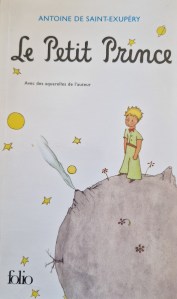 “A few remarks about the author before we give you the floor”, added Ms Clara Smartest. “Antoine de Saint-Exupéry was a pilot during the war and a courier, having crossed over the desert many times. He wrote several books, including one which stem from his nearly-dead experience after crashing in the desert. The description of his hallucinations is very interesting and lively. In a way, ‘The Little Prince’ also stems from such an experience, but reflects as well his concerns about the direction the world was heading. The thesis in the book is that grown-ups forget to be open to the world, as when they were kids, and understand nothing.”
“Martha, you may take the floor now. Tell us why you enjoyed the book so much”, said Mr John Booklish.
“Well, I think the Little Prince is really sweet. He is polite, but doesn’t let go of something he wishes to understand until he does. He is curious and is exploring the world with an open mind, ready to absorb what comes in his way. It’s a pity that only too late and when he was too far away he understood how much he loved his rose and how much his rose loved him.”
“Well, the rose was really annoying, wasn’t it?”, commented Mr Jeremy Toughready.
“She was acting like that because she wanted the Little Prince to pay attention to her”, replied Miss Martha Lovefeelings a little bit irritated.
“That didn’t work very well, did it? She made him go away.”
“He went away because he wanted to explore the universe.”
“That could be true, but if she wasn’t so annoying, he wouldn’t think of leaving, I’m sure.”
“Well,” interrupted Mr John Booklish, “let’s move on. Johanna, Mark, what do you think about the book?”
“I think the pilot was having a hallucination, which helped him to cope with the situation. He was alone, had just crashed in the middle of the desert, and needed to make a repair on the plane in record time. Imagining there was a boy there with whom he could talk to would be a good distraction”, said Ms Johanna Practicewell.
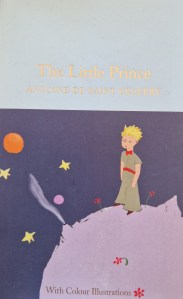 “It’s a beautiful fable about how adults lose sight of the most important things in life, like what love really is and how to make friends. Those people who the Little Prince met during his journey had become so focused on their purposes they had forgotten anything else. Therefore, the story aims to remind adults how it was to be a child, full of amazement and curiosity about the world”, said Mr Mark Mindhearting. “I especially like the fox. It’s like the voice of conscience we sometimes have in our mind, telling us to look closely, to become aware of what it is all about, really. It’s the fox that says the ‘essential is invisible to the eye’, as saying to look beyond what you can see with your eyes, that the important things, or better yet the most important things, are felt, not seen.”
“Yes! People usually don’t pay attention to feelings, it’s like they are blind”, said Miss Martha Lovefeelings with an indignant tone.
“Adults have responsibilities, children don’t. We need to focus on solving problems, not in guessing that some drawings represent elephants inside snakes”, commented Mr Jeremy Toughready. “The drawing does seem like a hat.”
“A hat with eyes…”, whispered Miss Martha Lovefeelings.
“Ok, people, it’s great that you have different opinions, but you don’t need to fight. This is just a book, nothing else”, interrupted Ms Clara Smartest. “Maybe this was the author’s goal when he wrote the story, to make people stop and think about their lives. Are we really paying attention to what is important to the people in our lives? Yes, people can be annoying, but, without them, life would be very empty.”
“I agree. All the people the Little Prince encountered during his journey lived alone. Yet, they didn’t notice it because they were so absorbed with the role they were performing. Do you really miss people if you don’t even notice they aren’t there?”, asked Ms Johanna Practicewell.
“Maybe, in time. If someone is too absorbed by his or her work, once they retire, they look around and there is no one there, no one to do things with, no one to share the wins and the fails…”, said Mr Mark Mindhearting.
They went on, discussing the ending. Some were sad because they hoped that the Little Prince would be rejoined with the rose. Others presumed that the Little Prince had found a way to get back home and lived happily with his rose.
“I’m afraid our time is almost up. There was much said to think about. And I guess the best endings are those which can have different interpretations”, said Mr John Booklish.
“True”, confirmed Ms Clara Smartest. “Before we wrap up, just to let you know that the next book will be ‘The Picture of Dorian Gray’, by Oscar Wilde. See you all (hopefully) in a month.”
 WORDS IN IDEAS