

Before the era of colonialism exploded in the 17th century, the Portuguese were already sailing the seas and establishing commercial ports on the coast of Africa (West and East), India and many other Asian countries, including China and even Japan. In China, despite the Chinese dislike for foreigners, they managed to be accepted as trading “partners” (it is not clear how) and built a very successful trading port in Macau. This port was in connection with other Portuguese ports in the area, for example in Japan, India, Malaysia, and Indonesia. The final aim was, of course, to ship many riches to the capital of the Portuguese empire, Lisbon.
“Mandarim” is originally a Portuguese word (mandarim), meaning a Chinese public official of a higher rank. Rumour has it that the Portuguese used to make fun of these bureaucratic officials, who were considered pedant, thus, the word mandarim could be used in a depreciative way. The Portuguese adopted this word from the Sanskrit mantrin via Malay mĕntĕri, meaning “counsellor”, as in “the one in charge”.
In truth, the term “mandarin” does not really exist in China, it is a European term. “Mandarins” were actually public servants that existed for as long as emperors existed. To become a public servant, one had to pass a very strict and demanding exam called 科举 [Keju], meaning “imperial examination”. The candidates would be (literally) locked up in cells for three days, dressed with a robe given to them (to avoid cheating) and would answer all kinds of questions from different fields of knowledge. Some would die during that time; many would fail the exam. However, those who passed the exam had a lifelong job waiting for them. The candidates could take the exam at any given age, so many would repeat it until old age.
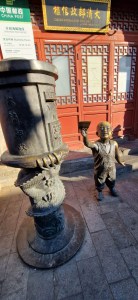 Education has always been very important in China, thus, these public servants (which were also scholars) were highly regarded by society. They were also examples and defenders of moral values, studying the arts, science, law, and politics throughout their lives. Confucius was one of those public servants in the law field. Things did not work very well for him in such a role and he ended up going back to his hometown to become a teacher. As a teacher, however, he was a success and his teachings set the basis for the entire moral framework of China, until our days. He lived at the same time as Sun Tzu, the one who set the military framework of China.
As part of the imperial staff, public officials spoke the language of the imperial court, which much later has become the standard language for the entire country. For Europeans that is “Mandarin Chinese”, which is named after those public officials. In Chinese, it is 中文 (Chinese language/writing). The first character is an abbreviation for 中国 (China or China-related). Some people say there are different languages in China, others say they are just different dialects. Standard Chinese is based on the language/dialect of Beijing (the old imperial court “language”), whose written version has been simplified in the 20th century to make it easier to teach it to the whole population and facilitate its spread throughout the country. Generally, this is the “language/dialect” learnt by foreigners.
Some decades ago, business people from outside China were encouraged to learn the Cantonese language. Cantonese comes from “Canton”, which originates from the Portuguese word Cantão, which was how Portuguese merchants would pronounce Guangdong, the Chinese province where Macau and Hong Kong are located. As both these cities became international trading ports (Macau was Portuguese and Hong Kong was British), during a period of time the international Chinese language for business was Cantonese. Not so much anymore.
Yet, “Mandarin” can have other meanings. It can refer to a type of orange, originated from Asia and similar to a tangerine, probably named after the Chinese imperial public officers due to their orange robes. The public offices also “gave” their name to a bird: the Mandarin duck that is very adorned, like the imperial mandarins…
Sources:
- Portuguese Macao (World History Encyclopedia)
- Mandarin (Merriam-Webster.com Dictionary)
- Scholar-Officials of China (Met Museum)
- 2,000 years of Chinese Examinations
- Who was Confucius? (National Geographic)
- Confucius (World History Encyclopedia)
- Mandarin duck
This article is part of the WORD CHRONICLES series
Word Chronicles are articles where the meaning of words, concepts, and perceptions are discussed.

 WORDS IN IDEAS