
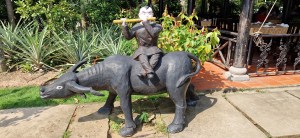
 Switzerland is all about the Alps, sanatoriums, chocolate, and cheese. In France, there is nothing else to do but to see the romantic Paris and eat haute cuisine. Italy was frozen in Roman times and only has pizza and pasta to taste. Portugal only has amazing beaches, good food, and friendly people. Nordic countries are cold in every way. And then there is Asia, which seems to be just one country full of Buddhist temples… and poverty. Africa is so poor, people still live in huts in the middle of the savannah, where there are lions, hyenas, hippos and giraffes. The Middle East is just desert. Latin America is Amazonia and the Caribbean is composed of exotic beaches.
These are just a few stereotypical perceptions Westerns, especially Europeans, have of foreign countries. Nowadays, local guides do their best to show all the beauty of their home countries, but even they sometimes fall into the marketing trap of giving people what they want… that is, what people have in their minds… that is, all the stereotypes they have been collecting in their minds. Is Paris really romantic? Is Inca civilization really lost? And what does it really mean “New York, the Big Apple”?
Before there was marketing (from the 19th / 20th century onwards), there were travellers who would roam the world and write their impressions about the foreign lands they were visiting. Usually, they were merchants looking for merchandise to buy, transport, and resell. They would follow routes like the Silk Roads. Even though they came into contact with people from different backgrounds, they were full of prejudices and their writings reflected them. Marco Polo, a Venetian merchant, travelled along the different routes of the Silk Roads for about 20 years, and conveyed his knowledge about Asia in a book that is still read 700 years later. His somewhat biased views have shaped how Europeans have perceived Asia.
Later, missionaries and colonialists have also provided a certain image of faraway lands. This time, the perspective was different. Europeans were imposing their culture throughout the world assuming that their culture was superior to all others. Therefore, since then, everything has been compared to European standards. Descriptions of uneducated people, weird traditions and behaviours, and odd constructions are still widespread in documentaries, films, stories… and marketing. All these distorted perceptions were so crystallised over the centuries that, when people go to those foreign countries, they expect to see what matches their perceptions. If there is not a match, people can get very disappointed, even demanding to see “the real country”.
Tourism began in Roman times, but it was in the 19th century that the idea of regularly traveling for pleasure was widespread (among rich people, of course, those who had money for that). After World War II, societies developed many inventions, infrastructures (like transportation networks), and better living conditions for their people. Workers have become entitled to paid holidays and packages to travel around the world grew and grew, especially recently with low-cost companies. Thus, the number of tourists around the world is now so great it is becoming problematic. Yet, although they can see other countries with their own eyes and make their own mind, many choose to keep seeing foreign lands with the outdated eyes of biased ancient travellers. Is it because it is easier? Is it because it is more comfortable? Is it simply because people travel to see what they have built in their mind as being true, and do not accept that their perception is wrong?
The world has changed dramatically. The Silk Roads closed in 1453, even though China is trying to rebuild it. Colonies have become independent countries, developing in their own pace and manner. Catholicism is no longer conquering the world, quite the opposite. The diversity of cultures and languages is being cherished. Europe is not the centre of the world anymore and their cultural superiority is being questioned. However, tourism wording still reflects the old times. Destinations are sold using descriptions of exotic and paradise places, and comparing them to European known places, or as luxury resorts built exclusively for tourists, in the middle of local extreme misery. The idea of traveling to other countries to see with their own eyes what they have pictured in their minds (fuelled by the images and the texts they have seen and read about the place), staying in hotels similar to the hotels they are used to in Europe, and eat similar food, is so strong that they get frustrated when they realise reality is very different.
It is difficult to let go of preconceived ideas on how the world is. Those beliefs help us make some sense of the world and give us a kind of safety feeling. However, it can also prevent us from discovering new wonderful things and realise that the other side may be as amazing (or even more amazing) that this one.
Learn more:
** YOUR WORDS AND IDEAS **
By Isabella Muir | On 26 February 2026 at 13:24
Your observations are so true. Our own cultural experiences are so ingrained that it can pervade all our opinions about ‘difference’. Keeping a truly open mind is challenging, but ultimately, so very rewarding!
By Words in Ideas | On 26 February 2026 at 14:22
Thank you, Isabella! Yes, we don’t realise how much our cultural experiences are a hindrance for our open minding…
This article is part of the FOREIGN LANDS series
Foreign Lands aims to discuss the difference between languages and cultural backgrounds.







 Long story short, merchants started to make a lot of money. And with wealth, came power. They organized themselves in guilds and companies, like the Dutch West India Company. These guilds and companies were owned by the State, but they acted as they were independent. Wealth increased exponentially, both for the State and the merchants. This led to a shift in the economy and feudalism gave way to mercantilism. In countries where agriculture was not as important, trading became the core business of society. This is what happened in The Netherlands, and which gave rise to the Dutch Golden Age.
  WORDS IN IDEAS