
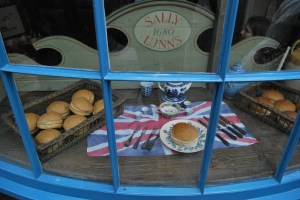
 If the thermal baths, for which Bath is famous, began with the Romans, “buns”, which nowadays are a famous English delicacy, were invented by a French woman. Or so it says the shop where these buns were supposedly invented. In fact, the origins of Sally Lynn’s buns are not proven, but the “official” story makes sense. It says that Solange Luyon was a Huguenot, who fled from France to England in 1680 to escape prosecution. Arriving in Bath, she was employed by a baker and there she invented the bun, which was inspired by the French brioche. And, as English people have enormous difficulty pronouncing foreign names, she became Sally Lynn.
A bun is something between bread and cake. It is usually eaten with butter or jam, but it can also come with savoury toppings. Whether the story is true or not, the fact is that Sally Lynn’s buns are unique. Many have tried to copy it, with no success. Therefore, you need to go to Bath, UK, to try it. You can find them in one of the oldest houses in Bath, officially dated from 1482, conveniently located 200 meters from the Roman Baths. Actually, excavations have shown that food has been prepared in Sally Lynn’s place since the Romans. A small museum in the basement tells you the story.
So, when Bath turned into a famous resort in the 18th century, Sally Lynn’s buns were already well established and widely known, fitting very nicely in the new city concept. Everyone would eat there and probably ordered them to be delivered at home, for breakfast, for example. Jane Austen was one of those people and there is evidence that she really enjoyed them.
A glimpse of Bath
Visiting Bath is immersing yourself in the 18th century. As you walk through the streets, you can almost imagine carriages pulled by horses, people dressed in the latest fashion of that time… and gossip, gossip everywhere. Gossip about who had married who, and why; who had recently died, and who inherited the estate and the fortune; who had eloped with whom, and whose family’s name had been sent to the mud…
London was still London, of course, and “the season” was not complete without going there. However, Bath was the place to go. At least for those who wanted to be someone, but hadn’t got there yet. The competition with London was fierce, even though it was not even. A lot of investment was made to turn Bath into a great recreational resort. Three centuries later, the buildings are still there, with little changes in the scenery created at the time.
Why invest so much in Bath from all places? Due to its thermal waters. The Romans, those barbarians who tried to invade England and failed, were right after all. Before they were duly expelled from the country, they had time to build a grand thermal public building in Bath, which is still standing and fully operational nowadays. Hence the name Bath (where Romans would take their bath, publicly). Those barbarians knew what they were doing… The waters were indeed miraculous and everyone wanted to bathe in them and become cured from all diseases, real or fictional.
However, did people in the 18th century actually bathe in those waters and really became cured? After all, there was so little time for that, with all that gossip to be had, the shops, the afternoon teas, and the balls (oh, my goodness, the balls!) … It would not be surprising if people would forget about the thermal waters…
 WORDS IN IDEAS