
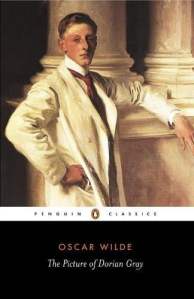
 “The book for this month was written by Oscar Wilde, an Irish writer who lived in the last half of the 19th century, during the last years of Queen Victoria’s extensive rule. His famous playwrights wittily characterized the society at the time and surpassed his numerous poems and short stories. His only novel, ‘The Picture of Dorian Gray’, tells the story of a beautiful young man throughout his increasingly decaying life. At the beginning of the story, a friend paints his portrait, forever preserving its untainted beauty. This painting will have a crucial role in his life”, said Ms Clara Smartest.
“Thank you, Clara. Now, who wants to be first?”, asked Mr John Booklish.
One by one, the members of The Intrepid Book Society gave their opinion about the book. In general, they thought the story was about vanity and how important appearances are in society, which is to say how someone who is very rich and very beautiful is beyond reproach, no matter what he does behind the scenes. The painting allowed him to maintain his youth beauty undamaged, giving him a free pass: he could do whatever he wanted that nothing would ever happen to him.
“The portrait would absorb all his ugliness, so Dorian Gray would remain immaculate before other people in society”, said Ms Abigail Vooght. “I know a lot of people who wish that could happen, even though they still can get away with a lot of ‘ugliness’. If only people knew what happens in the background…”
“I think Johanna made an important point: Dorian Gray was negatively influenced by Henry Wotton”, said Miss Amelia Matterfis.
“Yes, but he made his own decisions and, by realising he could get away with anything, he stopped restraining himself”, said Mr Jeremy Toughready. “It was his choice, no one forced him.”
“Maybe he was traumatised by the death of his fiancée; he felt guilty about it. So, all the wickedness was a result of that”, said Miss Martha Lovefeelings.
“That is just excusing him. He has no excuse. He became an evil man and that’s the end of it. Maybe he had always been evil. He certainly was very vain; only his beauty mattered to him”, said Mr Mark Mindhearting.
“Well, people around him were always praising him. That didn’t help…”, commented Miss Amelia Matterfis.
“I think it shows the hypocrisy of society. People would praise him because he was beautiful and rich. However, behind his back, the story was different. Many close friends had stopped speaking to him and they were spreading rumours about his bad conduct”, said Mr Mark Mindhearting.
“Except Basil, the painter, who actually wasn’t part of his social circle. He saw what was going on and he went there to warn him. Look what he got in return…”, said Mr Jeremy Toughready.
“Basil turned out to be his only true friend. All others, and especially Henry Wotton, weren’t really his friends. No one really cared about Dorian Gray. Only Basil, who had been cast out of his life”, said Ms Johanna Practicewell.
Then, they discussed the ending, how appropriate it was and how the story could have ended differently. Some thought the ending was perfect, others said that they would have preferred it if the story could have had a twist of some kind.
“We have to consider the time in which the novel was written. It shows the people’s mentality then”, said Mr Matthew Barnepy. “Besides, police work was different in those days, although police are mentioned in the book.”
“I don’t think people’s mentality is that much different today, to be honest”, said Ms Abigail Vooght.
“One thing is certain: nowadays no one would paint a portrait. They would just take several photos with the smartphone making funny faces”, laughed Miss Amelia Matterfis.
“When photography first appeared, it was believed it would capture people’s souls. If Oscar Wilde had written the novel at the beginning of the 20th century, instead of a painting maybe the story would be about a photo…”, said Ms Johanna Practicewell.
“I think he was inspired by the time he was living with a painter, at the beginning of his professional life. He had just graduated from Oxford and moved to London to pursue his literary career”, said Ms Clara Smartest.
“Well, nowadays, Dorian Gray wouldn’t be able to go so unnoticed. Someone would have taken pictures of him with the smartphone. Then, it would all be blown up on social media”, said Miss Amelia Matterfis.
The group went on discussing other scenes and other characters of the book and how they influenced the story. They also compared the differences and the similarities between the Victoria Era and the present day.
Wrapping up, Mr John Booklish announced that the book for next month would be “Tierra” [Earth], by Eloy Moreno.
 WORDS IN IDEAS