The Intrepid Book Society decided to organize a trip to Oslo, Norway, to get to know the hometown of the writer Jo Nesbø. Contrary to what was customary, the idea was not to visit the places where action took place in his books, but to capture the essence of the city that inspired him. 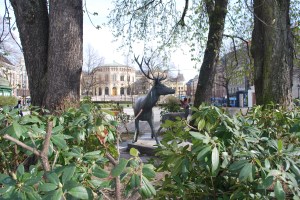 The capital of Norway is a pragmatic city, made for people to live there. Yet, it has a few surprises in store for less well-informed tourists. Looking like a simple village, Oslo is peaceful and quiet. Yet, it is also full of life and activities. It preserves its history, yet it is modernizing.
“Ok, so, like in any other city, Oslo has upper-class boroughs and lower-class boroughs”, said Mr John Booklish at the airport. The group was waiting to board the plane, a direct flight to Oslo, and John thought it was a great opportunity to do a briefing. He continued, showing a map of the Oslo boroughs to everyone.
“Generally speaking, wealthy people live next to the centre (called Sentrum, coloured in grey in the map), on the west side. The people with less money (let’s put it this way) live on the east side. Middle-class people live north of the wealthy borough. It may not be exactly like this, but it’s a reference. Vestre Aker is also where many wealthy people live. It is situated on the top of a hill and it has an amazing view over the fjord. Plus, there is more space to build and it’s far from the city centre, meaning it’s quieter.”
Mr John Booklish took a break to give them time to process the information and take a look at the map. Then, he continued by saying which boroughs they were going to visit and what they were going to see in each one. Nobody really paid attention to what he was saying as they weren’t familiar with anything and couldn’t relate. After a short while, the boarding began and the briefing ended. It was a good flight and they landed in Oslo without problems or turbulence. Due to the fact they had arrived very late, they went straight to the hotel to have dinner and rest. The next day, they had to wake up very early to make the most of it.
Modern Oslo
Their reference point was the Oslo Central Station, which is where the Airport Express arrives and departs. Besides taking people to several cities in Norway, the trains also travel to Sweden and Denmark. Nearby, there are connections to the city public transports: buses, metro, and tram. The members of The Intrepid Book Society were going to catch the metro on Line 1 in Jernbanetorget station, located on the square in front of the Central Station main entrance. The Holmenkollen Line connects central Oslo with the district of Vestre Aker. Here is where some of Jo Nesbø’s characters live, like Roger Brown (from Headhunters) and Rakel, Harry Hole’s love.
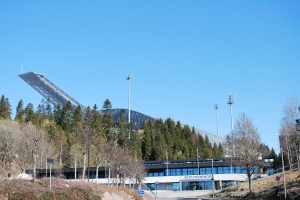 While Jo Nesbø’s characters usually drive their own cars to get there, the Society’s members had the chance to climb the mountain by metro, which runs along a narrow line very close to the edge of the steep slope. Although a bit scary for the fearful ones, the journey provides a spectacular view. The train carriages are prepared for the show as they are equipped with many windows. They are also prepared to accommodate the skis of those who go up the hill to practice alpine skiing, cross country, or ski jumping during winter. The Holmenkollen stop was constructed very close to the Holmenkollen National Ski Arena, where the Society’s members admired the huge Holmenkollbakken (the ski jumping hill of Holmenkollen). Being at the very top was vertiginous, especially because they knew that there was nothing but air underneath.
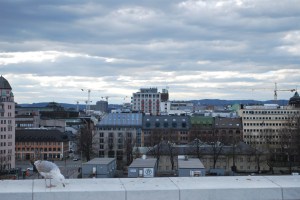
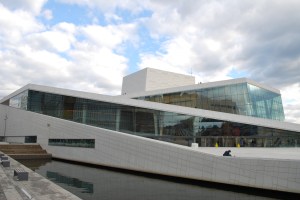 Back with their feet on the ground, the Society’s members made their return journey to Sentrum, the central area of Oslo, and got out at Jernbanetorget square. If they walked for about 20 minutes to the east, they would reach the district of Gamle Oslo (“Old Oslo”), where the Grønland Police Station is situated, the work place of Harry Hole. Instead, the Society’s members walked towards the waterfront, to Bjørvika. Here, they admired the Opera House, an iconic symbol of Oslo. Built by the water, it seems it is emerging from the fjord’s depths. Its roof extends to the ground, inviting visitors to climb to the top. Once there, the view is magnificent. On one side, the Society’s members could see the fjord in front and, on the left-hand side, the new Munch Museum and some new development buildings. On the other side, at the back, they could see the Barcode Project, which consisted of several tall and modern multipurpose buildings.
“The ‘oldest’ character of Jo Nebø, Harry Hole, witnessed the construction of all this”, said Miss Martha Lovefeelings, gesturing around.
“Yes, he is like Oslo: an oldie entering the 21st century”, said Mr Jeremy Toughready.
“Tomorrow we will visit a castle that was built at the end of the 13th century, way before Harry Hole existed. The Akershus Fortress is situated on a hill and has served different purposes throughout the centuries: defence, prison, military base, and even the office of the prime-minister”, said Mr John Booklish.
“What are going to do for the rest of today?”, asked Miss Amelia Matterfis.
“Ah, I’m glad you asked! We are going to have fun!”, replied Mr John Booklish.
 Everyone was happy to receive such great news. Not that they were not having fun, but that promised something special. Mr John Booklish remained mysterious and told them to follow him. They caught the tram to Aker Brygge, a modern area that mixed residence buildings for high-class people, marinas, shopping areas, and entertainment. There were many restaurants to choose from, but, before dinner, the Society’s members went to the Astrup Fearnley Museum of contemporary art, at the end of the street. It had an original design that perfectly blended into the environment.
Historic Oslo
The Society’s members woke up the next day very late in the morning and almost missed breakfast. As Mr John Booklish was expecting that to happen, he had planned a lighter second day: they would spend the day in the port area. Oslo was located at the end of the fjord bearing its name. Its inhabitants had built summer houses in many of the islands along the fjord, thus, there were boats parked in several marinas along the waterfront.
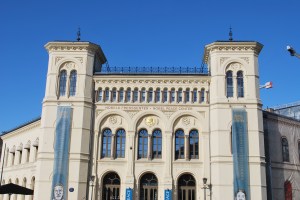 If someone was facing the fjord in front of the port, Aker Brygge would be on her/his right-hand side, the Akershus Fortress would be on her/his left-hand side, and Oslo City Hall would be on her/his back. It is in Oslo City Hall where it is announced the only Nobel Prize not awarded in Stockholm, Sweden: the Nobel Peace Prize. In front of Aker Brygge, in what was once a train station, the Nobel Peace Center tells the story of the award and provides information of every Nobel Peace Prize awarded. The Society’s members thought it was quite inspiring.
“Why is the Nobel Peace Prize awarded in Oslo while all others are awarded in Stockholm?”, asked Miss Amelia Matterfis.
“No one really knows. It was on Alfred Nobel’s will. He determined how the Committee should be composed, but no explanation on why the Peace award would be in a different location with a different Committee”, explained Ms Clara Smartest.
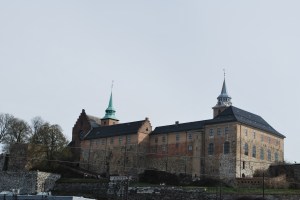 The Society’s members were talking about what they had learned at the Nobel Peace Center, about what peace meant in the world, and about how it related to the latest news while crossing the square in front of the port, passing the Fish Market and the City Hall, and heading to the Akershus Fortress. Once there, they were impressed by how well preserved it was. There were gardens everywhere around the buildings and a lovely park with a wonderful view to Oslo and the fjord.
One of the buildings was the Norway’s Resistance Museum. There, the Society’s members learned how Norwegians resisted the occupation of Nazi Germany. Despite the Royal Family having taken refuge in London, the Crown Prince, Olaf, never gave up on his people and played a crucial role in the fight against the invaders. When the war was over, he was welcomed with cheers by the population of Norway.
“You said it was going to be a lighter day…”, said Ms Johanna Practicewell when they were leaving the Akershus Fortress.
“Well, I thought it was. I mean, we didn’t leave the port area. And that’s all for today”, replied Mr John Booklish.
“Yes, but learning about the Nobel Peace Prize and the Norwegian resistance to Nazism during the Second World War in one day… it’s heavy. It reminded me of all the evil there is in the world”, said Ms Johanna Practicewell, thinking about her colleagues at the Doctors without Borders.
“You’re right. I guess I didn’t see it that way. But, then again, visiting a country is not only learning about the good, we also have to know about the bad”, said Mr John Booklish.
“Actually, the Second World War is the subject of one of Jo Nesbø’s novels: The Redbreast. What happened during that time is still a trauma for Norwegian people”, said Mr Matthew Barnepy.
The following days were spent exploring the Frogner district, where some of Jo Nesbø’s characters supposedly work or live. For example, Roger Brown (from Headhunters) opened an art gallery for his wife in Erling Skjalgssons gate, which is not far from where Olav’s boss (in Blood on Snow) lives, in Bygdøy Allé. Frogner is the city’s wealthiest borough and therefore the most coveted. London has Mayfair, Oslo has Frogner (maybe not so luxurious).
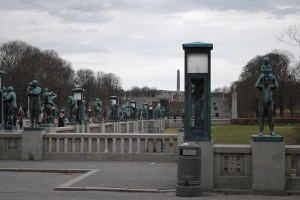 The Jo Nesbø’s character Harry Hole lives at a 15-minute walk north of Karl Johans gate. Karl Johans gate is the best-known street of Oslo and it is where the heart of the city beats. Located about 700 metres parallel to the port, it connects the Royal Palace and the National Parliament, and it’s full of shops, cafés and luxurious hotels, with a garden on the side. This is also where the National Theatre was built. All these landmarks were built in the 19th century. Built in the 18th century, the Frogner Manor, today the Oslo City Museum, gave its name to the entire district. Back in the day, the Manor included a garden that later became a park. Nowadays, this park is full of eccentric sculptures made by Gustav Vigeland, one of the greatest Norwegian artists. Vigeland was also the creator of the Nobel Peace Prize medal.
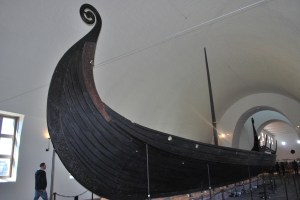 Like Berlin, Oslo also has a Museum Island. Except, in Oslo it is not an island, but a peninsula, and it is not exactly situated in the middle of the city centre, but not very far from the port. Besides, it is much bigger and you can hike, cycle, swim and do all kinds of outdoor activities there, including yoga. As for the museums, they are:
- the Viking Ship Museum, with authentic Viking ships;
- the Norwegian Museum of Cultural History, with real houses from all over Norway from different periods of history;
- the Norwegian Maritime Museum, with the history of shipbuilding and maritime technology;
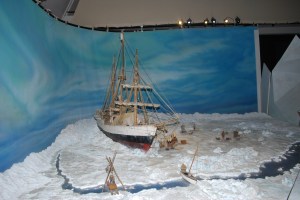
- the Fram Museum, with the polar exploration ship that went both to the Arctic and the Antarctic;
- the Kon-Tiki Museum, with the balsa wood raft used by Thor Heyerdahl to cross the Pacific Ocean.
By the end of the trip, everyone was tired, but very happy. They went to Aker Brygge to have the last dinner in Oslo, sharing impressions and showing their pictures.
** YOUR WORDS AND IDEAS **
By Isabella Muir | On 30 April 2025 at 12:12
Ah, the wonderful city of Oslo. I had the pleasure of visiting it several decades ago and it sounds from your description that any changes that have occurred since then have only been positive!
By Words in Ideas | On 01 May 2025 at 21:33
They are recuperating key spaces in the city, but in a thoughtful way. It is remarkable!



 You can find these and other articles from the first two years compiled in Words in Ideas Book 1: “Articles 2024-2025”.
  WORDS IN IDEAS