
 In 1917, during the First World War, the writer Edith Wharton was invited to visit Morocco by the French Governor of the then French protectorate. She travelled around the country for a month, witnessing traditional events, admiring historical landmarks and meeting women who were part of the Vizier’s harem. Back home, she wrote a book, which was intended to be the first tour guide book of the country. It is a Westerner’s view of what was then considered the “Near East” (meaning North Africa). Edith Wharton fiercely and openly defended French governance and implicitly criticized some Arab practices. For example, she described the women of the Vizier’s harem as prisoners and unhappy and the ceremonies she witnessed were deemed primitive.
After reading the book, Ms Clara Smartest decided to travel to Morocco to get to know the country a century later. What she found was a surprising country, rooted in its traditions and accepting modernity on its own terms.
Marrakesh
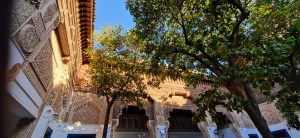 When in Marrakesh, Edith Wharton stayed at the Bahia Palace, which nowadays is a museum open to the public. It was built in the 19th century as the private residence of the Grand Vizir of the Sultan, who worked and lived there with his wives, his concubines, his children and many slaves. Before being occupied by the governor of the French protectorate, the Palace was the residence of the Grand Vizir’s son. After the independence of Morocco, the King lived in this Palace for a short while before he decided to transform it into a national monument.
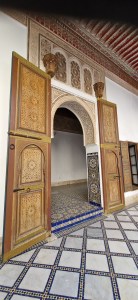 Ms Clara Smartest walked freely through the labyrinth of majestic rooms and courtyards. Although there was little furniture, Ms Clara Smartest could easily imagine how it was to live in such a place. For the Vizir, it was like living in the “One Thousand and One Nights” fairy tale. However, for the women who were part of the Vizier’s harem, and as Edith Wharton mentioned in her book, the Palace was a prison. A beautiful prison, with charming fountains, decorated with lovely tiles, and with interior courtyards and gardens, but a prison such the same. A world apart from the outside world.
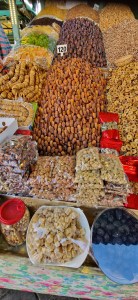 Outside, the city vibrated to the rhythm of its beating heart: the Jemaa el-Fnaa square. Several streets full of stores, where people often had to give way to passing motorbikes, flowed into (or from) this huge square. Its true dimension could only be appreciated in the morning, when it is empty. Throughout the day, traders gradually arrived and set up their stalls, where they would stay until late night. Early in the evening, the square was already full of snake whispers, monkey owners, fruit sellers, clothes and shoes retailers, food and spices merchants. Everything could be found and bought here. After the sun came down, performers from different arts would entertain bystanders.
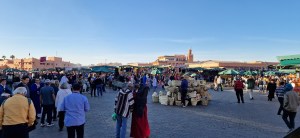 Ms Clara Smartest immersed herself in this improvised maze of street vendors and let her senses be overwhelmed. Later, she learned that this market has existed since the 11th century and remained pretty much the same. Travelling merchants from several regions of Africa, Europe, and the Middle East used to converge there to do business and exchange information, turning the square into a melting pot of different cultures. Due to these long-lasting traditions, Jemaa el-Fnaa became a UNESCO Intangible Cultural Heritage of Humanity in the 21st century.
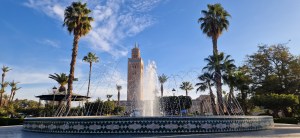 The square is located inside the Medina (the old Arabic town), a UNESCO World Heritage site, and was built next to the Kutubiyya Mosque, whose minaret tower looks at the market from above. On the other side of the tower, Ms Clara Smartest found a lovely long garden with a grand fountain at the end, reminding her of the importance of oases, water and plants in the middle of the Desert. Earlier, she had been given the opportunity to visit the Jardin Majorelle, the exotic garden created by the French painter Jacques Majorelle, with plant varieties from all over the world, and protected by Yves Saint Laurent and Pierre Bergé. As Ms Clara Smartest confirmed, gardens are different in countries with deserts. They are more exuberant, with lively and ever-present fountains.
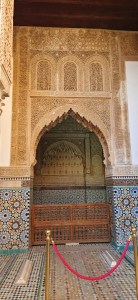 Edith Wharton had also visited the Saadian Tombs, which, at the time, had been recently discovered by the French. The Saadian family ruled Morocco in the 16th century and, to make their power recognizable for centuries to come, they built a majestic mausoleum similar to a palace. There are rooms where family members are buried, full of beautiful tiles and elegant columns, among small gardens and scenic pathways.
Atlantic Coast
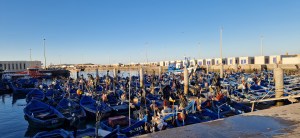 Travelling caravans, composed of camels loaded with goods to be sold or exchanged, have always been a typical image of the Desert. As Morocco is situated in a privileged geographical location, connecting North Africa and the Sahara Desert with the Atlantic Ocean and Gibraltar (the closest point between Europe and Africa), it is not surprising that European powers were eager to take hold of this land. The Roman Empire was the most successful, but then the Arabs invaded the region and kept Europeans out for centuries. Nevertheless, Europeans greatly influenced the Morocco Atlantic coast by building ports and doing business.
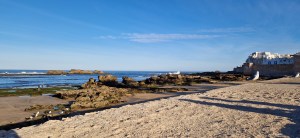 On reaching the coast, Ms Clara Smartest noticed how different the cities were compared with Marrakesh, located inland. While Marrakesh was connected to the desert and to oases, cities like Essaouira and El Jadida (both UNESCO World Heritage sites) were connected to the sea and fishing. Essaouira (formerly named as Mogador) became an important international trading port by the end of the 18th century and its fortifications, although built by the Moroccan government of the time, were greatly inspired by European architecture. El Jadida (formerly named as Mazagan) was a Portuguese colony established at the beginning of the 16th century as a support for the trading route to India. These points along the African coast were crucial for Portuguese ships to get supplies and to trade African goods (like slaves).
Back then, the ships were “camels” of the sea, loaded with precious goods. Thus, pirates represented a serious danger. They would create “nests” in strategic points along the coast, where they would regroup and repair their vessels. One of those “nests” was located 100 kilometres north of what would later be the Mazagan colony. The Portuguese destroyed the pirates’ hideout and a few years later established their own city there. They named it “Casa Branca”, which means “White House”. A few centuries later, Spanish merchants took over and they changed it for “Casablanca”. During the French protectorate, the city became “Maison Blanche”, but somehow the Spanish version prevailed. However, it was under the French administration that Casablanca became a major international port.
Ms Clara Smartest had high expectations when arriving in Casablanca [see here photos from real life in the city]. She had seen the famous film and was very disappointed when she was told that none of the scenes were shot there. The entire film had been shot in USA’s studios. As tourists wanted to go to Ricky’s Café (which never existed in reality), Kathy Kriger thought it was a good idea to make it real and she opened it on 1st March 2004. Looking for other similarities between the city and the film would be pointless, concluded Ms Clara Smartest.
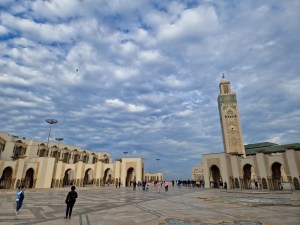 Casablanca was the most cosmopolitan city that Ms Clara Smartest visited in Morocco. The presence of international companies, especially American, was striking and contrasted with the old traditional buildings. Touristically, there was little to see there. The only exception was the Hassan II Mosque. Ms Clara Smartest was stunned when she approached the Mosque and she was even more impressed when she got in. It was not only about its dimension, which was huge, but the concern to make each detail as perfect and beautiful as possible. Yet, the most astonishing was the fact that it was partially built on the sea. This idea made total sense in Casablanca as the city has a strong connection to the Atlantic Ocean. The lovely promenade along the beach emphasizes such a relationship and it was the focal point of the city.
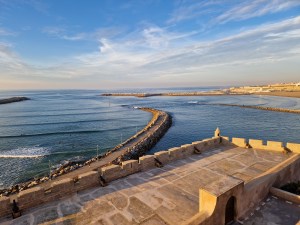
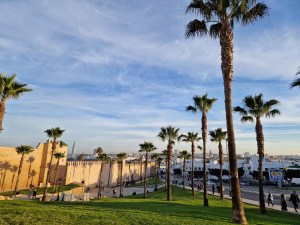 Ms Clara Smartest trip ended in Rabat, Morocco’s capital. At approximately 92 km north of Casablanca, the French governance made Rabat its administrative capital. The Governor underwent many constructions that transformed this imperial traditional city into a modern westernized capital, although Moroccan legacy was scrupulously respected. The result was an achievement worthy of inscribing Rabat as a UNESCO World Heritage site. Besides the Royal Palace and the Hassan Mosque and the Mohammed V Mausoleum, Rabat is famous for the Qasba of the Oudaïa (or Kasbah des Oudaias). Located on the top of a hill by the sea, this fortified old town has a privileged view in any direction. Their typical white and blue houses shape narrow streets that lead to small squares at the edge of the top of the fortress. Down there, Ms Clara Smartest could see the waves of the Atlantic Ocean crashing against the beaches’ sand.
It was the perfect ending of her Moroccan adventure. Although she didn’t go to the desert, to the Atlas Mountains, nor to the north part of the country, she could admire the Morocco culture, deeply rooted in international trading with various parts of the world. She could also notice how different was the Atlantic coast, heavily influenced by Europe, from inland, more closely linked to its desert legacy.
** YOUR WORDS AND IDEAS **
By Isabella Muir | On 31 March 2025 at 08:08
My thoughts chime with Ms Smartest, when she says that the people of Morocco have found a way to accept ‘modernity’ on their own terms. Protecting diverse cultures from interference from others who believe they ‘know better’ is surely the best way to ensure global harmony.
By Words in Ideas | On 31 March 2025 at 21:51
Ms Smartest is glad and totally agrees with you! 🙂
 Tea is drunk everywhere in the world and there are many cultural ceremonies related to it in different countries, like the Traditional Japanese Tea Ceremony in Japan, the Afternoon Tea in England, and the Maghrebi Mint Tea, in North Africa. All of these ceremonies aim to welcome guests and be a moment of relaxation and socialization with friends and family.
 WORDS IN IDEAS