
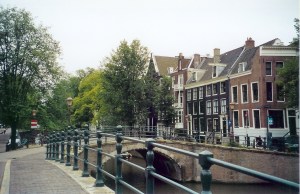
 Amsterdam is known for its special cakes and colourful districts. Looking at its peaceful, village-like streets, it is easy to forget that this city was once a centre of world trade and an important place during the Second World War. The best approach to get to know Amsterdam is to keep all types of preconceptions out of one’s mind and pretend one has never heard anything about the city, which was what the members of The Foreign Land’s Explorers tried to do. It was an intense week, full of fun and cultural knowledge. They didn’t change the idea they had about the city, but they expanded it. Amsterdam proved to be much more than they thought it would be.
The iconic image of Amsterdam
“When we think of Amsterdam, we think of bicycles. Ok, we also think of cannabis and the Red District. Michael is going to talk about that next. So, bicycles. Interesting story”, said Sophia before telling how the city turned green in transport, at the start of the presentation that The Foreign Land’s Explorers had prepared for The Intrepid Book Society.
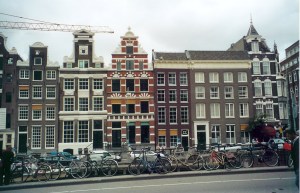 Bicycles were invented at the end of the 19th century and promptly were adopted by Amsterdam’s residents. As the city doesn’t have hills, it was easy to cycle there, first for fun and then for transportation. However, after the Second World War, cars started to invade the streets and soon the streets were full of noisy and killing machines. “Killing” because many people, mainly children, were being killed by cars. The residents organized themselves to end the situation and pressed the government to protect its people. It worked. A new way of thinking urban planning was put in place and cars were driven out of town. Now, the capital of the Netherlands stands as an example that a greener alternative is possible, one that protects the environment and the people.
“Amsterdam has a great tradition to be open minded”, said Michael. “While the population were fighting to end car circulation and return to bicycles, the government decided to legalize the use of cannabis. The idea was to set apart the cannabis market from the markets for other drugs, focusing on fighting the latter. It went well for a while, but now the Netherlands is a drugs’ hub”.
Michael paused his explanation to answer the questions from the audience whether they had been to a coffee shop. He said they all had, except Elizabeth, who had preferred to go to a museum. When asked about how it was, Michael said that each one experienced it differently. Sophia thought she was dying, Leo was euphoric and thought he could do anything, Michael just relaxed and saw the world as a big SPA, and Jack went on talking to everyone.
“The acceptance of drug use is in line with Dutch awareness of how people really are instead of imposing the way people should be. They also realised that prostitution was a reality and there was nothing they could do to end it (they tried). The solution was to embrace it and legalise it, with conditions, of course. Prostitution on the street is forbidden, hence the windows where the women are exposed”, continued Michael. “Although the Dutch are very open minded, they also have strict rules, which visitors have to follow.”
Obviously, Amsterdam is not just about bicycles, cannabis, and prostitution. In fact, the city itself looks like a quiet but busy village in the middle of the countryside. Sometimes, it is hard to believe that it is the official capital of a country. Just be careful when crossing the streets: you might be run over by a bicycle. They would not stop because of you.
Engineering and architecture
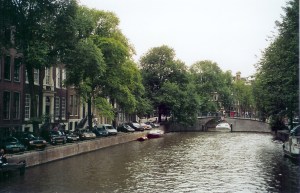
“Amsterdam’s urban landscape is also very iconic. Its canals were built in the 17th century to supply the population with goods arriving at the port. It was a major, and hugely successful, engineering work and urban planning makeover. The canals were built as rings around the city and houses were added along them. The idea was to sail boats from the harbour to people’s doorsteps (literally). They are now UNESCO World Heritage”, said Jack.
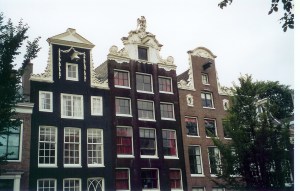 The houses were also part of this significant change in town. Partly residence, partly warehouse, they were tall and relatively narrow. The living quarters were located upstairs, right below the attic. The ground floor was used as a store and, together with the attic, as a warehouse to store goods, not only for domestic consumption, but also for selling. Cranes were installed at the top of the building, where the attic was, to help take the goods from the boats to the house. At that time, the houses were bordering the canals, so the boats were moored right next to the houses.
People from Amsterdam have always been very pragmatic. They not only accept how people really are, and base their society on those premises, but also combine comfort with practical matters. During the 17th century, society was based on commerce; there was nothing else. Therefore, people had to live accordingly. Shops, warehouses, residences were all mixed together. However, that didn’t mean that symbols of one’s wealth were not displayed. Indeed, they were, abundantly. Each house was built differently, reflecting its owner’s wealth, power, and social status.
Nowadays, Amsterdam is full of modern and original buildings, reflecting how far imagination can go. Just as it did in the 17th century, today it is reinventing itself to keep up with the times. As the climate change becomes increasingly pressing, Amsterdam is invested in becoming a circular economy. Buiksloterham is a good example of those efforts. Yet, and as a way to celebrate its trade-related past, a futuristic business area is being built in Zuidas District, where the Valley building is its main star.
These are just a few examples of the modern architecture you can admire in Amsterdam.
Painting during the 17th century and beyond
“Art has always been extremely important in the Netherlands, especially painting and especially during the 17th century”, said Elizabeth. “As Dutch merchants were becoming incredibly wealthy, they wanted to show it in every way they could, including through portraits of them, their families and their sumptuous daily life, which was, at the same time, deeply rooted in Dutch culture and its values. As painters were earning a lot of money with these commissions, they engaged as well in other types of paintings, discovering new techniques. Thus, Dutch painters dedicated themselves to portrait life in its smallest details in cities and in the countryside, for example, a woman pouring milk to make a cake, people playing instruments in a party, military meetings, maids in a house’s courtyard.”
Inadvertently, these paintings turned out to be precious to understand how life was in those days. They also reveal a new and innovative trend where the play between light and shadow is explored and advanced. Rembrandt was a master of this technique. Born in Leiden, he soon moved to Amsterdam where he opened his first workshop. Successful and recently married, he moved to a new and grand house, which tourists can visit today and where we can see how painters used to work and how they would prepare the colours. Although Rembrandt was forced to sell this house some years later due to family and financial tragedy, luckily it was possible to recreate its intimate quarters and his studio as it was back then. His paintings can now be admired in the Rijksmuseum.
“However, there are other famous Dutch painters from that time, whose work can also be admired in the Rijksmuseum: Johannes Vermeer, Gerrit Dou, Frans Hals, Judith Leyster, Pieter de Hooch, and Jan Steen. The detailed scenes of people living their lives is best appreciated when looking directly at the painting. It seems the characters come alive and take us back in time”, said Elizabeth. “Way better than going to a coffee shop. I really don’t regret going to the Rijksmuseum instead.”
Vincent van Gogh, born and dead in the 19th century, is considered the second greatest Dutch painter, right after Rembrandt. However, contrary to Rembrandt, van Gogh has his own museum in Amsterdam. He had a very troubled life that took him from the Netherlands to London, to Paris, to Belgium, and back to the Netherlands and then back to France again. After trying and failing many professions, he finally realised he was an artist and dedicated himself to drawing and painting. And after much studying and discussing with other artists, he found his unique style. He worked industriously for years until he shot himself due to a mental disorder, isolation, rejection, and continuous failure. At the beginning of the 20th century, after his death, success came in the most astonishing way.
“Van Gogh’s paintings are explosions of colours that seem to be images of what was happening in his own mind”, concluded Elizabeth.
Brief history of seven and a half centuries
“In 2025, Amsterdam celebrates 750 years of existence. This means that officially the city ‘was born’ in 1275”, said Leo. “Back then, it was a village settled on the banks of the River Amstel. That village became a city under the lordship of the Count of Holland. Nowadays, Amsterdam is located in North Holland, a province of the Kingdom of the Netherlands.”
Due to its privileged geographic location, Amsterdam became a trading hub, with ships sailing as far as the Baltic countries, returning full of goods that would be distributed throughout Europe. These activities gained weight in the city’s economy, becoming its driving forces. By the 17th century, Amsterdam was already a city of merchants and, due to the colonies the Dutch government were acquiring all over the world, it became the commercial centre of the world. Precious merchandise arriving from India (like spices), the Caribbean (like sugar), and other places would be transported through the newly built canals to the merchants’ houses, especially built for taking the special cargos and storing them until they would be sold to European clients who were willing to pay a large amount of money for them.
The city was busy and wealthy, in a time of religious persecutions and political wars. Amsterdam became a safe harbour for artists and intellectuals seeking opportunities or refuge. Thus, many scientific and cultural breakthroughs were made. René Descartes, Baruch de Spinoza, and John Locke were some of the famous “influencers” that lived and worked there during this period. The Dutch Golden Age seemed unstoppable and endless. Yet, it did stop when other cities, like London, took away its role of commercial and financial world hub, and it did end when Amsterdam was invaded first by the Prussians and then by the French.
 Nevertheless, that glorious century shaped the city and made it what it is today. A few centuries later, Amsterdam was finally thriving again when World War I broke out. Then, the Great Depression came, and, as this was not enough, World War II broke out. The Netherlands were invaded by the Nazi Germany and thousands of Jews were taken from the city. Probably many of them were descendants of those who had sought refuge during the 17th century’s persecutions. Anne Frank was among those who were taken to concentration camps and never returned.
After the end of the Second World War, Amsterdam was in need to recover again. And it did. However, everything changed again with the rise of social unrest. During the 1950s and 1960s, people went to the streets to claim important shifts in their lives. They succeeded in replacing cars by bicycles and witnessed their government liberalizing the use of cannabis and prostitution. This new open-mindedness, together with their talent for business, gave way to the modern Amsterdam that is now fighting climate change.
** YOUR WORDS AND IDEAS **
By Isabella Muir | On 28 May 2025 at 08:57
Thank you for a fascinating journey through Amsterdam, past and present. I visited the city many years ago and was struck by how open and friendly it was. I am always in awe of the way the Dutch – even the very young – have such a comprehensive knowledge of English – it puts many of us to shame!/p>
By Words in Ideas | On 28 May 2025 at 21:18
They learn English from primary school, the same as in the Scandinavian countries. For people who go there to live and learn their languages it’s actually an obstacle because the “natives” only speak in English with foreigners!
 WORDS IN IDEAS