

There is a huge avenue running from east to west (and vice-versa), whose midpoint is between Tiananmen Square and the Imperial City (which includes the Forbidden City). Besides these old iconic Chinese symbols, the avenue is full of modern buildings, the kind of buildings we are used to seeing in business districts in Western capitals. In reality, there are modern-Western-style buildings everywhere: airports, train stations, residential buildings, shopping centres. Wherever you look, it looks like you are in a Western city. Those who are expecting to see typical Chinese buildings, with the traditional roofs and characteristic doors, are going to be disappointed. Sure, there are palaces and temples from the old days, which are being preserved, especially for tourism purposes, but otherwise the city has been completely transformed.
The Imperial City, which includes the famous Forbidden City, was constructed at the beginning of the 15th century, together with the Tiananmen Square and the Temple of Heaven, a religious sacrificial place, exclusively for the emperor, located about six kilometres south. All these constructions were made to accommodate the emperor in the then new country’s capital. Until then, China’s capital had been Nanjing, further south. In Beijing, the emperor, his wife, his concubines and all his staff would live behind high walls. The Forbidden City was full of buildings with different purposes and where only authorised people could enter.
Similarly, Chinese families were living in courtyards, that is, the rooms were accessible from a central private courtyard. Just like in Forbidden City, each family house was organised according to the cardinal points. For instance, both the emperor and the head of the family would occupy the northern part of the palace/house. During the 20th century, after the end of the emperor’s era, these “courtyard” houses were demolished to give way to Western-like tall residential buildings. A few neighbourhoods are still standing or were reconstructed, but are exceptions.
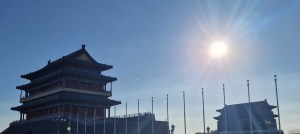 The history of China is full of this kind of destruction to construct better or different. The skyline of this city, as its name, has changed several times since it was founded. Back at the time of Marco Polo, this city was named Dadu and it was under the rule of the Mongol Empire. Its founder, Genghis Khan, was long gone and the empire was being managed by his descendants. Although the majority of the buildings from that time were destroyed, a few are still standing today, like the Bell and Drum Towers. These Towers are located near the Beijing Central Axis (Imperial City – Tiananmen Square – Temple of Heaven), whose urban planning was conceptualised in Marco Polo’s time.
Near Beijing, the Great Wall of China is a man-made wonder. It started as a small endeavour. Many, many centuries ago, warlords and rulers of the northern provinces felt the need to protect themselves from invaders coming further north, like the Mongolians. It did not work, as Mongolians invaded anyway. Truth to be told, at the time, the great wall did not exist, what existed was small walls built by each warlord or ruler. However, Chinese people do not forget and, once the Mongolians were expelled, they not only reinforced the different walls, but they connected them. Although the Great Wall is now continuous, there are sections constructed differently. Some are made of stone, others made of earth. Some are located in the desert, others follow steep mountains up and down.
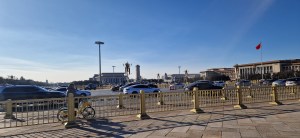 Beijing is not in danger of being invaded anymore. However, just in case, China has modernised its military forces and every now and then holds a grand military parade on the avenue between the former Imperial City and Tiananmen Square. The Chinese armed forces may still use Sun Tzu teachings, like the high level of discipline of its troops, but they also study the Western tactics and have developed Western equipment. Interestingly, in the last military parade, despite the fact that it had shown great military power, they also pledged for peace in the world.
Actually, the Chinese government believes, and it is working on it, that only peace can bring economic prosperity and economic prosperity is what makes the government pay for their military power as well as assure the improvement of the population’s living conditions. Since China has adopted Western trade models, the economic development has been astonishing. Scientific development has also been astonishing. However, unlike Western societies, scientific development aims to support economic development. The Chinese government invests in what will be more profitable and, when it does, the breakthroughs happen at breakneck speed. For example, the investment in green and sustainable technology is deeply changing the country in a very short period of time. Furthermore, technology is being adopted by the entire population: it is not possible anymore to pay in cash or debit/credit card, only through an app installed on the mobile phone (which means, everyone has at least one mobile phone). The only people paying in cash are tourists in designated tourist shops.
 Nevertheless, international economic development is dependent on international reputation and nothing shows how efficient and respecting other cultures a country is as organising big events like the Olympic Games. So, Beijing set itself to organise not one, but two Olympic Games: Summer Olympics in 2008 and Winter Olympics in 2022. They did not merely organise a flawless event, they planned jaw-dropping ceremonies and built iconic facilities. The Bird Nest (the National Stadium) and the Water Cube (the National Aquatics Centre) have become landmarks.
Has Beijing lost their cultural identity? Well, no. They are still following the same principles and Confucian teachings from thousands of years ago, but with new clothing.
Learn more:
- Article: “Story of cities #4: Beijing and the earliest planning document in history”, by Oliver Wainwright (The Guardian)
- Beijing and the Golden City of the Great Khan: Tracing Marco Polo’s Yuan Dynasty Dadu
- Video: “The Great Wall of China is NOT What You Think”
This article is part of the FOREIGN LANDS series
Foreign Lands aims to discuss the difference between languages and cultural backgrounds.



 WORDS IN IDEAS