
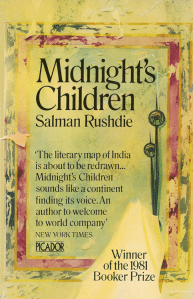
 Having decided to become a writer after graduating from the university, Salman Rushdie was failing by all accounts. His first book had been a flop, but he was not willing to give up just yet. It was 1976 and Salman Rushdie was wondering what he would write about next. So, he thought about going back to his happy childhood. He booked a trip to India and made a tour through memory lane. Being born a few weeks before India became officially independent, he decided to base his new book on a boy born exactly at midnight on 15 August 1947. The result was the book “Midnight’s Children”, which was awarded the Booker Prize in 1981, the Booker of Bookers in 1994, and the Best of Bookers in 2008.
The story is told by a boy born at the exact time as his home country has acquired independence from its coloniser (the British Empire). Later in life, he decides to write the memories of his life, not taking anything out. Full disclosure: even the most shameful events would be recounted. Throughout the narrative, we learn how the boy’s life is closely connected to the first 34 years of India as a sovereign country. The tale starts in the paradisiac landscapes of Kashmir, when the boy’s grandfather meets the boy’s grandmother, at a time when the country is still under British administration. As the family grows, it moves around throughout India: Delhi, Bombay, and Pakistan.
In a unique style, the author, through the narrator’s voice, describes what is happening to the boy as he grows up, to his family, and to his country. It is a roller coaster of changes and emotions. After knowing the story of his grandparents and his parents, we get to know how the narrator’s childhood was in Bombay. At some point, we learn that a nurse dramatically influenced his fate at his birth, something that marked him later in life. In the meantime, he finds out that has a special power that he loses in exchange for physical improvement.
What looked like a bright future turned into a troubled present as the country descended into dark times. Conflicts and wars affect everyone one way or another, especially in what the schism between Pakistan and India is concerned. The narrator navigates his existence as he can, gaining allies and rivals along the way. He loses people, loses his home, loses everything; gets misplaced and misunderstood in a very Indian way. Indeed, his story could only happen in India to an Indian person. The ending is what is possible: happy or sad is up to the reader to decide.
In a nutshell, a wonderful journey through history and a magical story.
Suggestions:
QUIZ
1. How did Amina pay for the legal process?
- A. Didn’t pay – her lawyer worked for free this time.
B. Sold her family jewels.
C. Won the money on horse racing bets.
2. What was the narrator’s gift?
- A. Shiva had excellent fighting abilities.
B. Saleem had the ability to read people’s hearts and minds.
C. Parvati had the abilities of a true witch.
3. How the members of the Midnight Children’s Conference communicate between themselves?
- A. Via telepathy.
B. Via post.
C. Via telephone.
4. What happened in 1965?
- A. Saleem got married with a woman he didn’t love to look “more” Pakistani.
B. Saleem lost his family, killed during the war between Pakistan and India.
C. Saleem was expelled from his family and went to live in exile to another country.
5. With whom did the narrator married?
- A. Jamila, his greatest love.
B. Padma, his greatest comfort.
C. Parvati, his greatest supporter.

Zarazoga, in Spain, has set a strategic plan to turn the whole city, including their many UNESCO World Heritage sites, accessible to everyone (this means, accessible to people with disabilities). It’s a huge effort, which they want to be a success in five years’ time. You can read the Plan (in Spanish) here.
Check the website daily to read the highlight of the day.

 The mother of a Chinese child dies. A stranger takes the little boy to London to give him an education. The boy goes with the stranger because he is suffering and there is nothing left for him in his hometown. The boy changes his name and becomes an Englishman. His tutor enrolls him in a special university in order for him to get a degree in translation. And there is where things turn sour. A secret organization, the true nature of his work as a translator, the return to his hometown, the bond with his friends, all collides in a spectacular and unexpecting ending.
 WORDS IN IDEAS