
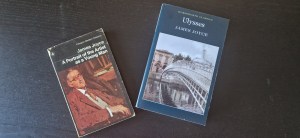
 You do not just read James Joyce; you become an Irish person that participates in the narrative.
James Joyce was a true Irish man, to the core. More specifically, a Dublin man. Although he spent his life running away from his homeland and his background, his work was all about them both. It was not by chance that he said “When I die, Dublin will be written on my heart”. Although he had lost his religious faith very early in his life, he was strongly influenced by his Catholic education, maybe even traumatised. Furthermore, his father led the family to poverty mainly due to his heavy drinking. Both these themes are greatly portrayed in his work.
“Dubliners” was his first published work. It took him almost 10 years to get it published and he had to endure multiple rejections. The book is composed of short stories, although the last one, “Dead”, may be considered a novella. Nowadays, this possible novella is considered a masterpiece.
Each story aims to portray people living in Dublin, going about their own lives. The topic is different in each one and there is no interaction between the characters of different stories. Although it seems that the narrator is just describing the events that are unfolding, in reality the author is making us go beyond that and pay attention to what is not explicitly said, to what the main character is actually hiding. The situation could happen in any other city, but the choices characters make (the actions they decide to take or the things they decide to conceal) are based on Irish culture and can only be justified under that light.
His second published work, “A Portrait of the Artist as a Young Man”, is a fictional story that portraits his Catholic childhood and shows how much it influenced him and his life.
His masterpiece is “Ulysses”. Based on the “Odyssey”, by Homer, it describes a day of Dublin life. Most of the action is seen through the minds of the characters and each chapter has its own literary style. The aim of James Joyce was to portray Dublin in such detail that the city could be rebuilt exactly as it was from his book.
James Joyce died in Zürich in 1941, to where he moved from Paris after Nazis invaded it in 1940. “Finnegans Wake” was the last work that was published when he was still alive and it is considered an experimental book, where he plays with words to an extreme. He also left an extensive poetry work and many other fictional stories were published after he died.
 WORDS IN IDEAS