
The decision to visit Vietnam was made on an impulse after months of looking for possible travel destinations. The descriptions of how beautiful the country was, the fact that the country was located in an exotic geographical location, or just because Elizabeth knew nothing about it, could have influenced her choice. She was aware that a fierce war had taken place there, which the USA had lost. After booking the trip, she found out that Vietnam had been a French colony and this sparked her curiosity even more, as she was a student of the French language. What would have been the legacy left by the French, she wondered.
 Once there, she realized that the French influence was elusive, but the country turned out to be surprising, with a fascinating culture. The war with the USA was present, yet gone. It was like it was something that had happened and which had shaped the country, but, although the people were still overcoming it, it was a closed matter. Interestingly enough, Elizabeth didn’t see any burgers or pizzas franchises. The Western influence was like the Chinese influence: had been assimilated and transformed into something typically Vietnamese.
South Vietnam
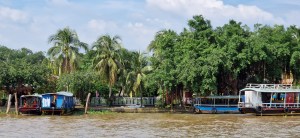 Watching the jungle passing by inside the boat, Elizabeth was imagining what it would be like for American troops to patrol the Mekong River during the Vietnam war. She had watched enough films and TV series to know how scared the Americans were of Viet Congs, the name given to the Vietnamese Communists’ guerrilla force. After visiting the Cu Chi tunnels, she understood why.
What Westerns called the “Vietnam War” was, in Vietnamese point of view, two “Indochina Wars”. The First Indochina War was about fighting and expelling the French colonizers. It ended with an agreement to split the country in two (the Communist North and the US-supported South). Ho Chi Minh, the leader of the Vietnamese nationalist movement, never gave up on the idea of uniting the country under communist rule and soon the Second Indochina War broke out. This time, it was about fighting and expelling the US troops, who were fighting against the spread of Communism in Asia, and in the world.
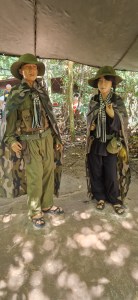 As the border between North Vietnam and South Vietnam was closed, Ho Chi Minh devised a route through Laos and Cambodia to provide the South with weapons and other supplies. One of the reception points was the Cu Chi base of operations. Started during the First Indochina War, an extensive network of tunnels was built underneath the jungle, giving Viet Congs access to strategic points for attack, villages and even barracks of the American troops. It was not just paths to move around, there were also weapons factories, dormitories, infirmaries, kitchens, and meeting rooms underground. This network would allow them to appear and disappear out of nowhere and attack from everywhere with no warning, while being protected from bombs and American tanks.
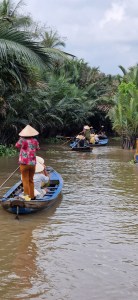 What was then a living hell, it was now a beautiful and peaceful site. Boats were running up and down the river, taking tourists to the islands along the Mekong River where they could go on a peaceful rowing boat trip, stroll through the jungle, watch how chocolate and coconut sweets were made, buy crocodile bags and liquor with snakes inside. Elizabeth noted how Vietnamese were friendly, but were not fooled. Their relaxed posture showed that Vietnam was their land and if foreigners would try to take their land away from them those foreigners would meet hell until they go back the way they came.
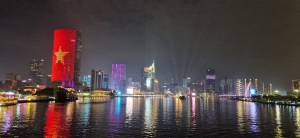
Back in the city, Elizabeth was invited to go on a cruise along the Saigon River, which included dinner. Saigon had been the capital of South Vietnam and it had previously been the capital of Cochinchina. Indochina was the name of the French colony, which encompassed what is now Vietnam, Cambodia, and Laos. Cochinchina was the administrative division in the south. After the Second Indochina War, Saigon was renamed Ho Chi Minh City. Elizabeth asked why, as she was puzzled on how much was named after the first leader of the Communist Party of Vietnam, who died before the war was over. She was told that the idea was for Ho Chi Minh to be present all over the country: he had been born in Central Vietnam and lived many years until he died in North Vietnam. Naming Saigon after him was a way to bring him to the South, where his heart was during the war. For Vietnamese people, President Ho Chi Minh is still their leader.
During the cruise, Elizabeth learned more about Vietnam’s history. She had no idea that the French had not been the first to invade the country and to be expelled due to a strong feeling of independence of the whole population. The first to invade were the Chinese in 111 BCE. What is now North and Central Vietnam was then the Nam Viet Kingdom. “Việt” in Vietnamese meant “Yue” in Chinese. The Yue were a group of different tribes that lived in what is now the Guangxi autonomous region of China and North of Vietnam. “Nam Viet” meant “Southern Yue”. The “Southern Yue” had declared their independence in 207 BCE and had expanded its territory to what is now Central Vietnam. Unfortunately, their independence was short-lived.
 During the 1050 years of Chinese rule, the feeling of independence grew stronger and stronger despite the efforts of China to turn the Viets of the South into submissive Chinese. It took a lot of time, but the Viets finally expelled the intruders. Except for a short period of 10 years in the 15th century, the Nam Viet maintained its independence (in the midst of many internal wars), changed the name to Đại Việt [the big Viet] and then to Việt Nam, and expanded its territory to the South. The French invaded in the second half of the 19th century and were expelled in 1954. By then, the feeling of independence was already embedded in Vietnamese identity. Therefore, when the time came to fight the mighty force of the USA, the population united against it: while some took up arms, others would provide them with supplies. For example, women would work during the day, and then, in the dead of the night and dressed in black, they would take food and messages to the warriors. The entire population were engaged in the war on the same side, except for those collaborating with the Americans (who left the country along with the Americans and are now living in California).
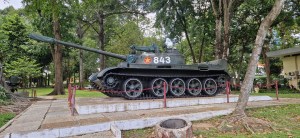 The peace and the unification of the country began when the tanks from the North entered Saigon and arrived at the Presidential Palace, the seat of the Southern Government, on 30 April 1975. This Palace is now a museum and the historical tanks are still there as a reminder.
Central Vietnam
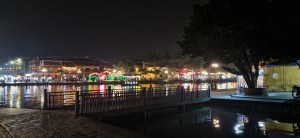 The Portuguese landed in Vietnam in 1516, being the first Westerns to get there. By 1535, they were allowed to build a port, which contributed to turning Faifo (now Hoi An) into an important trading centre. The buildings existing today were built between the 15th and the 19th centuries and reflect the influence of different cultures. There are some westernized houses, but the majority have clearly a Chinese or a Japanese design. In fact, back in the day, there was a great Japanese community of merchants living there. They left the iconic Japanese bridge, which is now the symbol of Hoi An.
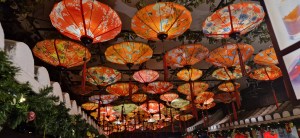 Nowadays, Hoi An Ancient Town is a UNESCO World Heritage Site. Walking through the streets, Elizabeth felt like she had been transported to another space and time. Wherever she looked, there were lanterns hanging. If they were lovely in daylight, in the evening, when lit up, they looked absolutely fantastic. When crossing a bridge, she stopped and bought a lantern with a lit candle inside from a Vietnamese lady and threw it to the river after making a wish. Then, she watched it slowly move away.
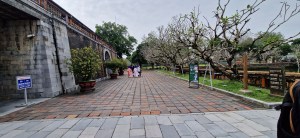 The 19th century was a time of change in the country. The port of Hoi An started to decline as the port of Da Nang, about 50 kilometres north, started to rise and slowly replaced it as the new trading centre. Today, many foreign companies are establishing there, which, combined with luxury beach resorts that take advantage of the coast, has led to a great development of the city. Back in 1802, a new dynasty began in Vietnam and the new Emperor changed the country’s capital to Hue, about 100 kilometres north of Da Nang. Greatly influenced by Chinese culture, he decided to build a new Imperial Palace there inspired by the Forbidden City in Beijing. It was the Emperor’s residence until 1945. It was partly destroyed during the Second Indochina War by American bombs (or democratic flowers, as they are called in Vietnam). Now, it is a UNESCO World Heritage Site and is being reconstructed.
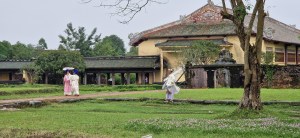 Even under construction, the old Imperial City was a wonder. As a Citadel, the interior was surrounded by high walls, which were surrounded by a course of water. When crossing the bridge to get through the entrance gate, Elizabeth looked to the left and saw a big flag of Vietnam on an artificial hill, marking the country’s new rule. Once inside, she admired how the buildings were beautifully framed by symmetric lakes, which were surrounded by trees. Then she watched as many women and men, dressed with the traditional imperial garments, were taking artistic photographs like true professionals. They didn’t care about the numerous tourists who were wandering everywhere. The young Vietnamese were ignoring them, with an attitude of ownership of the Palace. It was theirs, but they allowed foreigners to go and see it.
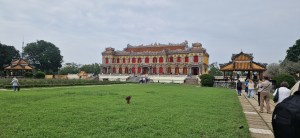 The Palaces followed one after the other, each one with its own specific function. There were secondary buildings on both sides where Elizabeth saw photos hanging on the walls showing ceremonies that took place during the 140 years that the Imperial City was in operation. Halfway through, empty spaces reminded tourists of the war that destroyed the missing Palaces. The first and the last Palaces were already reconstructed and they were both magnificent. However, Elizabeth noticed how different the last one, which served as the emperor’s residence, was. It had clearly a Western influence.
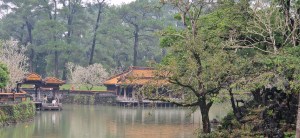 Several Emperors ruled in the Imperial Citadel of Hue and they all had to deal with the French. The political line of this dynasty was to ignore the French (and all other Western powers), isolating the country and banning international trade. From the Emperors of this dynasty, Tuc Duc was the most disliked. For starters, he was not supposed to be Emperor: his father preferred him to his older brother, who was supposed to be the next in line. Then, he failed to have children, something that is extremely important in Vietnam. Finally, he was unable to prevent the French from invading the country and add it to their Indochine colony. However, before he died, he built a lovely site for his tomb, with a big lake and several temples. He actually lived there with his family until he died, dedicating himself to writing and poetry.
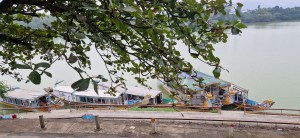 The Mausoleum of Emperor Tu Duc is located about 7 kilometres from the Imperial Citadel, which in turn is located about 4 kilometres from the Thien Mu Pagoda. This Pagoda was a symbol of the fight for the right of religious freedom in the 1960’s.
North Vietnam
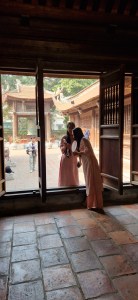 The first university in Vietnam was the Temple of Literature, established in 1070 in Hanoi. By that time, Vietnam had already regained its independence, but Chinese culture was still predominant. The university was based on Confucius’ teachings and it included a Temple in his honour. The buildings and the yards were designed in a Chinese-like structure and there are many bonsais in vases scattered around. Again, Elizabeth noticed young people dressed with traditional garments taking artistic photos with the same ownership attitude.
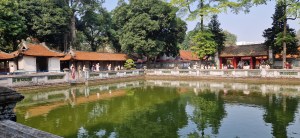 The old university is a reminder of the old days in modern Hanoi. As Elizabeth was walking through the yards, she compared what she was seeing to what was surrounding, outside that premises. The country’s capital was pulsing with present-day vitality and yet they remained traditional. It was like they would remain the same as they were for thousands of years, but would take what was good from modern life. Like motorbikes and scooters, for example. Bicycles were replaced by them as they are faster and petrol is subsidized. When on the road, no one stops, but everyone respects everyone else. Elizabeth was fascinated by watching how motorbikes, cars, and even people would cross paths without getting angry and without accidents. It was incredible.
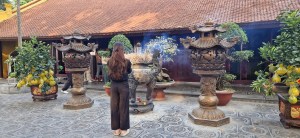 Buddhism was another Chinese legacy. This religion seemed to be more important as Elizabeth travelled north. There were many pagodas and temples and she didn’t know why they were named differently. So, she asked and was told that pagodas were Buddhism’s worship places, like the One Pillar Pagoda and the Ba Da Pagoda in Hanoi. Temples were built to pay tribute and honouring real people who had an important role in society like teachers (for example, the Temple of Literature that honours Confucius) and military commanders, or deities (for example, the Quan Thanh Temple that honours a Taoist deity).
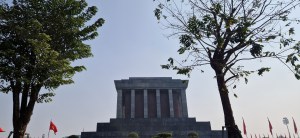 Since 1010, except for the period between 1802 and 1902, Hanoi has been the capital of Vietnam. It changed its name a few times and it endured different rulers: Vietnamese, French, and even Japanese, when they occupied the country between 1940 and 1945. Today, the country is ruled by the National Assembly, whose members are elected directly by the people via elections. Then, those members elect the Prime-Minister and the members of Government. The citizens do not vote in parties, as there is only one party, but directly in those individuals who decide to run for elections. Once elected, they represent the people of the region where they were elected. The parliament is located opposite the old Presidential Palace, built by the French, which is situated next to the Ho Chi Minh Mausoleum.
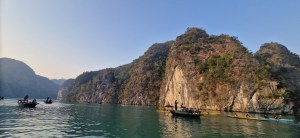 A visit to Vietnam could not be completed without going to Ha Long Bay. Located about 150 kilometres east of Hanoi, this UNESCO World Heritage Site is composed of 1133 islands and islets. Elizabeth had chosen to do a two-day cruise to fully appreciate the stunning natural scenery and she didn’t regret it. Besides navigating through the islands, she also had the opportunity to go onshore and take a rowing boat trip through a cave. Before catching the plane back home, Elizabeth still had time to go and see a lovely traditional water puppet show in Hanoi.
 WORDS IN IDEAS