
So, when the true “terra australis” was found, they had to come up with a different name. “Arctic” comes from the Greek word arktikos, a reference to arktos, which means “bear”. In the old days (and even today, for those who are willing to skip GPS), people were guided by Polaris (the North Star), which indicates North for those located in the North Hemisphere. Polaris is a star right above the North Pole and, because of that, barely moves in the night sky. To find Polaris, one would only have to identify the constellation Ursa Minor (literally meaning Little Bear) and follow its tail. Therefore, as the Arctic was up in the north, near Polaris, then it was the land near the bear. The fact that the Arctic has polar bears, while Antarctica does not, may or may not be a coincidence.
Partly inside the Arctic Circle, there is Greenland, a huge island permanently covered by ice and with no trees. So, why is it called a land of green? Because it was, thousands of years ago, when the Vikings disembarked there. However, its true name is actually Kalaallit Nunaat, which means “the land of the Kalaallit”. The Kalaallit are the native Indigenous people of “Greenland”. They are Inuit, which means “people” (please note that “Eskimo” is a term European people used to use that is nowadays considered highly offensive). There are different tribes of Inuit. The Kalaallit are the ones from Greenland, or better yet Kalaallit Nunaat. There are also Inuit in Northern Canada and in Alaska. By the way, “Alaska” comes from the Aleut word alaxsxaq, which means “the object towards which the action of the sea is directed”. The Aleut are the Inuit of Alaska.
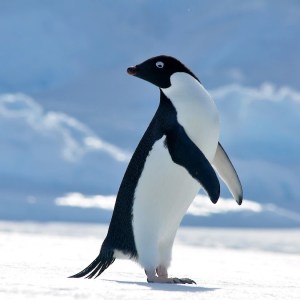
In the Arctic and in Antarctica there are no Indigenous people, but there are plenty of unique animals. Polar bears can only be found in the Arctic regions and penguins can only be found in cold regions in the southern hemisphere, especially in Antarctica. “Penguin” is a curious word… It comes from the Welsh words pen gwyn, meaning “head white”. In reality, it meant “great auk”, “auk” being a bird similar to the current penguins, but not related. Auks have become extinct in the 19th century. Back in the Arctic, narwhals are a type of whales perfectly adapted to these icy waters. Their name comes from Old Norse nāhvalr, a composition of the words nār and hvalr. This last word means “whale”, the first means “corpse” … but in the sense of having a colour similar to the one a corpse has. Another Arctic whale that was named according to its colour is the beluga. “Beluga” comes from the Russian word belyĭ, which means “white”.
Many other animals have adapted themselves to the extreme cold of the Poles. However, Antarctica, like Kalaallit Nunaat, was once green and warmer. In a continent roughly the size of Europe and Australia combined, there are high mountains like the Alps, glacier-carved valleys, flat plains and even an ocean. Researchers have recently succeeded in starting to figure all this out using technology (read the article “Landscape beneath Antarctica’s icy surface revealed in unprecedented detail”, from the link below). The problem for these researchers is that Antarctica’s landscape is covered by a thick ice sheet, just like Greenland. Ice sheets are similar to glaciers, but the former have a much greater extension. They consist of layers of snow that have not melted. Each layer of snow is compressed by the layers above and turns into a kind of ice-rock. As the snow keeps being added above, the snow-turned-ice-rock below moves slightly and very slowly. That is why glaciers carve valleys and ice sheets find their way to the ocean. Those high ice walls, typical images of Antarctica, are the edge of the ice sheet.
Researchers are studying ice sheets to understand how Antarctica is formed and how it will react to climate change. Essential for them are ships. Yet, these ships are not ordinary ships. They are icebreakers. Icebreaker ships are more resistant than a normal ship and have a special design in order to be able to cut the ice. Without this capacity, the ship may get trapped in the ice. That was what happened to Endurance, the famous ship of Captain Shackleton. Another famous Polar explorer ship is Fram. Fram went both to the Arctic and the Antarctica at the end of the 19th century and the beginning of the 20th century and “lived” to tell the tale. This ship is now “parked” inside a museum, where we can get in and have an idea what it was like to travel inside it. Around it, there is plenty of information about its missions and about other missions during that time.
In the nutshell, there is a lot to discover about Antarctica, about the Arctic, and about Kalaallit Nunaat (Greenland).
Sources / more information:
- What Are The Origins Of The Names Arctic And Antarctica?
- Where the name ‘Australia’ came from
- “Arctic”, by Merriam-Webster.com Dictionary
- “What is the North Star and How Do You Find It?”, by Preston Dyches (NASA)
- Why is Iceland Called Iceland? (And Greenland is called Greenland)
- Inuit (Merriam-Webster.com Dictionary)
- The Indigenous World 2025: Kalaallit Nunaat (Greenland)
- State Symbols – State of Alaska
- Penguin (Merriam-Webster.com Dictionary)
- Narwhal (Merriam-Webster.com Dictionary)
- Beluga (Merriam-Webster.com Dictionary)
- Article: “Landscape beneath Antarctica’s icy surface revealed in unprecedented detail”, by Mark Poynting and Erwan Rivault (BBC)
- Glaciers & Ice Sheets
- Ice sheets and glaciation
- Article: “Explorer Shackleton’s lost ship as never seen before”, by Rebecca Morelle and Alison Francis (BBC)
- Fram Museum Oslo
Check the ongoing research:
- Alfred Wegener Institute [Germany]
- Antarctica New Zealand
- Australian Antarctic Division
- Brazilian Antarctic Program
- British Antarctic Survey
- Czech Antarctic Foundation
- Instituto Antartico Argentino
- Instituto Antártico Chileno
- Institut polaire français Paul-Émile Victor (IPEV) [France]
- Korea Polar Research Institute
- National Antarctic Research Program (PNRA) [Italy]
- National Centre for Polar and Ocean Research [India]
- National Institute of Polar Research [Japan]
- Norwegian Polar Institute
- Polar Research Institute of China
- Russian Antarctic Expedition
- South African National Antarctic Programme
- United States Antarctic Program
- Instituto Antártico Uruguayo

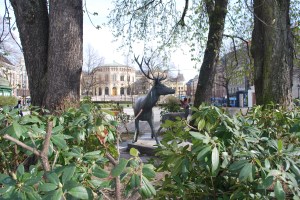 The capital of Norway is a pragmatic city, made for people to live there. Yet, it has a few surprises in store for less well-informed tourists. Looking like a simple village, Oslo is peaceful and quiet. Yet, it is also full of life and activities. It preserves its history, yet it is modernizing.
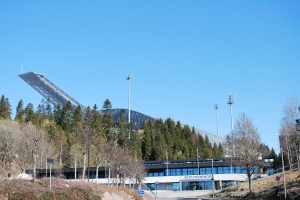 While Jo Nesbø’s characters usually drive their own cars to get there, the Society’s members had the chance to climb the mountain by metro, which runs along a narrow line very close to the edge of the steep slope. Although a bit scary for the fearful ones, the journey provides a spectacular view. The train carriages are prepared for the show as they are equipped with many windows. They are also prepared to accommodate the skis of those who go up the hill to practice alpine skiing, cross country, or ski jumping during winter. The Holmenkollen stop was constructed very close to the Holmenkollen National Ski Arena, where the Society’s members admired the huge Holmenkollbakken (the ski jumping hill of Holmenkollen). Being at the very top was vertiginous, especially because they knew that there was nothing but air underneath.
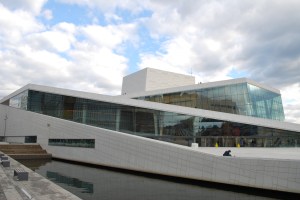 Back with their feet on the ground, the Society’s members made their return journey to Sentrum, the central area of Oslo, and got out at Jernbanetorget square. If they walked for about 20 minutes to the east, they would reach the district of Gamle Oslo (“Old Oslo”), where the Grønland Police Station is situated, the work place of Harry Hole. Instead, the Society’s members walked towards the waterfront, to Bjørvika. Here, they admired the Opera House, an iconic symbol of Oslo. Built by the water, it seems it is emerging from the fjord’s depths. Its roof extends to the ground, inviting visitors to climb to the top. Once there, the view is magnificent. On one side, the Society’s members could see the fjord in front and, on the left-hand side, the new Munch Museum and some new development buildings. On the other side, at the back, they could see the Barcode Project, which consisted of several tall and modern multipurpose buildings.
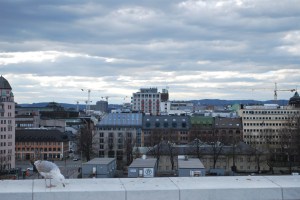 Everyone was happy to receive such great news. Not that they were not having fun, but that promised something special. Mr John Booklish remained mysterious and told them to follow him. They caught the tram to Aker Brygge, a modern area that mixed residence buildings for high-class people, marinas, shopping areas, and entertainment. There were many restaurants to choose from, but, before dinner, the Society’s members went to the Astrup Fearnley Museum of contemporary art, at the end of the street. It had an original design that perfectly blended into the environment.
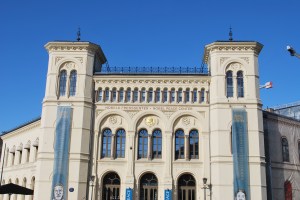 If someone was facing the fjord in front of the port, Aker Brygge would be on her/his right-hand side, the Akershus Fortress would be on her/his left-hand side, and Oslo City Hall would be on her/his back. It is in Oslo City Hall where it is announced the only Nobel Prize not awarded in Stockholm, Sweden: the Nobel Peace Prize. In front of Aker Brygge, in what was once a train station, the
 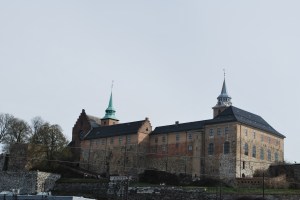 The Society’s members were talking about what they had learned at the Nobel Peace Center, about what peace meant in the world, and about how it related to the latest news while crossing the square in front of the port, passing the Fish Market and the City Hall, and heading to the Akershus Fortress. Once there, they were impressed by how well preserved it was. There were gardens everywhere around the buildings and a lovely park with a wonderful view to Oslo and the fjord.
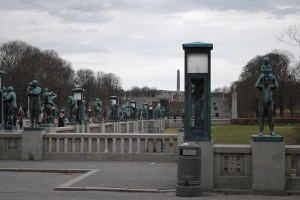 The Jo Nesbø’s character Harry Hole lives at a 15-minute walk north of Karl Johans gate. Karl Johans gate is the best-known street of Oslo and it is where the heart of the city beats. Located about 700 metres parallel to the port, it connects the Royal Palace and the National Parliament, and it’s full of shops, cafés and luxurious hotels, with a garden on the side. This is also where the National Theatre was built. All these landmarks were built in the 19th century. Built in the 18th century, the Frogner Manor, today the Oslo City Museum, gave its name to the entire district. Back in the day, the Manor included a garden that later became a park. Nowadays, this park is full of eccentric sculptures made by Gustav Vigeland, one of the greatest Norwegian artists. Vigeland was also the creator of the Nobel Peace Prize medal.
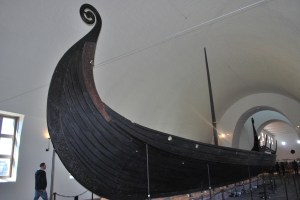 Like Berlin, Oslo also has a Museum Island. Except, in Oslo it is not an island, but a peninsula, and it is not exactly situated in the middle of the city centre, but not very far from the port. Besides, it is much bigger and you can hike, cycle, swim and do all kinds of outdoor activities there, including yoga. As for the museums, they are: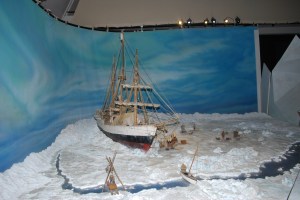
 WORDS IN IDEAS