
Words are the pillars of human society because without them there were no ceremonies, no contracts, no agreements, no law, no rules, no information, no science, no discussions, no news, no sales, no economics, no politics, no education, no literature, no religion… and so on and on. “Word” comes from the common Proto-Indo-European root were, meaning “speak, say”. It evolved to Old English as “word”, to Old German as “wort”, and to Latin as “verbum”, which, in turn, evolve to Old French as “verbe”. “Verb” is now a grammatical category, but back then it meant “word of God, saying”. “Idea” comes from Greek, meaning “to see” as in to see with the mind by way of thinking. Our thoughts are made of words, thus, ideas are made of words. Words convey meaning and it is that meaning that gives rise to ideas.
“Words in Ideas” was born from the curiosity of knowing the original concept of the words that convey ideas. Languages are constantly evolving and so does the meaning of words. Some words keep their original meaning pretty much the same, but others have a significant change of course. Yet, there are always some recollections of the original meaning. Furthermore, word definitions can be larger than what we read in a dictionary. There are books written with the sole purpose of explaining a certain concept, which we have read to support our articles.
The world we live in is increasingly complex and with all the fake news circulating everywhere it is hard to distinguish what is true and what is false. It is difficult to navigate between old ideas and new ideas. Besides, what seems true today may be proven false tomorrow. In these situations, the best course of action is to go back to the basics, to the beginning, to the root. And the root of all ideas is words. The words are the seeds that flourish in different directions and create different ideas. Some ideas are healthy, but some are ill. Some are insightful, but some are deceitful.
“Word in Ideas” also explores the words in different languages and the culture in which they emerged. Equivalence in translation is deemed incorrect. Although there are words that may mean exactly the same in different languages, usually there are some nuances, which leads to the expression “lost in translation”. Knowing foreign languages gives us not only access to other cultures but also the opportunity to understand words in a more comprehensive way. Through language, we can understand the world better, understand what makes us similar but cultures different. Cultures are deeply rooted in their countries of origin, reflecting their unique geographical and climate situation and conditions. History has also profoundly influenced language and culture and understanding it is paramount to understand what people say and the way it is said. Different perspectives don’t mean one of the sides is wrong and the other is right, it just means they see the picture differently.
THE WRITER
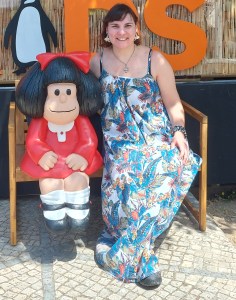 Ana Catarina Palma Neves (APCN) has been a freelance language specialist since 2013. Her knowledge is based on a translation diploma and on her previous and continuous professional experience in project management and international relations as well as on her personal experience, especially in many travels around the world. ACPN is a Portuguese native, proficient in English, with professional knowledge in French, Spanish, and German, and initiating studies in Chinese and Russian. Check also ACPN’s very short stories.
Ana Catarina Palma Neves is on:

 WORDS IN IDEAS