
It is a great film, with a lot more to be appreciated, but the focus here is the undeserved fame obtained by exploring the work of someone who remains anonymous. It did not start like that. Joan wanted to be a writer, but soon she understood that she would never be published because she was a woman. So, writing in the name of her husband sounded a good deal: she would write and fulfil her dream of being published, and he would become a world acclaimed author as he aspired. The film is fictional, but could easily be a true story. Joan’s dilemma happens more than people think, even today. For example, the publisher of J.K. Rowling decided to ditch “Joanne” in the author’s name for fear that boys would not want to read a book written by a woman. Many years later, Rowling chose a male pseudonym (Robert Galbraith) to anonymously send the first manuscript of a crime series (the Cormoran Strike series).
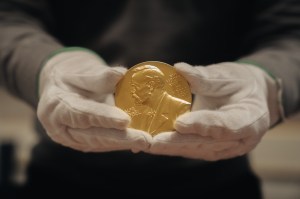
The Nobel Prize in Literature is the most prestigious award in this domain. It is part of a set of awards that also includes Physics, Chemistry, Physiology or Medicine, and Peace. In 1968, a new prize was added: the Sveriges Riksbank Prize in Economic Sciences in Memory of Alfred Nobel. Those original five awards were created by Alfred Nobel, a Swedish chemist, in a will where he established exactly how the prizes should be awarded and which were the criteria. When he died, in 1896, scientific developments and inventions were heavily dependent on individual reputation. Researches and discoveries were made with a lot of dedication and it could take many years before there could be a breakthrough. Most of the time, scientists worked alone in their lab, without any assistant. Those who were recognised could more easily obtain funding and carry on with their experiments. Therefore, public recognition and a good reputation were paramount.
Science today moves quite differently. It is not about a sole scientist pursuing difficult advances after several failed experiments anymore. Now, there are teams of scientists working together and basing their work on scientific articles written by other scientists and on knowledge being developed in other departments and institutions. Thus, although scientific Nobel Prizes are awarded to individuals, each one is in fact supported by many other anonymous individuals working with him/her that make him/her shine: colleagues, assistants, students, admin people. In the case of Literature, editors, translators, advertisers, graphic designers, typographers, logistics personnel, book shoppers, and librarians turn the writer’s manuscript into a book distributed and made available to readers all over the world. For Peace laureates, there are all those who were directly or indirectly helped by them.
Anonymity can be an advantage: one is free to explore and do whatever they want. Recognition implies playing by the rules, working at the right place and on the right issues, duly accepted by the “committees” in power. For example, Galileo Galilei was the first to state that the Earth (and not the Sun) revolved around the Sun (and not around the Earth). This statement got him in a lot of trouble with the Inquisition and he was forced to retract. If the Nobel Prize had existed back then, he would probably never have received it. Einstein won the Nobel Prize, but not for his famous theory of relativity, which the Nobel Prize committee has always rejected (read the article “Nobel Prize: 7 facts we bet you didn’t know” on the link below). On the contrary, there were laureates who later proved themselves unworthy of the prize (read the article “Here are the most controversial Nobel Prize-winners ever” on the link below). And, of course, the worthiest person to win the Peace Prize was not given such an honour, despite being repeatedly nominated: Mahatma Gandhi.
The Nobel Prize follows the “rules” and prejudices of European culture, for good and for bad. Alfred Nobel was Swedish and the prizes are awarded by Swedish committees, except for the Peace Prize, which is awarded by a Norwegian committee. One of the “rules” of European culture is to respect the power in place. At the beginning of the 20th century, the power was in Europe, especially Central Europe. After World War II, the power was “transferred” to the USA. Therefore, it is not surprising that most prizes were awarded in the USA, the United Kingdom, Germany, France, and Sweden, according to the World Population Review. Mahatma Gandhi was the one who led India’s fight for independence from the United Kingdom. Therefore, it would be highly improbable for him to win the prize… On the other hand, when Le Duc Tho, the Vietnamese diplomat who made the 1973 ceasefire deal with Henry Kissinger, was awarded with the Peace Prize, he refused. First, because it had been a ceasefire and not a peace deal (the war continued until 1975, proving him right). Second, the USA was the aggressor, therefore, not that peaceful.
Another feature of European culture is to be male-centred. According to the official website of The Nobel Prize, from the 1026 laureates, only 68 are women, which corresponds to 7%. Interestingly, 56% of those 68 women were awarded the Peace and the Literature prizes. Science decided to investigate the matter and wrote the article “One reason men often sweep the Nobels: few women nominees” (read it on the link below). Although these days there are many women who are scientists, published authors, and hold important positions in institutions related to peace, there are still very few nominations of women for the Nobel Prize. The rules were changed to address this problem, and women nominations doubled. Not the number of women laureates, though. Luckily, women are being recognized through other awards.
Unfortunately, women are used to remaining anonymous, whether they are willing or not. Vivian Maier chose to remain anonymous. Working as a nanny, she travelled the world, always with her camera hanging around her neck wherever she went. Despite never having had any formal training, she had learned the basics with a professional photographer. Then, throughout her life, she developed her style totally by herself. When John Maloof found her photos, she had just passed away. Since then, he has been tireless in finding all her photos, which are scattered in different places. Today, she is considered one of the best street pornographers of all time.
How many individuals remain anonymous and their amazing work never recognised? We will never know.
Sources:
- “The Wife” in the IMDb [the Internet Movie Database]
- Article: “JK Rowling or Robert Galbraith: How to pick a pen name” (BBC)
- Video: “Alfred Nobel: From Dynamite to the Nobel Peace Prize” (Nobel Peace Center)
- “Galileo Galilei” (Stanford Encyclopedia of Philosophy)
- “Nobel Prize: 7 facts we bet you didn’t know” (Deutsch Welt)
- “Here are the most controversial Nobel Prize-winners ever” (CNBC)
- “This Asian Diplomat Once Rejected The Nobel Peace Prize” (NDTV)
- The Nobel Prize official website
- “One reason men often sweep the Nobels: few women nominees” (Science)
- Vivian Maier official site

In 1964, UNESCO launched a very ambitious project: to write the history of Africa by African historians and experts. Thirty-five years later, eight volumes were published in 12 languages. Recently, three new volumes were added. Read more about the General History of Africa here.
Check the website daily to read the highlight of the day.

Discover more from WORDS IN IDEAS
Subscribe to get the latest posts sent to your email.
 WORDS IN IDEAS