
 The pyramids! Miss Honeypraise was looking forward to seeing them. However, when searching about the country, she realized there was much more to see and visit. She was going on a tour with a travel agency for logistics and safety reasons. Considering that there was a “Tourism Police” in the country to make sure tourists were safe at all times, Miss Honeypraise thought it would be better not to risk going by themselves. Mr Theodore Williams, who was going with her, was her best-friend-turned-boyfriend and this was going to be their first trip together.
Miss Honeypraise had been prepared to be marvelled and to enjoy her new relationship. She wasn’t disappointed, quite the contrary. It was a wonderful vacation. Sitting back home on her balcony, drinking a cup of tea and watching the sunset, she recalled her grand adventure…
The Nile
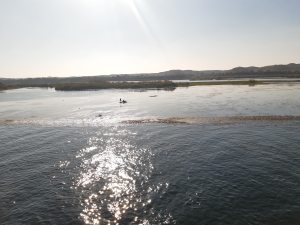 Navigating up the Nile, it was easy to imagine one had gone back in time, to the time of the Pharaohs. There were still many agricultural areas along the shore, where there were people walking around with their donkeys. The boats going up and down were also similar with the ones used in Ancient Egypt and some would carry fishermen working in the old ways. Kids would jump from the boats into the water and they would laugh happily and carelessly. When the Pharaohs ruled this land, the traffic was much more intense, the boats were brighter and more colourful, the farm lands would be full of activity, loading the boats with crops.
Ancient Egypt lived off the Nile River. It was everything to its people: a means of transportation, a means of subsistence, a means of entertainment. Everything happened on the Nile. Beyond it, there was nothing but the desert… and death. Death was a huge theme throughout the realm. Not as a sense of loss or sorrow, but as a celebration of the life that has ended and a transition to a new life on the other side. The pyramids, a reminder of past rulers, had the perfect shape to point the tomb up to the sky above. When a King died, the dead body would be turned into a mummy and the mummy would be buried at the end of smaller or bigger tunnels (according to the extent of their lives), filled with images about their lives, together with all kinds of treasures. A perfect bait for thieves. This became a problem and the solution was to build the new tombs in a mountain area away from everyone and difficult to access. Hence, the Valley of the Kings.
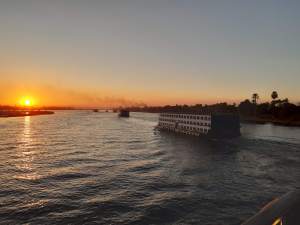 “You seem very contemplative”, said Theodore, sitting on the chair next to Clarissa.
“This sunset is absolutely stunning. It’s completely different from the one we’ve known”, said Clarissa, wrapping her coat tighter around her body. It was getting cold on the deck on the upper floor of the cruise boat.
“Indeed. This cruise up the Nile is startling. The landscape is so very beautiful. It is just like the films we’ve watched that are set here.”
“Yes. Speaking of it, don’t you have the feeling we are living in Agatha Christie’s story ‘Death on the Nile’? I swear to you, I almost expect to see Poirot around the corner worried about some person who has died…”
“Well, no one is going to die here, especially murdered.” Theodore laughed. “And Poirot was a fictional character… But, yes, it makes you think how many tourists have taken this trip since… I don’t know… About 100 years, maybe? Let’s see… The British presence began to be felt in 1859 and it got more and more intensified from then on. It was during that time that all the archaeology discoveries began.”
“And all the looting…”
“Yes. Well, back then, the archaeology discoveries were a huge thing, so I guess it was when they decided to create these tourist visits for the British citizens who were interested in coming to see them.”
“And patrons, especially, I suppose.”
“Definitely. They could be insensible to the natives, but the fact is they have greatly advanced Egyptology.”
“So, what happened in the meantime? I mean, between the end of the Pharaohs’ rule and the British ‘taking over’?”
“They were invaded by the Assyrians, then the Persians. Later, Alexandre, the Great, arrived in the north and founded Alexandria, which was named after him. He also built the famous lighthouse and the library. Both were destroyed, although the library was rebuilt twice, at least. Afterwards, the Romans came and Egypt became a Christian country until the Arabs invaded and the country turned Muslim. During that time, Saladin became the Sultan of Egypt and was responsible for initiating many important public works in Cairo, especially a unique water system. In the 16th century, Egypt became part of the Ottoman Empire. Napoleon invaded, but lost. Finally, the British came and settled until 1922, when Egypt regained its independence at last.”
“Wow, what a story! No wonder I thought Egypt didn’t have its own history since the Pharaohs.”
“However, their history as an independent country has not been smooth. It started as a kingdom under the influence of the British and in 1953 turned into a Republic after they kicked the British out for good. However, they got into trouble with the British and the French when they decided to nationalize the Suez Canal. Things got worse and they went to war with Israel. President Sadat signed a peace treaty in 1979, but he was assassinated because of it two years later. A period of great unrest followed, including terrorist attacks on tourists.”
“Hence, the Tourism Police we see today everywhere, keeping us all under their eye.”
“Exactly. Tourism is economically very important here. The unrest continues, with many protests and violence. They are still trying to control the situation.”
“I suppose this country is a work in progress. No wonder they don’t finish the buildings and don’t bother to clean the rubble when a building collapses.”
“Maybe they are still learning how to be an independent country. The last time that happened was in Ancient Egypt… A very long time ago.”
“It’s getting cold now. Let’s go inside. The sun has set, the show is over”, said Clarissa shivering slightly.
Luxor
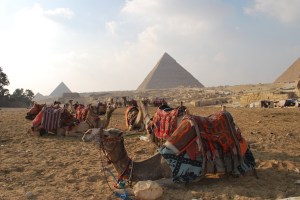 Cairo was founded as the capital of Egypt when the Arabs invaded the country. It was located not far from the old capital Memphis, the city that became the capital when the two kingdoms, the Upper Egypt (in the south) and the Lower Egypt (in the north), came together as one realm. During this time, the Giza Pyramids were built, along with other pyramids and monuments in the region. It was later that it was decided to bury the Pharaohs in the Valley of the Kings to avoid thefts. Not far from the Valley of the Kings, a new capital emerged: Thebes. After its decline, the capital became Luxor, which thrived from Thebes’ ruins. Luxor is where the full splendour of Ancient Egypt can be glimpsed. Many buildings have been destroyed over the centuries, but the ruins unveil what they may have been at the time. They are still magnificent and one can only imagine the full scale of its majesty.
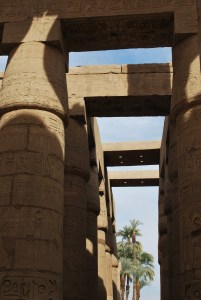 Starting in Luxor, the Nile cruise takes visitors to different key spots along the river. The adventure starts at the temples of Karnak and Luxor, which are connected by a road with lined Sphinxes at both sides (partially destroyed now) and are characterized by tall columns and huge statues. These make anyone feel small, which was probably the goal. Pharaohs wanted to show how magnificent they were and how important it was to respect religion. After all, the Pharaohs were also the religious leaders. Therefore, many temples were built, usually by the water. This was important due to the frequent religious parades, which took place on boats.
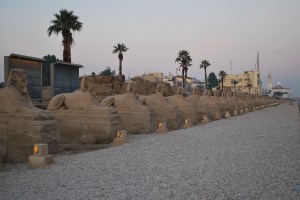
“Did you capture the meaning of the images carved in stone?”, asked Clarissa.
“At the time, yes. I have forgotten everything by now. It’s fascinating how they would record their life for eternity in such a way.”
“Only the good things. They were pretty good at hiding the bad things. This way, it seems that the 3000 years of Ancient Egypt was a wonderful time, full of great achievements, where everyone was happy and healthy.”
“You didn’t expect them to record the bad things on the walls, did you?”, laughed Theodore.
“Well, nowadays we record everything: the good, the bad, the ugly… the false…”
“In truth, it is easier to write on a computer than to carve on stones…”
Aswan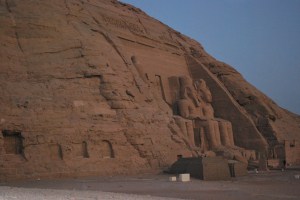 The Temples of Abu Simbel and Philae were two of the historical monuments that had to be relocated when the Aswan High Dam was constructed, resulting in the rising of the waters of Lake Nasser. The monuments could have been submerged if it wasn’t for the specialized work carried out by the UN, responsible for financing the project. This was not an easy task. Once a year, the sun enters the main Temple of Abu Simbel and illuminates the statues located deep inside. UN specialists had to recreate this unique feature when relocating the Temple, which they did (with a very slight variation).
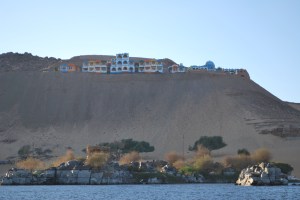
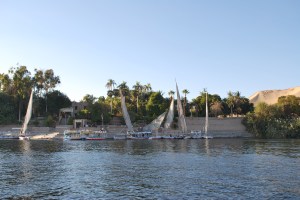 The Temple of Abu Simbel is the closest to the border with Sudan and it is located in the Aswan region, a region different from other Egyptian regions, full of cataracts and islands along the river. One of these islands is the Elephantine Island, located right in front of the region’s capital, Aswan (named the same as the region itself), where boat traffic is especially intense. No wonder. This was once an important trade point with Sudan and the administrative centre of the former independent region named Nubia, which has been under Egypt control for many centuries. Yet, they maintain their culture intact, namely in some typical villages located in the island, full of their colourful houses.
 “That concludes our trip to Egypt”, said Theodore. “From Alexandria, in the north, to Abu Simbel, closer to the border with Sudan, it’s about 1300 km along the Nile River. 1300 km with 3000 years of ancient history.”
“I feel like I went back in time, although all I saw was ruins. Nevertheless, we can imagine how it was full of life, especially the river. And all this happened about 2000 years ago! It’s incredible!”
Discover more from WORDS IN IDEAS
Subscribe to get the latest posts sent to your email.
 WORDS IN IDEAS