
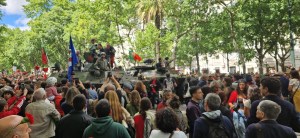
 Every year on 25th April there is a parade in Lisbon, the capital of Portugal, to celebrate the coup d’état that ended dictatorship in 1974. Since then, this day is called Freedom Day and people walk down Freedom Avenue to celebrate Freedom. So, yes, freedom means a lot to Portuguese people, even for those generations who were born in a democratic regime and never witnessed dictatorship (thankfully!).
In a way, everyone knows what freedom is, even if they struggle to define it in words. The Oxford English Dictionary has 15 entries with different examples from different periods of time. Basically, freedom means not having constraints. Portuguese people instinctively understood this on 25th April 1974, when they learned that the military were there to end the highly restrictive regime they were living in.
If you look up the meaning of the word freedom, you will find many different types of freedom and many associated concepts. It is also interesting to note the relationship between freedom and responsibility. As an example, you can read the (small, but meaningful) article of Seth Godin about it. At a time when the far-right is rising again throughout Europe and other parts of the world, it is worth recalling three fundamental types of freedom we all must fight to maintain.
The first is Freedom of Speech, which is the freedom of saying what you want without fear of retaliation, prosecution, or punishment. In the workplace, it is the freedom to state your opinion about the matter being discussed without fear of being devalued just because you are a woman, you are young, you are not part of the privileged group of people who make decisions (and play golf together). It is the freedom of drawing attention from your boss about a procedure that is not working right or it is heading to a disastrous outcome without fear of being fired, being blamed for it, being told not to say anything because that could raise alarms no one wants to be raised. In social life, it is the freedom of talking to your friends about anything without fear of someone outside the group listens and denounces you to the police (and you being arrested for it), your friends stop talking to you because you said something different from everyone else, being marginalized because “you’re weird”. 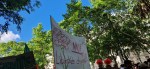 However, as stated in a poster in the 2024 Freedom parade in Portugal, “hate speech is not freedom of speech”, meaning, you are free to say whatever you want as long as you respect other people. Insulting, humiliating, dehumanizing, inciting to violence is not freedom of speech.
The second is Freedom of Press, which is the freedom for journalists to publish or broadcast what they think is important without any kind of censorship or external interference. States or companies (trying to “maximizing profit”, for example) that control what should be published or broadcasted are violating this principle. This doesn’t mean that all pieces should be published or broadcasted. The role of editors is to choose what and in what order should the pieces be published or broadcasted. The violation of the freedom of press is when someone from outside (a politician, a public official, the owner of a company) tries to replace the editor in such a task (or pressures them to do what they want). In addition, journalists should not be threatened or killed because they are doing their job. In conflicts, and especially in wars, journalists are clearly identified precisely because of this. Of course, journalists must have strong evidence (documents and/or reliable sources) to support their information. Releasing information without verifying it first can be considered defamation or lying. This can hurt the reputation of the journalist or the media where they work.
The third is Freedom of Association, which is the freedom of you to associate with whoever you want to discuss something, do something, or defend a cause. It ranges from a simple book club, where a (small or big) group of people come together to talk about books, or a group of friends that gather once a week to play a sport, to an association aiming to do something that can transform society for the better (for example, end poverty, end the mistreatment of animals, end domestic violence, encourage cultural education, encourage sport activity, defend the environment). This includes political parties. In a free country, people have the right to state and defend their opinions and beliefs as long as they respect other people’s views. Democracy is made of a plurality of parties. In a country where some political parties are forbidden, other freedoms such as freedom of speech or freedom of press are compromised as well, for sure.
Discover more from WORDS IN IDEAS
Subscribe to get the latest posts sent to your email.
 WORDS IN IDEAS